The city’s past lingers in the air here, mixing with the scent of street-side coffee. This maze of narrow lanes, each named after the trade that once defined it, hasn’t changed much since the 11th century. Locals call it the "36 Streets," though the number has grown. Artisans and merchants settled here first, and their workshops still occupy the ground floors of the same buildings.
The architecture explains why. The "tube houses" are narrow and deep, their facades barely wider than a doorway. This design avoided taxes based on street frontage. Many show French colonial influence—shuttered windows, wrought-iron balconies—while their interiors hide courtyards where families escape the city’s noise. Some structures have stood for centuries, their upper levels lived in by the same families for generations.
Walking through the Old Quarter means stepping into a market that never closes. In the mornings, the scent of fresh baguettes mixes with Vietnamese coffee brewed on tiny plastic stools. By midday, motorbikes, vendors, and the occasional cyclo bell fill the streets. At night, lanterns glow over silk shops and lacquerware stalls, while conversations spill from open-air cafés. You can get lost, but you might also find elderly men playing chess under a banyan tree.
Each street has its own trade. Silk Street sells bolts of fabric and ao dai made in a day. Copper Street gleams with handcrafted pots and gongs. Sugar Street offers sticky rice sweets and coconut candies. Even if you don’t buy anything, the streets themselves draw you in. On Hang Ma, artisans fold paper into lanterns for festivals, their hands moving with the same precision as their ancestors’.
The Old Quarter is also a cultural hub. Temples stand between the shops. Bach Ma, one of the city’s oldest, honors Hanoi’s guardian spirit. Built in the 11th century, its weathered stone and carvings offer a quiet moment. Locals light incense or sit beneath the ancient banyan, its roots twisting like the city’s history.
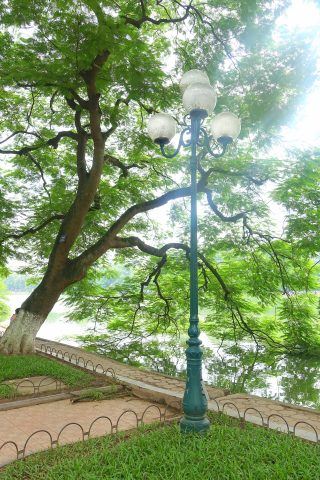
As evening falls, the quarter changes again. Sidewalks fill with diners eating pho or banh mi. Near Hoan Kiem Lake, music drifts from street performers or water puppet shows. The lake, tied to the legend of a magical sword returned to a golden turtle, becomes a gathering place. You might see an impromptu concert or students practicing dance moves under streetlights.
The Old Quarter blends the old and the new without effort. Families who’ve run shops for decades still haggle, while their children scroll through phones in the same doorways. Modern cafés and boutique hotels have moved in, but they haven’t erased the past. A 19th-century shophouse might sit next to a coffee shop serving avocado toast.
The contradictions make it real. Motorbikes weave past cyclos. Teenagers in ripped jeans walk alongside elders in ao dai. Construction noise mixes with street vendor chatter. Exhaust fumes compete with grilled corn. It’s messy and loud, but that’s why it feels alive.
To visit the Old Quarter is to see Hanoi as it is. The streets may have new names, the trades may have shifted, but the spirit remains. It’s in the way a vendor wraps bun cha, in the way a grandmother scolds her grandchild, in the way the light hits the lake at dusk. The past isn’t just remembered here—it’s lived.