The Temple of Literature in Hanoi is one of those rare places that feels untouched by time. Founded in 1070 under Emperor Lý Thánh Tông, it wasn’t just a center of learning—it was Vietnam’s first university, a place where Confucian ideals took root and shaped the country’s intellectual and cultural identity. Here, generations of scholars were trained not only in literature and philosophy but in the art of governance, producing officials, poets, and thinkers whose names still echo in Vietnam’s history. Walking through its courtyards, it’s impossible not to wonder how many young minds once crossed these thresholds, how many debates unfolded under the shade of ancient trees, and how many futures were quietly shaped within these walls.
The temple’s architecture reflects the elegance and restraint of Vietnam’s Lý dynasty, a style that balances grandeur with simplicity. Five courtyards, separated by imposing gates, guide visitors inward, each space unfolding like a chapter in a story. The first courtyard opens into a vast expanse where ceremonies and imperial examinations once took place. Beyond it lies a tranquil pond, its surface mirroring the sky and the stone steles perched on the backs of tortoises—symbols of wisdom and endurance. These steles, erected in the 15th century, bear the names of scholars who passed the rigorous imperial exams, their achievements carved into history. Today, they stand as some of Vietnam’s most treasured artifacts, a testament to the value placed on education in traditional society.
At the heart of the temple is the Pavilion of the Constellation of Literature, or Khuê Văn Các, built in 1805. Its two-tiered roof, with its gracefully curved eaves, resembles a bird in flight, while its wooden beams and columns are fitted together without a single nail. Inside, the pavilion once housed precious manuscripts and now displays artifacts that offer a glimpse into Vietnam’s ancient education system. Nearby, the altar of Confucius is flanked by statues of his disciples, a space where reverence lingers in the air. Even now, ceremonies honoring the philosopher are held here, the quiet rituals preserving a connection to the past.
One of the temple’s most striking features is the courtyard of 82 stone steles, each dedicated to a scholar who passed the imperial exams between 1442 and 1779. More than just names, the steles carry brief biographies and words of wisdom for future generations. They were inscribed to honor those who had achieved academic excellence, but also to inspire others to follow in their footsteps. Recognized by UNESCO as part of the Memory of the World program, these steles are carefully preserved, shielded from the elements that threaten to erode their inscriptions. Standing among them, it’s easy to sense the weight of history—the unbroken line of learning that stretches back centuries.
The Temple of Literature is far more than a museum. It remains a living symbol of Vietnam’s reverence for knowledge. Today, students still gather here for graduation ceremonies, and during festivals, traditional rituals in honor of Confucius draw crowds. In the summer, the courtyards fill with high school graduates dressed in ao dai, the national costume, posing for photographs—a modern rite of passage that ties them to the scholars of the past. In winter, the temple grows quiet, the stillness broken only by the rustle of leaves and the occasional footsteps of visitors. The seasons change, but the temple endures, a silent witness to the passage of time.
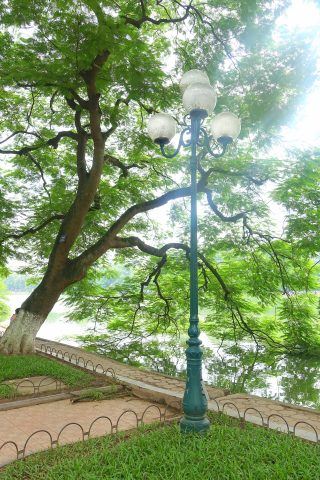
Despite its age, the temple doesn’t feel frozen in history. It exists comfortably alongside modern Hanoi, a place where the past and present intersect. The small park nearby is a favorite spot for locals practicing tai chi or simply enjoying a moment of calm on a bench. On weekends, artists often set up their easels to capture the temple’s beauty, while musicians play traditional tunes, their melodies drifting through the air. In these moments, the temple feels like a world apart, a place where time moves differently—slower, deeper, offering a respite from the city’s relentless pace.
For many Vietnamese, the Temple of Literature is more than a landmark; it’s a cornerstone of national identity. It embodies the ideals that have long defined the country: the pursuit of knowledge, respect for teachers, and the belief that education can transform lives. That’s why, when you step through its gates, it’s easy to feel a connection to the generations that came before. The temple doesn’t just preserve history—it invites you to become part of it, if only for a little while. Here, wisdom wasn’t just an abstract concept; it was a way of life, and in some ways, it still is.