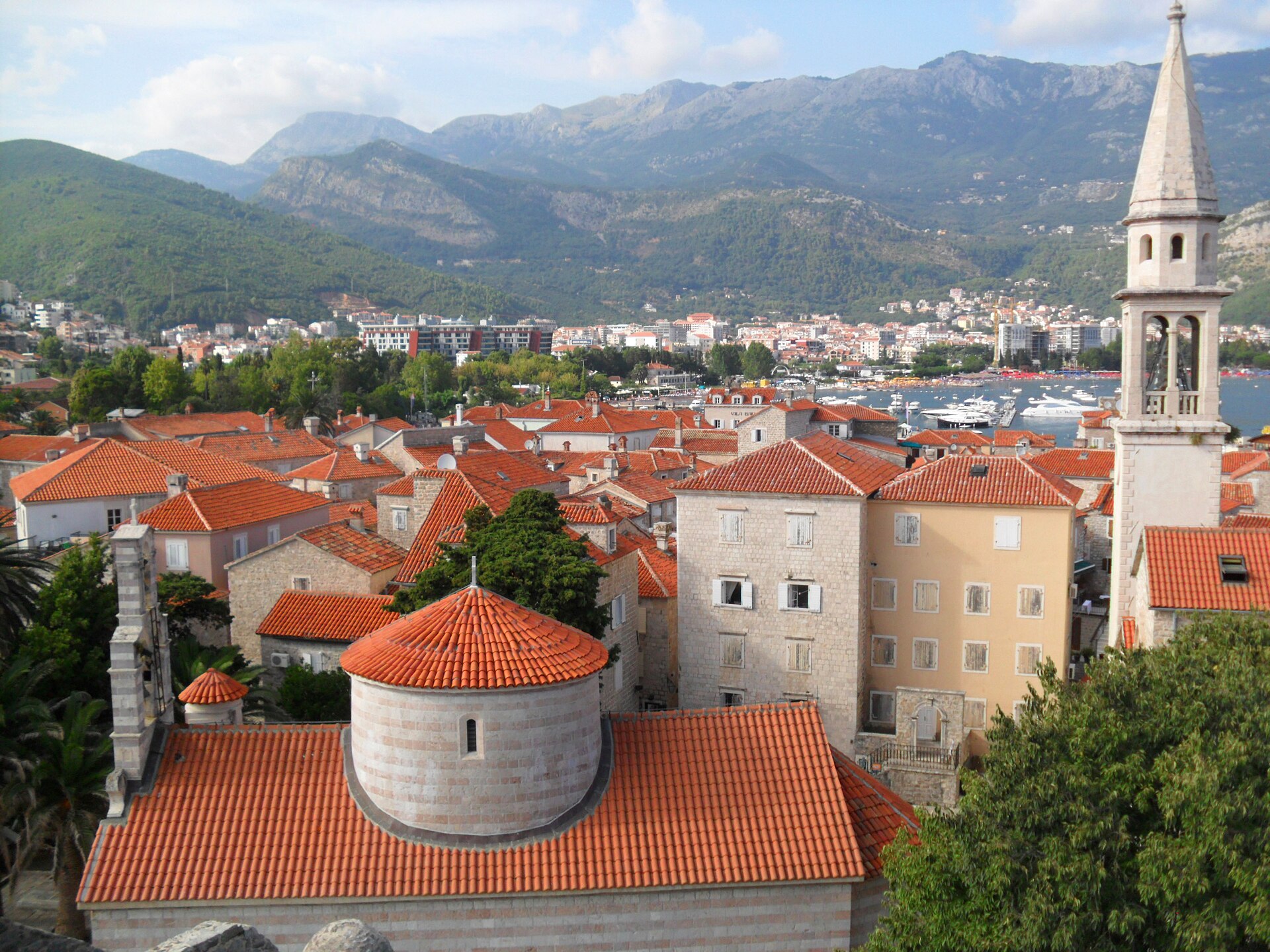
Budva’s Old Town
Budva’s Old Town sits on a small peninsula, linked to the mainland by a narrow strip of land. Stone-paved streets wind between terracotta-roofed houses, their wooden shutters and weathered facades bearing the marks of empires. From the ramparts or the waterfront, the town looks suspended over the Adriatic, as if the waves have been lapping at its walls for centuries.
The first traces of Budva appear in the 5th century BC, when Greek settlers founded a colony here. Over time, Romans, Byzantines, Venetians, Austrians, and Russians ruled the town. The Venetians left the deepest imprint, fortifying it with walls, bastions, and alleys designed to confuse invaders. Their architecture remains: arched doorways, narrow windows, and faded coats of arms carved into stone.
Walk through the main gate, and the streets twist without logic. There are no grand boulevards, only paths that dip and rise, passing tiny squares, hidden fountains, and churches. Losing your way is part of the experience. Around every corner, something waits—a shop selling olive oil and aged cheeses, a craftsman carving wood, or a courtyard where an old fig tree shades a bench.
The Citadel dominates the skyline, built by the Venetians in the 15th century and later reinforced. Its walls still overlook Budva Bay, the island of Sveti Nikola, and the mountains. Inside, you’ll find barracks, cisterns, and a small museum with artifacts from the town’s history. In summer, the fortress hosts open-air concerts, the music drifting over the water at sunset.
Among the oldest structures are the churches of St. John the Baptist and St. Mary in Punta. The first, from the 7th century, stands on the site of an ancient pagan temple and holds early Christian mosaics. The second, founded by Benedictine monks in the 9th century, is a humble stone building with a quiet atmosphere. Locals light candles here, and visitors pause for a moment. No gilded altars—just stone, wood, and candlelight.
In summer, the streets fill with conversation, the scent of grilled seafood, and live music. Taverns serve smoked prosciutto, kajmak cheese, and fresh octopus. As evening falls, the heat gives way to a breeze, and the waterfront lights up. Couples stroll, fishermen mend nets, and children run through the squares. The sea, just steps away, reflects the streetlamps.
But the Old Town is more than a historical site. It’s where Montenegrin life unfolds. There’s no rush. Locals greet each other by name, shopkeepers remember regulars, and visitors recognize faces after a few days. Mornings start with coffee at a sidewalk café, afternoons pass in exploration, and evenings end with a glass of Vranac wine.
Winter reveals a quieter side. The streets empty, the churches stand silent, and the wind whispers through the alleys. The Citadel’s walls, usually crowded, become a private vantage point. In December, holiday lights transform the town—garlands twinkle, citrus scents the air, and snowflakes dust the rooftops.
Budva’s Old Town isn’t just a place to visit. You could spend an hour or a week, and each time, something new would appear—a hidden courtyard, a forgotten legend, or the way light falls on a street at dusk. Wander without a map. Let curiosity lead you. The monuments and museums won’t stay with you as much as the feeling of touching something timeless.