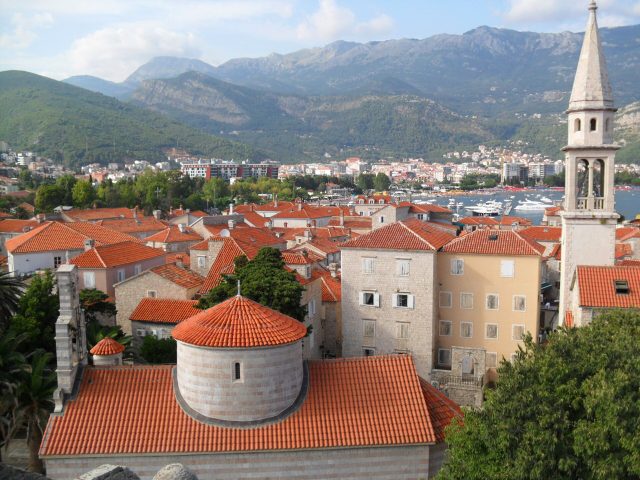
Perched above the labyrinth of Budva’s Old Town, the Cathedral of Saint John the Baptist feels less like a monument and more like a living witness to the city’s turbulent past. Its weathered stones have absorbed centuries of change—Byzantine chants, Venetian trade disputes, Ottoman sieges, and the quiet resilience of a community that refused to vanish. The cathedral didn’t just survive these shifts; it became their silent chronicler, its walls holding the echoes of prayers, battles, and the everyday rhythms of a coastal town that has always existed at the crossroads of empires.
The first church on this site dates back to the 7th century, though the structure standing today took shape much later, in the 12th century, when Budva had already established itself as a key Adriatic hub. Back then, the cathedral was more than a place of worship—it was a fortress of faith and a symbol of authority. Pilgrims flocked here to venerate its relics, while the bell tower doubled as a lookout, scanning the horizon for approaching ships that might bring either trade or trouble. The architecture reflects the Romanesque style dominant in Dalmatia at the time: thick walls, rounded arches, and narrow windows that cast a dim, contemplative light inside, a stark contrast to the blinding Mediterranean sun outside.
Step inside, and the atmosphere shifts. The high vaulted ceilings and slender columns create an unexpected sense of airiness, defying the building’s sturdy exterior. Unlike the ornate Baroque churches that would later dominate Catholic Europe, Saint John’s interior is restrained, almost austere. The walls bear faint traces of frescoes, and the altar adheres to a simplicity that feels deliberate, as if the builders knew that grandeur wasn’t necessary to convey holiness. The cathedral’s most revered treasure is a 13th-century icon of the Virgin Mary and Child, believed by locals to possess miraculous powers. Over the centuries, during earthquakes, wars, and plagues, people have turned to this icon for solace, and its presence still draws quiet devotion.
The bell tower, added in the 17th century, is more than an architectural afterthought—it’s a defining feature of Budva’s skyline. Climbing its steps rewards you with a sweeping view of the Old Town’s terracotta rooftops, the jagged fortress walls, and the shimmering Adriatic beyond. The tower has endured its share of disasters, including the devastating 1979 earthquake that nearly leveled Budva. Though the cathedral was painstakingly restored, some scars remain visible, a reminder of how fragile even the most enduring structures can be. Yet the tower still stands, as much a part of the city’s identity as the sea that laps against its shores.
What makes Saint John’s Cathedral unusual among historic sites is that it hasn’t been reduced to a museum piece. It remains an active place of worship, where locals gather for Sunday mass and tourists wander in during the quieter hours of the morning. There’s something deeply moving about seeing a space that has served the same purpose for nearly a thousand years, where the rituals of the past and present overlap. In the early hours, before the crowds arrive, the cathedral is at its most serene. The morning light filters through the narrow windows, illuminating the worn stone floors, and the only sounds are the distant clatter of a café opening or the murmur of an elderly woman lighting a candle.
The cathedral also plays a surprising role in Budva’s cultural life. Each summer, it hosts classical music concerts as part of the Budva-Grad-Theatre festival. The acoustics of the ancient stone vaults lend an ethereal quality to the performances, whether it’s a Mozart sonata or a Vivaldi concerto. For visitors, it’s an unexpected juxtaposition—the weight of history meeting the fleeting beauty of music. The flickering candlelight, the centuries-old frescoes, and the notes hanging in the air create a moment that feels both timeless and deeply human.
For the people of Budva, the cathedral is more than a landmark; it’s a repository of personal and collective memory. Generations have been baptized here, married here, and mourned here. It’s where families mark the milestones of their lives, and where the stories of the past are passed down. This connection to lived experience is what keeps the cathedral from feeling like a tourist attraction. Even as visitors snap photos and wander the aisles, the space retains an authenticity that can’t be staged. It’s a place where the past isn’t just preserved—it’s still being written.
To truly appreciate the cathedral, you have to look beyond the obvious. The small details tell their own stories: the medieval tombstones embedded in the walls, each marking the life of a merchant, a priest, or a noble; the fragments of Byzantine-style frescoes in the side chapels, their colors faded but their expressions still vivid. These elements add layers to the cathedral’s history, revealing how it has absorbed influences from different eras and cultures. Saint John’s isn’t just a building to be admired from a distance; it’s a place to be experienced slowly, where every corner holds a piece of the past waiting to be discovered.
In a city that has seen so much change, the Cathedral of Saint John the Baptist endures as a quiet constant. It’s a reminder that some things—faith, community, the need for beauty—transcend the rise and fall of empires. Whether you come for the history, the architecture, or simply the chance to sit in a space that has known centuries of human emotion, the cathedral offers something rare: a sense of continuity in a world that often feels fleeting. Here, the past isn’t just remembered; it’s still alive.