Huye Stadium sits quietly on the edge of Butare, Rwanda’s intellectual heart, where the hills roll gently and the air carries the scent of eucalyptus and damp earth after rain. It’s not the kind of place that draws crowds for its sheer scale or flashy design—no towering floodlights or polished VIP boxes here. Instead, it feels like a gathering spot for the city itself, a patch of open ground where the rhythms of daily life and sport intersect without fuss. The stadium is modest, almost unassuming, with a simple oval track encircling a grass pitch that’s seen better days but still serves its purpose. The stands, low and weathered, offer just enough seating for a few thousand spectators, though on match days they often spill over with people standing along the sidelines, leaning against the railings, or perched on the surrounding slopes.
Butare, once known as Astrida under Belgian colonial rule, has always been a city of ideas rather than industry. It’s home to Rwanda’s oldest university, the National University of Rwanda, and its streets hum with the energy of students, academics, and civil servants. The stadium reflects that understated character. It wasn’t built to impress outsiders but to serve the community—local football matches, school sports days, occasional political rallies, and even impromptu markets when the need arises. There’s no grand history of international tournaments or record-breaking performances here. Instead, the stadium’s significance lies in its ordinariness, in the way it anchors the city’s social life without demanding attention.
Football is the heartbeat of Huye Stadium. On weekends, the pitch comes alive with matches between local teams, some organized by the district league, others just pickup games between neighborhoods. The players are a mix of amateurs—students, shopkeepers, teachers—who train after work or on lazy afternoons. The quality of play isn’t polished, but the passion is real. Fans cheer in Kinyarwanda, the local language, their voices rising in waves as the game unfolds. There’s no jumbotron, no half-time entertainment, just the raw energy of a community coming together. For many in Butare, the stadium is where friendships are forged, rivalries play out, and the simple joy of the game takes precedence over everything else.
Beyond football, the stadium has played a quieter role in Rwanda’s recent history. In the years following the 1994 genocide, the country was in desperate need of spaces where people could rebuild a sense of normalcy. Huye Stadium, like many others across Rwanda, became one of those places. It wasn’t a site of trauma or memorialization, but rather a neutral ground where life could resume. Kids who had known only displacement and loss could run onto the pitch, kicking a ball without the weight of the past pressing down on them. For a few hours, the stadium offered a reprieve, a reminder that joy and competition still existed in the world.
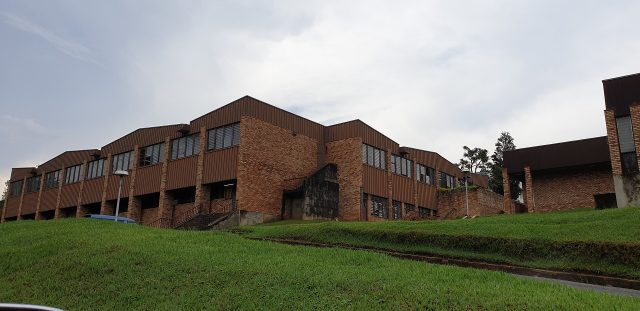
The architecture of the stadium is purely functional. The stands are made of concrete, their edges softened by time and the occasional coat of faded paint. The main entrance is little more than a gap in the perimeter fence, wide enough for a steady stream of people to pass through. There are no grand arches or decorative flourishes, just the practicality of a space built to endure. The pitch itself is grass, though not the manicured turf of professional stadiums. It’s patchy in places, worn thin by constant use, but that only adds to its charm. This isn’t a place designed for perfection; it’s a place designed for people.
In the evenings, when the sun dips behind the hills and the air cools, the stadium takes on a different character. The floodlights, if they’re working, cast a dim glow over the pitch, and groups of young men might linger to play a final game under the artificial light. Others walk the track, using it as a place to exercise or simply to unwind after a long day. The surrounding area is quiet, with only the occasional hum of a motorcycle or the distant laughter of children breaking the stillness. It’s a time when the stadium feels most like a public square, a shared space where the boundaries between sport, leisure, and daily life blur.
Huye Stadium isn’t the kind of place that makes it onto postcards or travel brochures. There are no guided tours, no gift shops, no plaques commemorating famous moments. But that’s precisely what makes it worth visiting. It offers a glimpse into the everyday life of Butare, a city that doesn’t put on airs. If you find yourself here on a match day, you won’t be treated as a tourist—just another face in the crowd, swept up in the energy of the game. The players might not be professionals, the facilities might be basic, but the experience is authentic in a way that polished stadiums often aren’t.
For those who take the time to sit in the stands and watch, there’s a certain rhythm to the place. The way the light shifts over the hills as the afternoon wears on, the way the crowd’s mood rises and falls with the fortunes of the home team, the way the air smells of grilled maize and fried plantains from the vendors outside. It’s not about spectacle; it’s about connection. In a country that has seen so much upheaval, places like Huye Stadium remind you that life persists, not in grand gestures, but in small, steady moments. And sometimes, that’s enough.