Sri Ksetra is one of those places in Myanmar that draws visitors not for crowds or fanfare, but for the quiet that settles over it like a second skin. Located near the ancient city of Pyay, these ruins were once the heart of the Pyu Kingdom, one of the earliest civilizations to take root in what is now Myanmar. Today, little remains of its former grandeur beyond scattered stones and crumbling structures, yet they carry the weight of a time when Sri Ksetra was a crossroads of trade, culture, and Buddhist thought, bridging the gap between India and Southeast Asia.
The city flourished between the 5th and 9th centuries, though archaeological evidence suggests it existed as early as the first few centuries CE. The Pyu people, who built this kingdom, left behind more than just brick walls and pagodas—they created one of the region’s first writing systems, introduced coinage, and developed an intricate irrigation network. Sri Ksetra was encircled by massive brick fortifications stretching nearly eight kilometers, complete with moats and gates that once controlled access to different parts of the city. Now, only fragments of these walls remain, but even those hint at the scale of the settlement that once stood here.
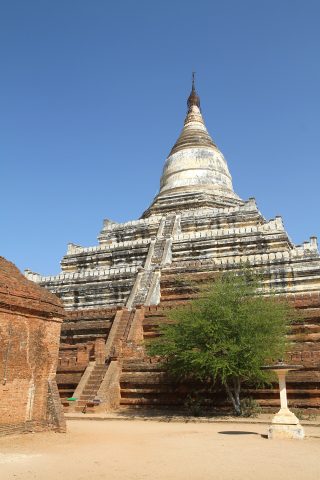
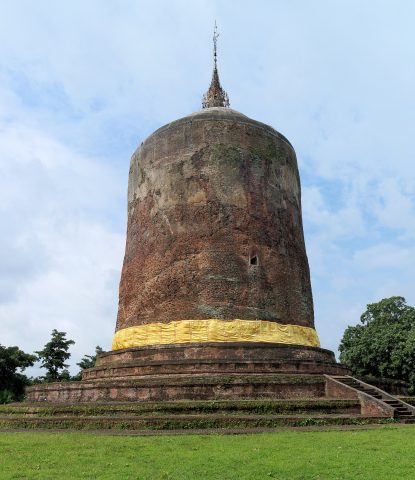
The most striking remnants of Sri Ksetra are its stupas, or pagodas, scattered across the site. Among them, Payama Stupa stands out as one of Myanmar’s largest surviving examples, its rounded dome and solid base still intact despite centuries of wear. While later restorations have altered some details, its form remains true to the Pyu architectural style. Nearby, other stupas lie half-buried under earth and vegetation, their outlines just visible beneath the grass and moss. Some are little more than mounds now, but their presence lingers, a quiet testament to the city’s past.
A small open-air museum on the site houses artifacts uncovered during excavations—stone tablets inscribed in the Pyu script, pottery, jewelry, and fragments of sculptures. Some pieces date back to the early centuries CE, their preservation remarkable given the passage of time. The museum is modest, but it offers a glimpse into daily life in Sri Ksetra, where Buddhism coexisted with local traditions and merchants from distant lands traded goods and ideas. The exhibits feel unassuming, yet they piece together a story of a city that was once vibrant and cosmopolitan.
Unlike more polished tourist sites, Sri Ksetra doesn’t offer neatly labeled paths or multilingual guides. There are no souvenir stalls or crowds jostling for the best photo. Instead, the ruins sit in vast, grassy fields, shaded by the occasional tree, where the only sounds are the rustle of leaves and the calls of birds. Locals sometimes visit to pray at small shrines, leaving offerings of flowers and incense. For them, Sri Ksetra is more than a historical site—it’s a place tied to faith and ancestral memory, where the past feels close enough to touch.
Visiting Sri Ksetra requires a certain mindset. This isn’t a place to rush through in an hour, ticking off highlights. It invites you to linger, to sit on a weathered stone and imagine the city in its prime—the processions of monks winding through its streets, the clatter of workshops crafting pottery and jewelry, the bustle of markets where silk, spices, and gemstones changed hands. Time here moves differently, as if slowed by the weight of history pressing against the ancient walls.
Though less famous than Bagan or Mandalay, Sri Ksetra’s significance to Myanmar’s history is profound. It’s one of the few places where you can trace the roots of Burmese civilization, where the foundations of a culture that would later flourish in great empires were first laid. There are no towering palaces or gilded pagodas here, but there’s an authenticity that’s harder to find in more tourist-heavy destinations. The ruins don’t demand attention; they simply exist, as they have for centuries.
The journey to Sri Ksetra begins in Pyay, a quiet town about half an hour away by taxi or motorbike. The road winds past rice fields, palm trees, and small villages, offering a glimpse of rural Myanmar. Pyay itself is worth a stop—its colonial-era buildings, markets, and temples have a slow, unhurried rhythm. But as you approach Sri Ksetra, the noise of the town fades, replaced by open space and stillness. The closer you get, the more the landscape shifts, as if the land itself is preparing you for what lies ahead.
Sri Ksetra doesn’t shout its history. It doesn’t try to impress or entertain. It simply endures, a reminder that even the greatest civilizations fade, leaving behind something more than just ruins. Here, the past feels tangible, not as something distant but as a presence that lingers in the air. That’s why those who visit often find themselves returning—because some places don’t just tell a story. They let you step inside it.