Bebe Pagoda sits quietly on the edge of Pyay, a town that feels suspended in time. Unlike the grand, gilded temples of Yangon or the sprawling ruins of Bagan, this place doesn’t demand attention. It simply exists, surrounded by low hills and the rustling leaves of tropical trees, as if holding secrets older than the stones beneath your feet. There’s no crowd here, no hurried footsteps or camera shutters—just the occasional murmur of pilgrims and the soft sigh of the wind through the palms. That stillness is what makes Bebe different. It doesn’t need to dazzle; it only needs to endure.
The pagoda’s origins stretch back to the 11th century, when Pyay was the capital of a small kingdom under the rule of the Bagan Empire. Legend says King Anawrahta, one of Myanmar’s most revered rulers, founded it during a southern campaign, bringing with him a sacred relic—a hair of the Buddha—to enshrine within its walls. Historians, however, suggest a later date, perhaps the 13th or 14th century, when Pyay had already faded as a political power but remained a spiritual stronghold. Whatever the truth, Bebe has weathered rebellions, wars, and earthquakes, emerging almost unchanged, as if time itself had spared it.
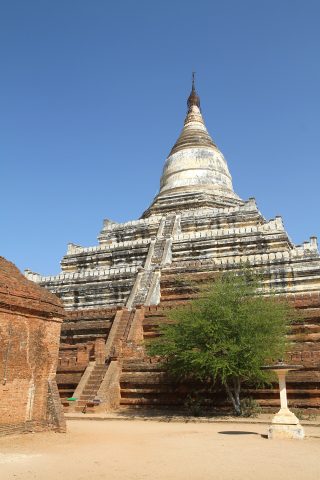
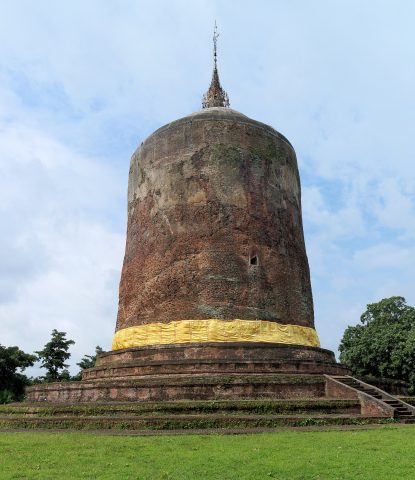
The architecture is unassuming, a reflection of the era’s modest religious structures. A stepped pyramid rises toward the sky, crowned by a spire that symbolizes the path to enlightenment. The walls, built from reddish brick, bear few ornate details—no intricate carvings or lavish gold leaf, just the quiet dignity of age. Smaller stupas and shrines cluster around the main pagoda, forming a compact complex. What sets Bebe apart is its setting: built atop a natural rise, it requires a climb up worn stone steps, their surfaces smoothed by centuries of footsteps. The ascent isn’t easy, but that’s part of the experience. Each step feels like a small act of devotion, a slow approach toward something sacred.
Inside, there are no tourist shops or museum displays. The space is devoted to ritual—worshippers leave offerings of flowers, light candles, and murmur prayers before small altars. The central shrine holds a Buddha statue, its surface layered with gold leaf left by generations of pilgrims. Locals believe that touching the statue with a pure heart can make wishes come true. Outside, an ancient garden offers shade from the midday sun, where towering banyan and mango trees shelter monks in saffron robes. They sit in quiet conversation or meditation, their presence adding to the sense of timelessness.
Pyay isn’t a place that caters to tourists, and that’s part of its charm. The town moves at its own pace, untouched by the rush of modern travel. Mornings bring the scent of fried onions and spices to the streets, where vendors arrange fresh fruit on woven mats and old men play chess beneath the awnings of tea stalls. Bebe Pagoda is woven into this daily rhythm. Locals visit not just for festivals but for moments of quiet reflection, a break from the noise of life. For them, it’s a place of solace, where the weight of the world feels lighter.
It’s curious how little Bebe appears in guidebooks, given its cultural significance. Perhaps it’s because it doesn’t overwhelm the senses like Shwedagon or the temples of Bagan. There are no gleaming domes or towering statues here, just the quiet strength of something real. The pagoda hasn’t been polished into a tourist attraction or stripped of its authenticity. It remains a living place, where faith and daily life intertwine, and the past feels as present as the stones underfoot.
Visiting Bebe is a chance to see Myanmar without the gloss. There are no crowds, no pushy guides, no staged photo ops—just the scent of incense, the hum of distant prayers, and the sense that time here follows its own rules. If you’re lucky, you might witness the evening chanting of monks, their voices rising in unison over the hills, a sound that seems to have echoed for centuries and will continue long after you’ve gone.
Even without the chanting, the pagoda leaves an impression. It asks nothing of visitors except respect for its peace. You can sit on a stone bench, watching the stupas stand sentinel, and wonder how many others have done the same over the centuries—each with their own hopes, their own quiet prayers. That’s the quiet magic of places like Bebe. They don’t change; we do. And sometimes, all it takes is a moment in their presence to feel connected to something far greater than ourselves.