Christ Church Cathedral stands in the heart of Dublin, where the city’s layers of history feel almost tangible. It occupies a spot that has been a crossroads for centuries—where merchants, monks, soldiers, and ordinary citizens once walked, and where the weight of the past lingers in the air. The building itself is a living record of change, shaped by religious upheavals, wars, and revivals. Today, it remains an active Anglican cathedral, but its walls hold memories of a very different Ireland.
The first church on this site dates back to the early 11th century, when Dublin was still a Viking settlement. It was founded by Sitric Silkbeard, a Norse king who brought more than just raids to the island—trade, craftsmanship, and Christianity followed in his wake. That wooden church didn’t last, and by 1172, construction began on a stone cathedral in the Romanesque style. This was a time when Ireland was just coming under English influence, and Christ Church became a symbol of that shift, representing both spiritual and political authority.
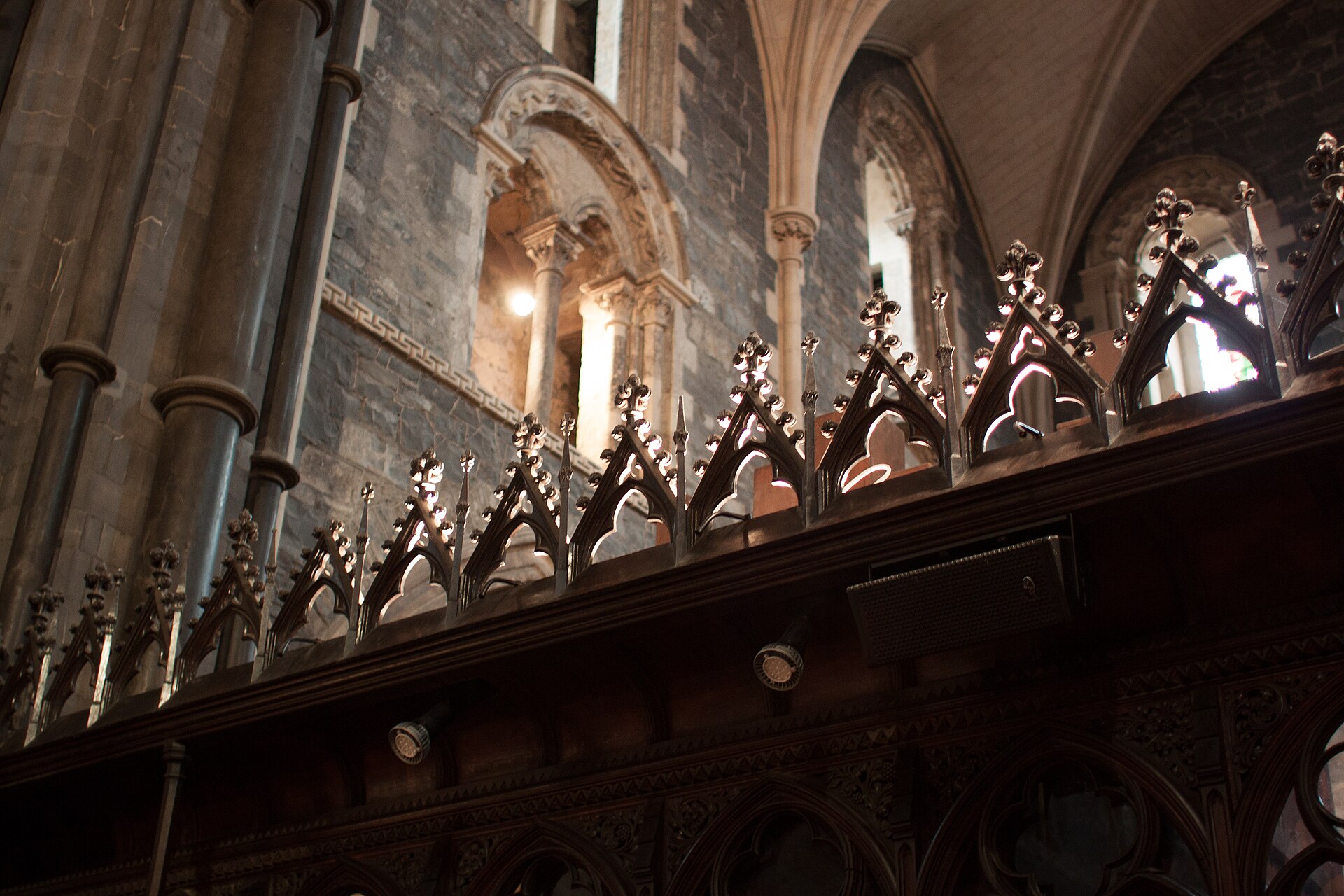
The cathedral’s architecture is a patchwork of eras. Medieval walls stand alongside Gothic arches added in the 13th century, while a 19th-century Victorian restoration gave the building much of its current appearance. The nave is particularly striking, with its high vaulted ceilings and light filtering through stained glass, casting warm patterns on the stone. Below, the crypt—one of the largest in Britain and Ireland—holds fragments of ancient walls and even remnants of the original Norman timber structures. Among its curiosities are medieval tombs and an odd relic: the mummified remains of a cat and rat, discovered inside the organ pipes.
Christ Church has always been more than just a place of worship. In the Middle Ages, it served as a coronation site for Irish lords and housed royal charters. When the English Reformation took hold, the cathedral became a Protestant stronghold in a predominantly Catholic land. In the 17th century, it nearly met its end when city officials considered demolishing it to widen the streets, but intervention by the archbishop saved it. The 19th century brought a major restoration led by architect George Edmund Street, who restored its medieval character while adding Victorian touches.
Inside, the atmosphere is both grand and intimate. The towering columns create a sense of space, yet every corner is filled with details that draw the eye—carved wooden pews, faded inscriptions on old gravestones, and memorial plaques honoring notable Dubliners. The choir, one of the finest in Ireland, fills the cathedral with rich sound during services. Down in the crypt, the dim light and quiet make it feel as though time has stood still.
The cathedral is deeply woven into Dublin’s history. It holds the remains of Laurence O’Toole, a medieval archbishop later canonized by the Catholic Church, despite the cathedral’s long-standing Protestant affiliation. The crypt also contains the tomb of Richard de Clare, known as Strongbow, one of the first Norman invaders of Ireland—a reminder of the island’s early ties to England. In the 20th century, Christ Church became a venue for city milestones, from Dublin’s millennium celebrations to memorial services for those lost in conflicts.
Today, the cathedral is both a place of worship and a major landmark. Visitors come to admire its medieval architecture, listen to the choir, explore the crypt, or simply sit in silence, watching the light play across the stone. It’s open to the public year-round, with an admission fee that helps maintain the building—no small task for a structure over eight centuries old. Outside, a small park offers a quiet spot to rest, while nearby attractions like Dublin Castle and Trinity College Library make it easy to continue exploring the city’s history.
A visit to Christ Church feels like stepping into the past. Unlike a museum, where artifacts are kept behind glass, here the history is tangible. The stone under your fingers is cold and rough, just as it was hundreds of years ago. Services, concerts, and exhibitions still take place within its walls, keeping the cathedral alive as part of the city’s rhythm. Even for those who aren’t religious, it’s easy to feel a connection to the generations who have walked these same floors, making Dublin what it is today.