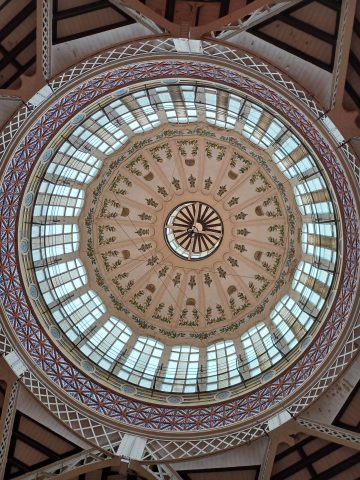
Valencia Cathedral stands at the heart of the city’s old quarter, where layers of history unfold with every step. The site itself has been sacred for centuries—once a Roman forum, later a mosque under Moorish rule, and now a cathedral that has watched over Valencia since the thirteenth century. Construction began shortly after King James I reclaimed the city from the Moors, and over time, the building became more than a place of worship. It grew into a symbol of the city’s transformations, a silent witness to the ebb and flow of power, faith, and culture.
The cathedral’s architecture tells a story of shifting tastes and influences. The core structure is Gothic, with soaring pointed arches and ribbed vaults that draw the eye upward, but the details reveal a patchwork of styles. The main façade, facing Plaza de la Virgen, is adorned with a flamboyant Gothic portal, its intricate carvings a testament to the craftsmanship of the era. The side entrances, by contrast, are more restrained, blending classical columns with rounded arches that hint at earlier Romanesque traditions. Inside, the space feels vast and luminous, thanks to the high ceilings and stained-glass windows that bathe the stone in soft, colored light. The effect is one of quiet grandeur, a place where the past feels both distant and immediate.
Among the cathedral’s most famous treasures is the Holy Grail, a chalice carved from agate that has been housed here since the fifteenth century. The cup is shrouded in legend—some claim it is the true vessel used at the Last Supper, while others dismiss it as a medieval relic with no historical proof. Yet for many, its presence alone is enough to lend the cathedral an air of mystery. Nearby, in the Chapel of the Holy Cross, another artifact draws visitors: a crucifix said to have been brought from Rome in the fourteenth century. These objects, whether viewed as sacred or simply curious, add a layer of reverence to the space, making it a destination for pilgrims and travelers alike.
The Miguelete Tower, added in the fifteenth century, is another defining feature of the cathedral. Named after its largest bell, Miguel, the tower has long served as a beacon for the city, its chimes marking festivals, warnings, and moments of collective joy or sorrow. Climbing the narrow, winding staircase to the top is a challenge, but the view makes it worthwhile. From this height, Valencia unfolds in all directions—the labyrinth of old streets, the modern districts beyond, and, on clear days, the distant shimmer of the Mediterranean. The climb itself feels like a journey through time, each step a reminder of the hands that built the tower centuries ago.
Inside, the cathedral’s details reward close attention. The main altarpiece, gilded and ornate, dominates the space, while the Chapel of the Reconquest holds the relics of Saint Vincent the Martyr, Valencia’s patron saint. The walls and ceilings are adorned with frescoes depicting biblical scenes and the lives of saints, but the smaller elements tell their own stories. Ancient tombstones are set into the floor, their inscriptions worn by time, and the coats of arms of noble families are embedded in the walls like silent markers of history. Even the scars of conflict—bullet holes from wars and revolutions—are visible if you know where to look, a reminder that this building has endured far more than just the passage of time.
Beyond its religious significance, Valencia Cathedral remains a living part of the city. It hosts daily services, weddings, and concerts, its organ filling the space with music that echoes off the stone. In the summer, the inner courtyard becomes a venue for festivals and fairs, while in winter, the square outside transforms into a bustling Christmas market. The atmosphere shifts with the seasons and the hour—solemn during mass, lively when tourists gather, and peaceful in the quiet moments between. It’s a place where the sacred and the everyday coexist, where history is not just preserved but actively woven into the present.
A visit to the cathedral is a slow, meandering experience. There’s no rush to take it all in; the building invites you to linger. The carved capitals of the columns offer endless details—grotesque figures, scenes of medieval life, and symbols whose meanings have faded with time. The fountain in the patio, where worshippers once washed before prayer, still trickles softly, a remnant of rituals long past. Even the benches scattered throughout the space encourage pause, whether to rest, reflect, or simply listen to the murmur of voices and the echo of footsteps. The cathedral has a way of slowing time, of making the present feel connected to something older and deeper.
What makes Valencia Cathedral remarkable is not just its age or its beauty, but the way it has absorbed the life of the city around it. It has seen kings and beggars, triumphs and tragedies, moments of splendor and periods of neglect. Yet it endures, not as a relic of the past, but as a place that still matters. People come here for many reasons—to admire the architecture, to pray, to learn, or simply to sit in the quiet and feel the weight of history. And perhaps that’s the real magic of the place: it doesn’t just tell a story. It lets you step inside it, if only for a little while.