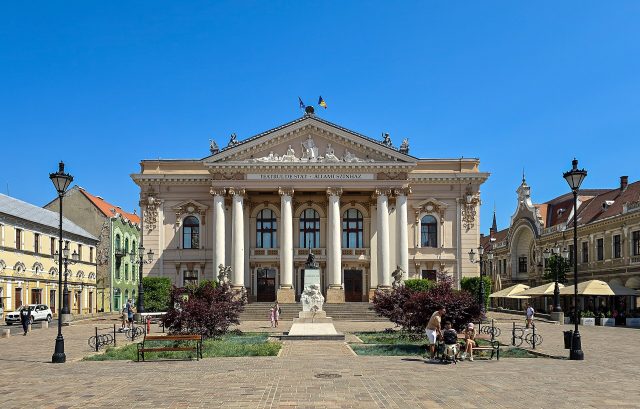
The Cathedral of the Assumption of the Virgin Mary in Oradea is one of those places that doesn’t immediately demand attention, yet lingers in the mind long after you’ve left. Tucked slightly away from the city’s busier streets, it stands as a quiet witness to a time when Oradea was more than just a provincial Romanian town—it was a crossroads of cultures, faiths, and histories. The cathedral doesn’t overwhelm with grandeur like some of Europe’s more famous cathedrals, but there’s a harmony in its understated architecture, one that comes from centuries of slow, unhurried change.
Its story begins in the 18th century, when Oradea—then known by its Hungarian name, Nagyvárad—was part of the Habsburg Monarchy. The city was a stronghold of Catholicism in the region, and the cathedral was built in 1752 to a design by the Italian architect Giovanni Battista Ricca. His vision gave the building the graceful lines of late Baroque: the smooth curves of the façade, the elegant pilasters, the tall windows with their semicircular arches. Inside, the same style continues with stucco work on the vaulted ceilings, frescoes depicting biblical scenes, and an altar adorned with gilded details. The effect is one of solemnity without pomp, as if the cathedral was always meant for quiet reflection rather than grand spectacle.
Over the centuries, the cathedral has seen empires rise and fall. In the 19th century, when Oradea became part of the Hungarian Kingdom and later the Austro-Hungarian Empire, it remained a spiritual center for the local Catholic community. Even after the city was incorporated into Romania between the world wars, the cathedral retained its significance, though its role shifted in a new cultural landscape. During the socialist era, when religion was suppressed, the cathedral continued to function, albeit in a more subdued way. Today, it stands open to both worshippers and visitors, a subtle reminder of how some places endure beyond the politics of their time.
The architecture of the cathedral is a conversation between different eras. From the outside, it appears as a classic Baroque church, but inside, you can spot later additions. The organ, installed in the late 19th century, carries the romantic era’s love of grandeur and emotion. The altar is framed by frescoes painted in an academic style, while the side chapels hold images of saints created by different artists over the years. The result is a sense that the cathedral isn’t frozen in one moment—it has grown and adapted, absorbing new influences while holding onto its traditions.
Oradea has always been a borderland city, where Hungarian, Romanian, and German cultures intersected, and where Catholicism coexisted with Orthodoxy and Protestantism. The Cathedral of the Assumption of the Virgin Mary became a symbol of that diversity. It wasn’t just a place of worship; it hosted public events, concerts, and gatherings. In the 19th century, the renowned Hungarian composer Franz Liszt performed here during his tours of the Austro-Hungarian Empire. Today, the cathedral still serves as a meeting point for different generations and traditions, a place where the past and present overlap.
Stepping inside, you’re struck by the stillness. Even when the city outside is bustling, the cathedral offers a space where time seems to slow. Sunlight filters through the tall windows, casting a soft glow over the old frescoes and wooden pews. The air carries the scent of wax and incense. On weekdays, the cathedral is often empty, allowing visitors to take in the details—the intricate carvings on the confessionals, the old books in the sacristy, the marble plaques with Latin inscriptions. On feast days, the space fills with people, and the walls seem to come alive, a reminder that this place was built not just for beauty, but for community.
The cathedral isn’t just an architectural landmark; it’s a living piece of Oradea’s history. It tells the story of how the city has changed, how different cultures have coexisted, and how faith and art have helped people stay connected to their past. Most tourists come to Oradea to see the fortress or stroll through the old town, and the cathedral often goes unnoticed. But those who do step inside usually leave with the sense that they’ve discovered something authentic—unassuming, yet deeply meaningful.
Outside, a small park surrounds the cathedral, where locals like to sit on benches in the shade of the trees. It’s a quiet spot to listen to the bells and reflect on how many people have come here over the centuries—with prayers, hopes, and memories. The cathedral doesn’t demand admiration; it simply exists, as much a part of the city’s fabric as the streets and squares around it. In that quiet persistence lies its charm. It doesn’t try to impress or astonish; it just waits for those who are willing to notice.