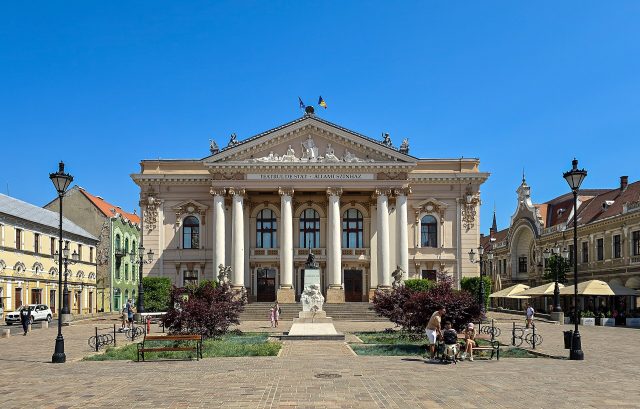
The Black Eagle Palace in Oradea is one of those places where time seems to have paused, preserving the spirit of the early 20th century. Built in 1907, it became a symbol of the city’s economic and cultural flourishing during a period when Oradea thrived as a crossroads of trade and influence under the Austro-Hungarian Empire. The building’s architecture reflects the eclectic tastes of the era, blending elements of Art Nouveau with more traditional forms. Its facade is adorned with intricate stucco, wrought-iron balconies, and, of course, the black eagle that gives the palace its name—a nod to the city’s coat of arms and a mark of its significance.
Inside, the palace once buzzed with life. It housed luxury shops, cafes, a hotel, and even a cinema, serving as a hub for social gatherings, business meetings, and leisure. Today, only fragments of that grandeur remain: the high ceilings with ornate plasterwork, marble staircases, and the occasional stained-glass window still visible in some rooms. The building has weathered two world wars, political upheavals, and economic crises, yet it retains a sense of its former monumentality. Now, it hosts offices, small shops, and cultural spaces, though many of its halls stand empty, awaiting restoration.
One of the palace’s most intriguing features is its inner courtyard, a quiet retreat from the bustle of the streets. Once a winter garden filled with exotic plants, it now offers a peaceful spot where visitors can imagine the sounds of music from long-ago balls or the murmur of cafe patrons enjoying their coffee. In warmer months, the courtyard occasionally hosts small exhibitions and concerts, giving the palace a taste of its former role as a cultural center. Even in its current state, the building carries the atmosphere of old Europe, where every stone seems to whisper stories of the past.
Architecturally, the Black Eagle Palace is a fascinating example of transitional design. It combines classical elements—columns, arches, symmetry—with the more fluid, almost whimsical forms of Art Nouveau. This blend is particularly evident in the facade, where rigid lines coexist with flowing curves and floral motifs. Such stylistic experimentation was typical of the early 1900s, as architects sought to break away from academic traditions and explore new forms of expression. In Romania, few buildings from this period have survived, making the palace in Oradea all the more valuable.
The palace’s history is deeply intertwined with that of the city itself. Oradea has always been a borderland, shifting between Hungarian, Romanian, and Austrian rule. In the early 20th century, under Habsburg influence, the city experienced an economic boom. The construction of the palace coincided with the arrival of tram lines, the growth of industry, and an expanding population. The Black Eagle wasn’t just a building—it was a symbol of progress and prosperity. After World War I, when Oradea became part of Romania, the palace continued to play a vital role in the city’s life, though its purpose gradually evolved. During the socialist era, it housed government offices, and after the regime’s fall, it fell into disrepair, like many other architectural landmarks.
Today, the Black Eagle Palace draws both tourists and locals. Some come to admire its architecture, others to sit in one of the few remaining cafes or simply stroll through the courtyard. The building no longer exudes the opulence of its early years, but that slight air of neglect gives it a unique charm. The cracks in the walls, the peeling paint, and the creak of old staircases all contribute to an atmosphere of authenticity, a quality often lost in meticulously restored monuments.
Oradea isn’t one of Romania’s most tourist-heavy destinations, and that’s part of its appeal. Visitors can wander its streets without crowds, discovering places like the Black Eagle Palace at their own pace. The city itself is a blend of architectural styles, with a history stretching back to the Middle Ages and a relaxed, unhurried rhythm of life. The palace serves as a kind of anchor, offering a glimpse into what Oradea might have been like a century ago.
In recent years, Romania has seen a growing interest in preserving its architectural heritage, and the Black Eagle Palace is no exception. While no large-scale restoration has taken place yet, the building is protected as a cultural monument. Local authorities and community groups occasionally organize clean-up efforts and minor repairs to prevent further deterioration. There’s hope that one day the palace might be revived as a museum, cultural center, or even a hotel. But even if that never happens, it will remain an important part of Oradea’s history—a reminder that cities, like people, go through rises and falls, yet always carry the memory of their past.