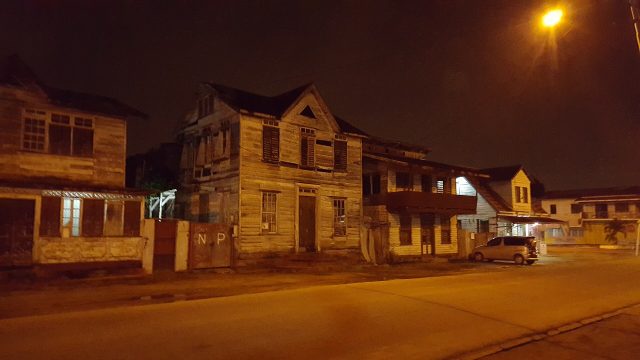
Standing tall over Paramaribo, the Cathedral of Saints Peter and Paul is one of those rare places that doesn’t just impress with its architecture—it carries the weight of a nation’s story within its walls. Built almost entirely of wood, the cathedral seems to rise from the city like a ghostly galleon, its dark silhouette a striking contrast against the tropical sky. Constructed in the late 19th century, when Paramaribo was already the bustling heart of a Dutch colony, it was meant to assert the presence of the Catholic Church in a city where Protestantism, African spiritual traditions, and the beliefs of indentured laborers from Asia had long taken root.
The cathedral’s origins trace back to 1883, when a Dutch architect drafted the initial plans. Yet the final structure bears the unmistakable touch of local craftsmanship. The wood was sourced from across Suriname, including the dense rainforests where hardy, moisture-resistant species thrived. Over time, the timber darkened, giving the cathedral its current deep, almost ebony-like hue. This transformation wasn’t intentional—it was the slow work of climate and age, turning the building into something far more striking than its creators could have imagined.
Inside, the cathedral feels both vast and intimate. The high vaulted ceilings, supported by rows of slender columns, create an airy sense of space, while sunlight filters through stained glass, casting warm golden reflections across the wooden surfaces. The altar is adorned with intricate carvings that blend European religious motifs with subtle nods to Suriname’s indigenous and African heritage. There’s no gilded opulence here, no marble grandeur—just the quiet beauty of wood shaped by human hands, each detail telling a story of the people who built it.
The cathedral hasn’t always been in such good condition. By the mid-20th century, neglect had taken its toll: the wood rotted, the roof leaked, and the foundation sagged under the weight of decades. For a time, it seemed the building might be lost. But in the early 2000s, a major restoration effort began, funded by both local and international sources. The work was painstaking, requiring not just repairs but a deeper understanding of how to preserve a wooden structure in a tropical climate. Today, the cathedral stands restored, though some elements still bear the marks of time, a reminder of how close it came to disappearing.
For many Surinamese, the Cathedral of Saints Peter and Paul is more than just a landmark—it’s a living piece of history. Suriname’s past as a Dutch colony shaped its religious landscape, and Catholicism took hold among the Creole population and indigenous communities. Yet the cathedral also became a place where cultures intersected. On any given Sunday, you might hear hymns in Latin alongside songs in Sranan Tongo, Suriname’s Creole language, sung by a congregation that reflects the country’s diversity: descendants of enslaved Africans, indentured laborers from India and Indonesia, and European settlers. The building itself, with its mix of influences, mirrors this blend.
Paramaribo is a city of contrasts, where colonial mansions stand beside stilted wooden houses, and modern shops share the streets with open-air markets selling jungle spices and exotic fruits. The cathedral fits seamlessly into this mosaic, a quiet testament to the city’s role as a crossroads of cultures. Nearby, the Presidential Palace and Fort Zeelandia tell their own stories of Suriname’s past, but the cathedral draws the eye with its understated elegance. It sits slightly apart from the main thoroughfares, as if inviting visitors to step into a slower, more reflective pace.
A visit to the cathedral pairs naturally with a walk through Paramaribo’s historic center, a UNESCO World Heritage site. The streets here are paved with cobblestones, and the buildings, painted in soft pastels, give the city a dreamlike quality. Around the cathedral, a small park offers a place to sit and take in the view, especially beautiful in the late afternoon when the setting sun deepens the wood’s rich tones. If you’re lucky, you might hear the bells ringing in the evening, their sound drifting over the rooftops.
There’s something deeply human about the Cathedral of Saints Peter and Paul. It’s not as grand as Europe’s cathedrals, nor as ancient as Asia’s temples, but it has a sincerity that’s hard to find elsewhere. Perhaps that’s why it resonates so strongly with Surinamese—it’s not just a relic of the past, but a place where history feels alive. If you find yourself in Paramaribo, take the time to step inside. Run your fingers over the smooth wood of the columns, listen to the quiet creak of the floorboards, and let the stillness of the place settle over you. It’s a rare moment of connection, not just to a building, but to the people who shaped it—and the country it represents.