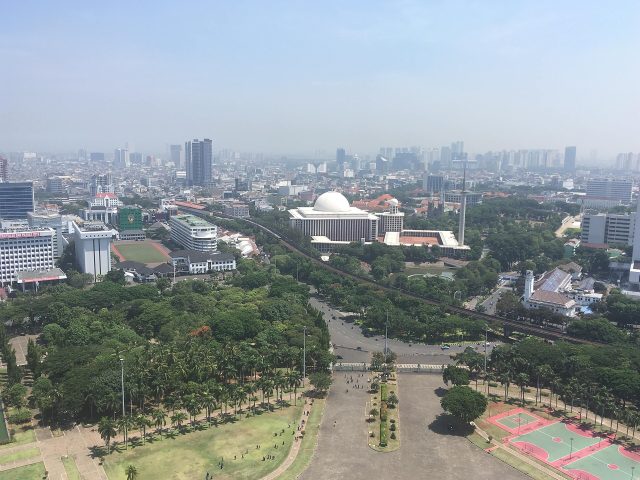
Jakarta’s Cathedral of Our Lady of the Assumption, more commonly known as St. Mary’s Cathedral, stands as a quiet counterpoint to the city’s relentless energy. Built in the late 19th century, it occupies a small but significant plot in Central Jakarta, just across from the grand Istiqlal Mosque, a pairing that often surprises visitors. The two buildings, one Catholic and one Islamic, share a plaza and have come to symbolize Indonesia’s pluralistic identity, though their proximity wasn’t always so harmonious. The cathedral’s history is tied to the colonial era, when the Dutch East Indies government sought to establish a permanent place of worship for the growing Catholic community in Batavia, as Jakarta was then known.
The original structure, completed in 1829, was a modest wooden church that quickly proved inadequate for the city’s expanding congregation. By the 1890s, plans were underway for a more substantial building, designed in the neo-Gothic style that was popular in Europe at the time. The architect, a Dutch priest named Antonius Dijkmans, drew inspiration from medieval cathedrals, though the tropical climate demanded adaptations. The result is a building that feels both familiar and slightly out of place—its pointed arches and ribbed vaults evoke European grandeur, but the pale yellow exterior and wide verandas hint at the need to keep the interior cool. The cathedral was consecrated in 1901, though construction continued in phases, with the twin spires added later to complete the silhouette.
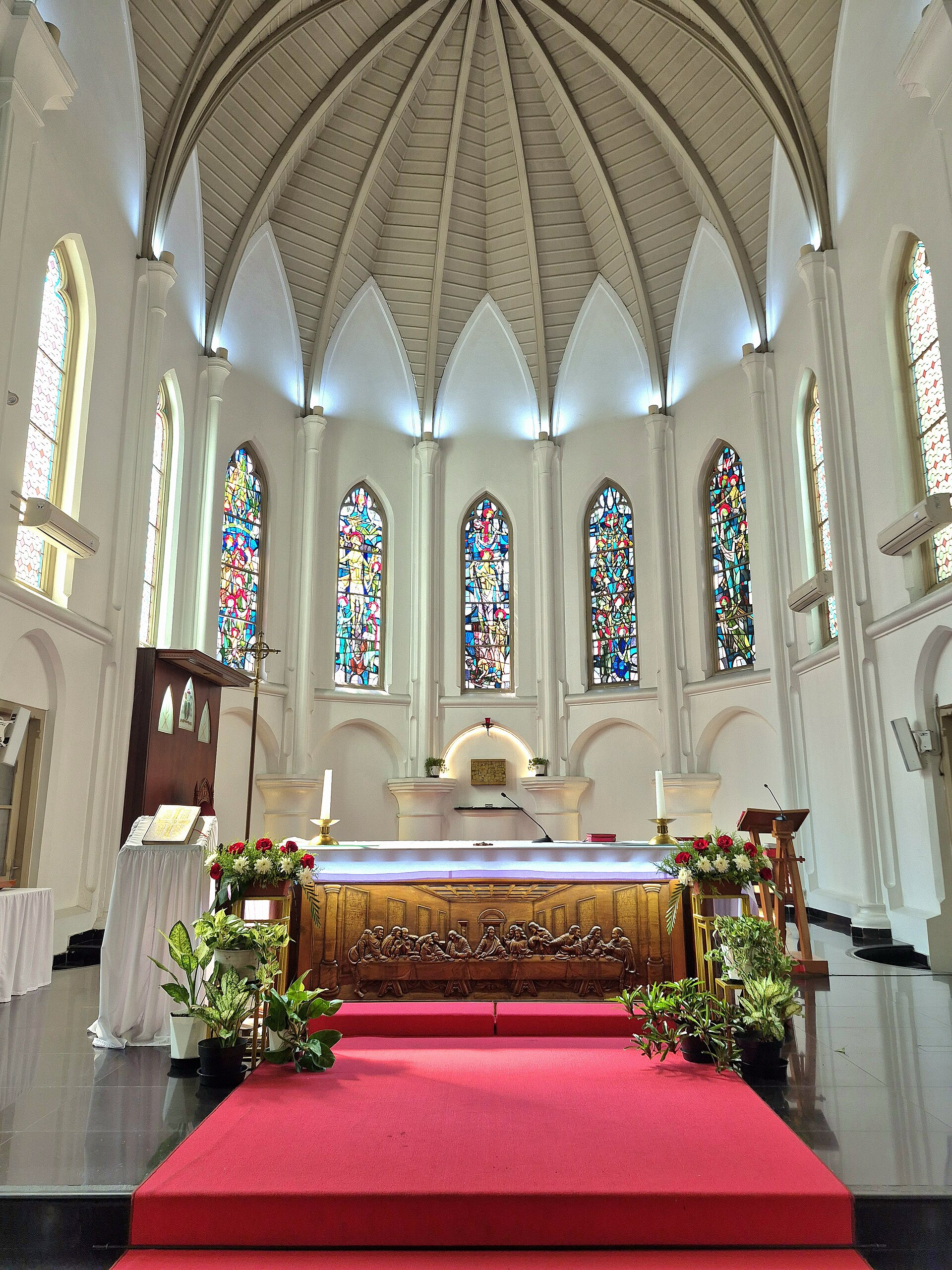
Stepping inside, the first thing that strikes you is the light. Unlike the dim, candlelit interiors of many Gothic churches, St. Mary’s is bathed in natural brightness, filtered through stained-glass windows that depict scenes from the life of Christ and the Virgin Mary. The windows are not the elaborate, jewel-toned masterpieces of Chartres or Notre-Dame, but simpler, more restrained designs that suit the building’s scale. The altar, carved from local teak, is a blend of European and Indonesian influences, with intricate floral motifs that soften the otherwise austere lines of the sanctuary. The pews, worn smooth by generations of worshippers, face a pulpit that rises like a ship’s prow, a nod to the maritime history of the Dutch East Indies.
The cathedral has witnessed much of Jakarta’s turbulent history. During the Japanese occupation in World War II, it became a refuge for those fleeing violence, its doors remaining open even as the city around it descended into chaos. In the years following Indonesia’s independence, when anti-colonial sentiment ran high, the building could have been seen as a relic of foreign domination. Yet it endured, in part because of the local Catholic community’s deep roots in the city. Today, it serves as the seat of the Archdiocese of Jakarta, a role it has held since 1961, and remains an active parish church, not just a historical monument. Masses are held in multiple languages—Indonesian, English, and even Latin—reflecting the diverse backgrounds of its congregation.
Outside, the cathedral’s grounds are a small oasis in a city that has long since outgrown its colonial core. The plaza between St. Mary’s and Istiqlal Mosque is often filled with people—worshippers, tourists, street vendors selling snacks and souvenirs. On Sundays, the sound of church bells mingles with the call to prayer from the mosque, a reminder that Jakarta, for all its modernity, still grapples with the layers of its past. The cathedral itself is surrounded by a low fence, its iron gates usually open, inviting passersby to step inside. Nearby, the old Dutch cemetery, now overgrown, offers a glimpse of the city’s earlier inhabitants, their weathered gravestones bearing names that have long faded from memory.
What makes St. Mary’s Cathedral worth visiting isn’t just its architecture or its history, but the way it feels like a living part of the city. It’s not a museum, though it could easily be one. Instead, it’s a place where Jakarta’s contradictions—old and new, local and foreign, sacred and secular—coexist in a single space. The cathedral has survived fires, earthquakes, and political upheavals, each time adapting without losing its essence. Even the air inside carries a sense of continuity, thick with the scent of incense and old wood, a quiet reminder of the generations who have gathered here to pray, to mourn, or simply to find a moment of stillness in a city that rarely slows down.
For those who take the time to explore beyond the main sanctuary, there are small details that reveal more about the cathedral’s place in Jakarta’s story. The side chapels, dedicated to various saints, are often overlooked by visitors but are rich with local devotion. One houses a statue of Our Lady of the Assumption, the cathedral’s patroness, dressed in a traditional kebaya, a subtle nod to Indonesian culture. Another features a plaque commemorating the victims of the 2009 Jakarta bombings, a stark reminder of the violence that has touched the city in recent decades. These elements don’t shout for attention, but they’re there for those who look.
The cathedral’s role in Jakarta’s religious life extends beyond its walls. It’s a starting point for the annual Easter procession, a vibrant event that winds through the streets of the old city, drawing thousands of participants. During Christmas, the plaza becomes a stage for nativity plays and carol services, open to all regardless of faith. These moments of public celebration are when the cathedral feels most alive, not as a relic of the past, but as a participant in the city’s ongoing narrative. Even on ordinary days, the steady stream of visitors—some praying, others simply sitting in the pews—keeps the space from feeling like a mere tourist attraction.
In a city that is constantly reinventing itself, St. Mary’s Cathedral remains a constant, a rare piece of 19th-century Jakarta that hasn’t been swallowed by skyscrapers or shopping malls. It’s not the most famous landmark in Indonesia, nor the most visually stunning, but that’s part of its charm. There’s no grand entrance fee, no guided tour required—just an open door and the quiet invitation to step inside. For those who do, the cathedral offers more than just a glimpse into Jakarta’s colonial past. It offers a moment of reflection in a city that moves too fast, a place where history isn’t just remembered, but still very much alive.