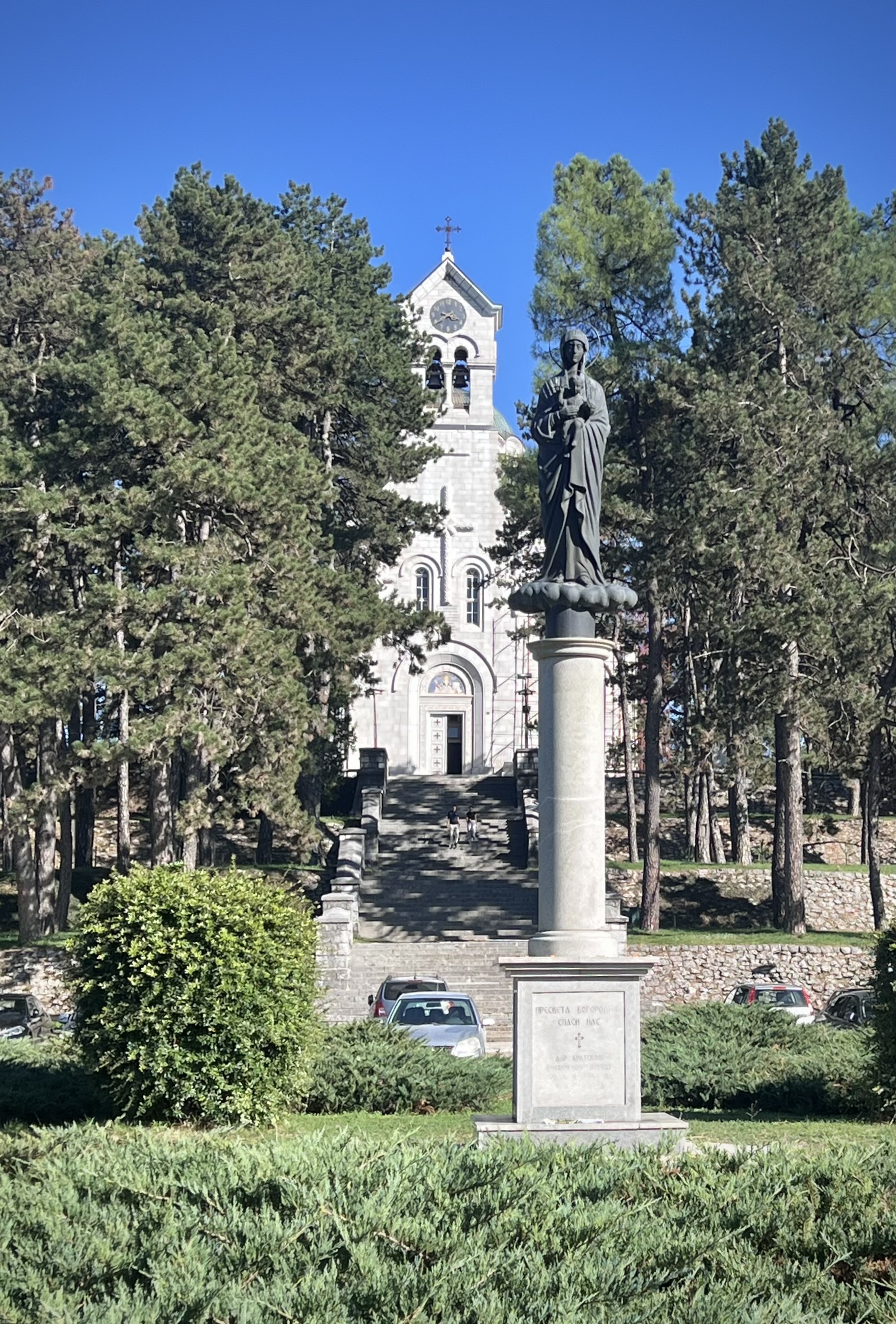
St. Basil of Ostrog Cathedral in Nikšić is one of those places that doesn’t immediately reveal itself to travelers, yet leaves behind a quiet, almost unnoticed sense of strength. It stands on the edge of the city, where the bustle of Nikšić gradually gives way to foothills, and the horizon is framed by low, rolling hills. Unlike many other Orthodox churches in Montenegro, this cathedral doesn’t announce its significance with ornate architecture or gilded domes. Its grandeur lies in its simplicity and scale, in the way it blends seamlessly into the landscape, as if it has always been there.
Construction began in the late 19th century, a time when Nikšić, like the rest of Montenegro, was experiencing a period of growth and change. The country was only just gaining independence, and every new church became not just a spiritual symbol but a national one. The design was entrusted to Russian architect Mikhail Preobrazhensky, who had already worked in the Balkans. His approach was traditional yet innovative for the time: the cathedral was built in the Neo-Byzantine style, which was just beginning to gain popularity in the Orthodox world. The construction stretched over several decades, and the cathedral was finally consecrated in 1902, after the architect’s death.
From the outside, the cathedral appears austere, even slightly severe. Its walls are built from light stone that has taken on a warm, honeyed hue over time. The facades are adorned with modest arches and narrow windows, while the main entrance is framed by a portico with columns. The domes are low and squat, almost pressed to the ground—a form typical of many Balkan churches, where architecture has always been closer to folk tradition than to imperial splendor. Inside, the cathedral is spacious and bright, though without the opulence often found in churches of wealthier nations. There is no gilded stucco or intricate mosaics, but instead a sense of openness and tranquility created by the high vaults and soft light filtering through the windows.
The cathedral’s most revered relic is the relics of St. Basil of Ostrog, one of the most venerated saints in Montenegro and beyond. St. Basil, who lived in the 17th century, was a bishop and spiritual leader who supported his people and strengthened their faith during the difficult years of Ottoman rule. His relics were transferred to Nikšić in the mid-20th century, and since then, the cathedral has become an important pilgrimage site. Every year, thousands of people come to pay their respects, especially on the saint’s feast day, when the cathedral fills with prayers and quiet hymns.
Nikšić is not a tourist city, and St. Basil of Ostrog Cathedral is less a sightseeing attraction than a living place where the daily life of the parish continues. On Sundays after services, locals gather by the entrance to chat, share news, and discuss their concerns. In summer, children often play in the cathedral’s courtyard under the shade of old trees, while in winter, elderly residents sit on benches, soaking up the sun. There’s nothing staged or artificial about it—just life unfolding as it always has, with the cathedral as an integral part of it.
The cathedral has not only endured the long years of its construction but also the turbulent events of the 20th century. During World War II, Nikšić was under Italian occupation, and later, it fell under the control of communist Yugoslavia. Churches were often closed, repurposed as warehouses, or even destroyed, but St. Basil of Ostrog Cathedral survived. Perhaps it was because of its location on the outskirts of the city, or perhaps it was simply luck. Whatever the reason, after the fall of communism, the cathedral was returned to the church and restored, though without excessive embellishment.
Today, the cathedral is not just a place of worship but also a kind of cultural center. It hosts concerts of sacred music, exhibitions of iconography, and meetings with historians and theologians. In recent years, Nikšić has begun to attract more travelers seeking something deeper in Montenegro than just beaches and mountain resorts. For them, St. Basil of Ostrog Cathedral offers a chance to connect with the country’s history, understand its spiritual roots, and see how people live beyond the usual tourist routes.
If you find yourself in Nikšić, it’s worth visiting the cathedral not just for photos or to tick it off a list. Come early in the morning, when the city is still asleep and the sun is just beginning to illuminate the stone walls. Or in the evening, when the lamps are lit and the cathedral grows especially quiet. There are no crowds of tourists here, no rush—just silence and the feeling that time moves a little slower within these walls. That, perhaps, is the true charm of this place: it doesn’t try to impress or astonish, but simply exists, as the mountains around Nikšić have existed for centuries, or the rivers that have flowed through these lands for generations.