Nikšić is a city where history feels quietly present, woven into the fabric of everyday life rather than displayed for spectacle. On its outskirts, where the hum of traffic fades into the rustle of olive groves and the low hills that rise beyond the last houses, stands the Church of Saints Peter and Paul. It’s an unassuming building, the kind that might escape notice if you’re hurrying through the city, yet those who take the time to visit often find themselves lingering longer than expected. There’s nothing grandiose about it—no gilded domes or elaborate frescoes—but that’s precisely what makes it feel authentic, a place untouched by the polished veneer of mass tourism.
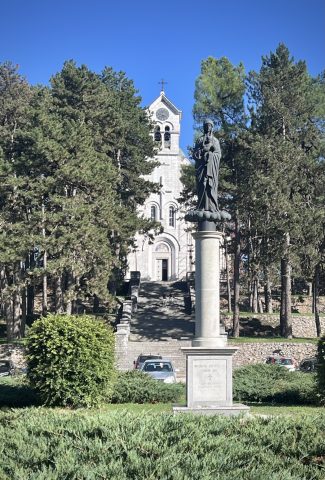
The church was built in the 19th century, a period when Montenegro was redefining itself after centuries of Ottoman rule. Nikšić, situated in the heart of the country, had long been a crossroads—first as a medieval Serbian principality, later as a fortified outpost under the Ottomans. When the church was constructed, Montenegro was emerging as an independent nation, and places like this became symbols of that new identity. The building itself is modest, constructed from pale stone that has softened over time into a warm, honeyed hue. Its facade is simple, marked only by a few shallow carvings and narrow windows, while the entrance is framed by a small portico supported by two columns. Inside, the space is intimate, with a low vaulted ceiling and an iconostasis of dark wood, its icons flickering in the light of oil lamps. The atmosphere is one of quiet reverence, as if the outside world moves at a different pace here.
For the people of Nikšić, the Church of Saints Peter and Paul is more than just a historical landmark. It’s a place where life’s most significant moments unfold—baptisms, weddings, funerals. On feast days, the church fills with the sound of chanting and the scent of incense, drawing not only the devout but also those who simply want to connect with the traditions of their community. The most important celebration is Petrovdan, the church’s patronal feast, when the streets around the building come alive with visitors. It’s a day when the past and present intersect, when the rituals of faith become a thread linking generations.
Just beyond the church lies an old cemetery, its gravestones telling the story of the city in their own way. Some are weathered and barely legible, their inscriptions worn smooth by time, while others are newer, adorned with photographs and personal mementos. Walking among them, you can trace the evolution of Nikšić—the names that were common in different eras, the professions that once defined the town, the families who have lived here for decades. There’s no sense of melancholy in this place, only a quiet acknowledgment of continuity, of lives lived and memories preserved.
Nearby, a small park offers a peaceful retreat from the city’s busier areas. Shaded by plane trees, it’s a favorite spot for locals to stroll, read, or simply sit and listen to the birds. The paths are well-kept, winding between benches and a modest playground, and in the summer, the cool shade provides relief from the heat. Occasionally, the park hosts small gatherings—a market, a concert—and then the atmosphere shifts, becoming livelier without losing its sense of calm.
What makes the Church of Saints Peter and Paul special isn’t its size or its architectural splendor, but the way it remains a living part of Nikšić’s daily rhythm. It doesn’t demand attention, yet those who visit often leave with a sense of having touched something real. In a world where so much is curated for effect, places like this offer a different kind of experience—one rooted in simplicity, in the unbroken thread of history and community.
If you find yourself in Nikšić, it’s worth taking a detour to this quiet corner of the city. You don’t need to be religious to appreciate its atmosphere; just standing in the doorway, listening to the silence and looking at the walls that have witnessed so many lives, can be enough. It’s a reminder that history isn’t just about grand events or famous figures, but about the ordinary people who shaped it—and the places that still hold their stories.