Uzhhorod’s Cathedral of the Holy Cross stands quietly at the heart of the city, a place where history and daily life intersect without fanfare. Built in the late 17th century, it was originally a Jesuit church, part of a broader effort by the order to establish a presence in the region. The Jesuits arrived in Uzhhorod in 1646, and their influence shaped not just the religious landscape but also education and culture in what was then a small but strategically important town. The church they built was modest in scale but carried the distinct marks of Baroque architecture, a style that had begun to spread across Europe, blending grandeur with emotional intensity.
Over the centuries, the building has seen its share of changes. When the Jesuit order was suppressed in the 18th century, the church passed into the hands of the Greek Catholic community, which adapted it to its own liturgical traditions. This transition wasn’t just administrative; it reflected the shifting religious and political currents of the region. Uzhhorod, after all, has long been a crossroads—geographically, culturally, and confessionally. The cathedral’s walls have absorbed these layers, bearing silent witness to the ebb and flow of empires, wars, and local identities.
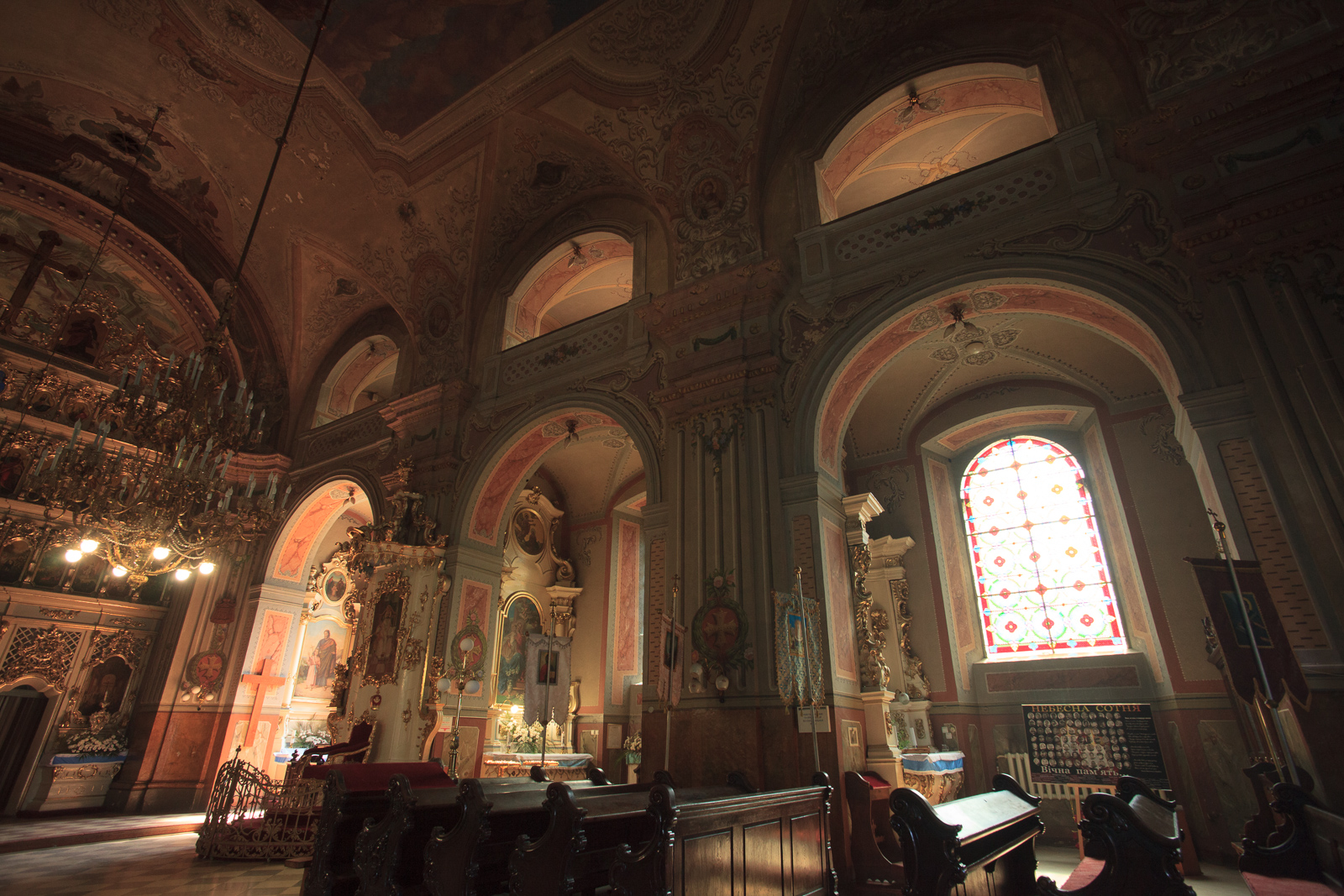
The architecture of the cathedral is a study in contrasts. The exterior is restrained, with a simple facade that doesn’t immediately announce its significance. The twin towers, added later, rise symmetrically, framing the entrance in a way that feels both welcoming and solemn. Inside, however, the space opens up into something more elaborate. The high vaulted ceilings, the play of light through the tall windows, and the intricate iconostasis—installed when the church became Greek Catholic—create an atmosphere that is at once intimate and awe-inspiring. The iconostasis itself is a masterpiece of woodcarving, its icons arranged in tiers that tell a story of faith and tradition.
What makes the cathedral particularly interesting is how it embodies the region’s complex religious history. The Greek Catholic Church, which emerged from the Union of Brest in 1596, sought to bridge Eastern and Western Christian traditions. In Uzhhorod, this meant blending Byzantine liturgy with elements of Latin rite, a synthesis that is still visible today. The cathedral’s interior, for instance, retains the Baroque altars from its Jesuit past, while the iconostasis and the use of Church Slavonic in services reflect its later Greek Catholic identity. This duality isn’t just historical trivia; it’s part of the living fabric of the place.
Beyond its religious significance, the cathedral has also played a role in the civic life of Uzhhorod. In the 19th century, it became a center for the Ruthenian national revival, a movement that sought to preserve and promote the cultural identity of the local Slavic population. Intellectuals, clergy, and ordinary people gathered here not just for worship but for discussions about language, literature, and the future of the region. The cathedral’s library, though no longer accessible to the public, was once a repository of rare manuscripts and books, some of which dated back to the Jesuit period. These texts were more than just religious artifacts; they were tools for preserving a culture that had often been overshadowed by larger powers.
Today, the Cathedral of the Holy Cross is still an active place of worship, but it also draws visitors who come for reasons beyond faith. Some are interested in its architectural details, others in its historical layers. The building itself has aged gracefully, its stone and plaster bearing the patina of time. The square in front of it is often quiet, with a few benches where locals sit in the shade of chestnut trees. On Sundays, the sound of bells spills out into the streets, mingling with the hum of the city. There’s no grand spectacle here, no tourist crowds—just a sense of continuity, of a place that has endured by adapting, not by resisting change.
For those who take the time to look closely, the cathedral offers more than just a glimpse into the past. It’s a reminder of how faith, culture, and identity are intertwined, how a single building can hold within its walls the stories of countless lives. The icons on the iconostasis, darkened by centuries of candle smoke, still gaze out with a quiet intensity. The wooden pews, worn smooth by generations of worshippers, invite you to sit and reflect. Even the air inside feels different—cooler in summer, warmer in winter, as if the building itself breathes.
Uzhhorod is a city that doesn’t always reveal itself immediately. It’s easy to pass through without noticing the details, the small things that make it unique. The Cathedral of the Holy Cross is one of those details. It doesn’t demand attention, but if you pause, if you let yourself be drawn in, it has a way of making the past feel present. Whether you come for the history, the architecture, or simply to sit in silence, the cathedral offers a space where time seems to slow down, where the weight of centuries is felt not as a burden, but as a kind of quiet companionship.