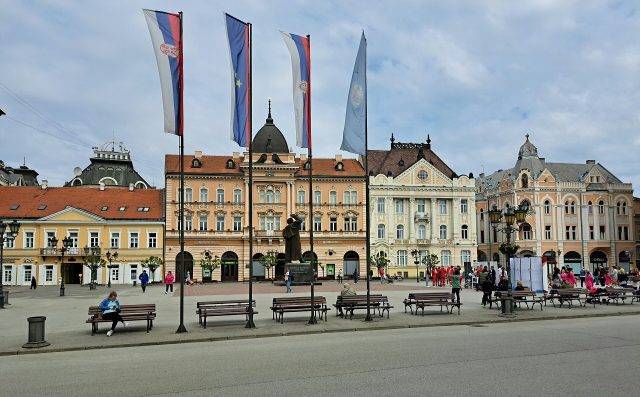
St. George’s Cathedral doesn’t announce itself at first glance. It stands on Republic Square, framed by low, pastel-hued buildings of Austro-Hungarian architecture. The facade gives little away, but step inside, and its history becomes clear.
The cathedral’s story begins in the mid-18th century, when Novi Sad was part of the Habsburg Monarchy. The first church here was wooden, replaced by a stone structure in 1740, though that building didn’t survive the fire of 1849. The current cathedral was built in the 1860s, designed by architect Georg Molnar, and has stood as a witness to the city’s changes. Novi Sad was then a cultural and religious hub for the Serbian community, and St. George’s was a gathering place for ideas and debates.
The architecture merges Baroque and Neoclassical elements. The facade has pilasters and a triangular pediment, while the clock tower above the entrance has marked time for over a century and a half. Inside, high vaulted ceilings are supported by slender columns. The 19th-century iconostasis features woodwork and gilding, reflecting Orthodox tradition.
St. George’s has always been more than a religious site. In the 19th century, Novi Sad was at the heart of the Serbian national revival. The cathedral hosted lectures and debates about Serbian culture and autonomy within the Habsburg Empire. After World War I, when Novi Sad became part of Yugoslavia, it remained a spiritual anchor for the city.
Today, the cathedral is part of Novi Sad’s daily life. Services, weddings, and baptisms fill its schedule. On holidays like Easter and Christmas, candlelight, flowers, and chants fill the space. On ordinary days, it offers quiet—flickering candles, the scent of incense, the rustle of prayer books. Locals stop by to sit in stillness.
Republic Square around the cathedral is lively. Street musicians, artists, and families gather under the plane trees. In summer, festivals and concerts take place; in winter, a Christmas tree stands tall. The cathedral watches over it all.
For visitors, St. George’s is a window into Serbia’s history. The cathedral holds relics from the Habsburg era, and a small museum on-site explains its past. But the real draw is the atmosphere—a thread connecting the present to those who came before.
Novi Sad has been called the Serbian Athens. The city has always been a crossroads of ideas, and the cathedral embodies that spirit. It doesn’t overwhelm; it invites conversation—with history, with faith, with quiet thoughts. People keep coming back because it endures.