Novi Sad’s Freedom Square is the kind of place that feels like it has always been here, even though its story is far from static. Tucked in the heart of the city, it serves as a quiet witness to the ebb and flow of daily life, where the past and present coexist without much fuss. The square isn’t grand in the way some European plazas are—no towering monuments or sweeping vistas—but it has a warmth that comes from being lived in, not just looked at. Locals cross it on their way to work, students linger under the trees with coffee, and in the evenings, the hum of conversation spills out from the cafés lining its edges.
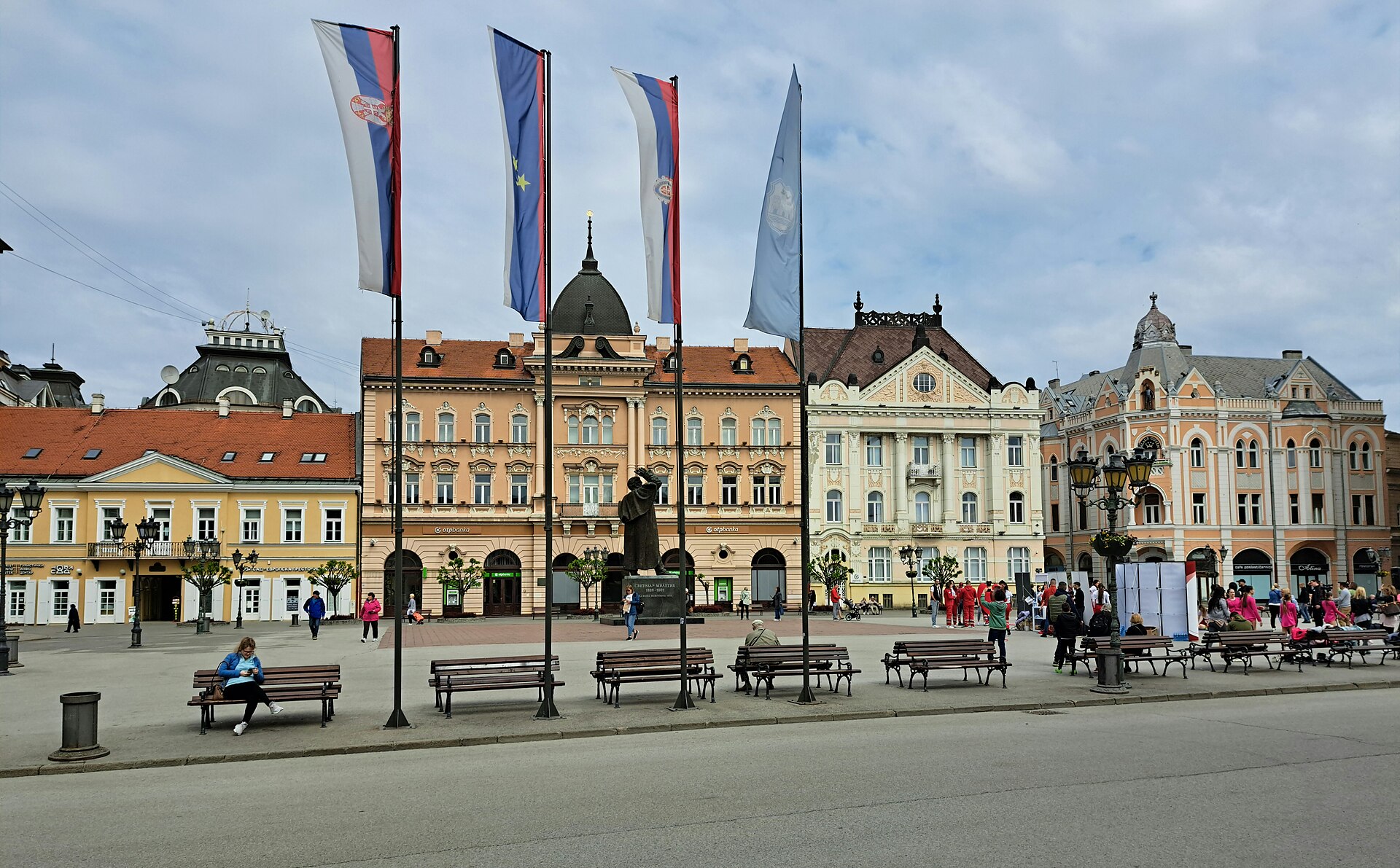
The square’s layout is simple, almost unassuming. A wide pedestrian space stretches between rows of low-rise buildings, their facades a mix of 19th-century elegance and more modest, functional designs. The architecture here tells a story of Novi Sad’s layered history. Some structures bear the marks of the Austro-Hungarian era, with ornate balconies and pastel hues that hint at a time when the city was part of a vast empire. Others are plainer, built during the socialist period, when practicality often took precedence over ornamentation. The result is a space that feels authentic rather than curated, where the buildings don’t compete for attention but instead create a harmonious backdrop for the life unfolding around them.
At the center of the square stands a statue of Svetozar Miletić, a figure who looms large in Novi Sad’s collective memory. Miletić was a 19th-century politician and lawyer, a champion of Serbian rights within the Austro-Hungarian Empire, and a man whose ideas helped shape the city’s identity. The statue itself is unpretentious—a bronze figure on a stone pedestal, more about presence than grandeur. It’s not the kind of monument that demands reverence, but it does invite curiosity. Who was this man, and why does he still matter? For those who take the time to look, the answer lies in the way the city has carried his legacy forward, not through grand gestures, but in the quiet resilience of its people.
Freedom Square isn’t just a historical landmark; it’s a living part of Novi Sad’s rhythm. In the mornings, the square is a thoroughfare, with people hurrying to the nearby market or the city’s administrative buildings. By midday, the pace slows. Office workers take their lunch breaks on the benches, and the scent of grilled pljeskavica drifts from the small eateries tucked into the side streets. In the summer, the square transforms into an open-air gathering spot. Children chase each other around the statue, while older residents sit in the shade, watching the world go by. There’s no schedule to this, no grand events—just the steady, unscripted flow of life.
The square’s edges are where the energy really gathers. Cafés and small shops spill out onto the pavement, their tables and chairs arranged in a way that blurs the line between public and private space. This is where Novi Sad’s social life thrives. Friends meet for coffee, debates about politics or football unfold over espresso, and strangers strike up conversations simply because the setting makes it easy. The cafés here aren’t the kind with polished interiors and overpriced drinks; they’re unassuming, the kind of places where a cup of coffee can stretch into an hour of conversation without anyone minding. It’s this informality that gives Freedom Square its character—it’s a place where people feel at home, even if they’re just passing through.
Beyond its social role, the square has also been a stage for Novi Sad’s more turbulent moments. During the 1999 NATO bombing, the city was hit hard, and Freedom Square, like much of Novi Sad, bore the scars. The buildings around it were damaged, and for a time, the square was a symbol of resilience as much as it was a gathering place. Today, the repairs are seamless, but the memory lingers in the way the city carries itself—not with defiance, but with a quiet determination to move forward. This duality is part of what makes the square special. It’s a place that has seen history unfold, yet it remains firmly rooted in the present.
For visitors, Freedom Square offers a glimpse into the soul of Novi Sad. It’s not the kind of place you come to for a checklist of sights, but rather for the atmosphere—the way the light hits the buildings in the late afternoon, the sound of laughter from a nearby café, the sense of being in a city that’s both proud of its past and comfortable in its own skin. There’s no need to rush here. The best way to experience it is to find a bench, order a coffee, and watch the day unfold. Whether it’s the first time you’ve set foot in Novi Sad or the tenth, the square has a way of making you feel like you’ve always been part of its story.