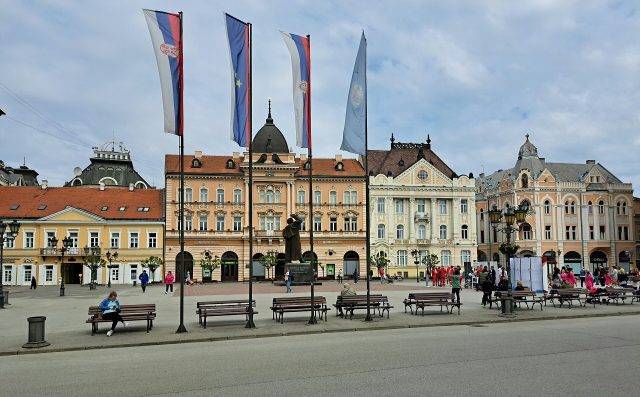
Novi Sad’s National Theatre of Serbia, named after Jovan Sterija Popović, is one of those places where history feels alive—not in the way of dusty exhibits or frozen monuments, but through the quiet persistence of art that has outlasted empires, wars, and shifting borders. The theatre stands near the center of the city, its neoclassical façade a familiar sight to anyone wandering the streets of Novi Sad. It doesn’t dominate the skyline like some grand opera house, but its presence is unmistakable, a reminder that culture here has always been more than just entertainment; it’s been a form of resilience.
The building itself is a product of the late 19th century, a time when Novi Sad was part of the Austro-Hungarian Empire and a thriving cultural hub for Serbs, Hungarians, and other communities living along the Danube. The original theatre was constructed in 1861, but the current structure dates back to 1981, after a fire destroyed its predecessor. The reconstruction preserved the essence of the old design while adapting it to modern needs. The result is a space that feels both timeless and functional, with a grand auditorium that still carries the echoes of performances past. The exterior, with its columns and arched windows, might look modest compared to the opulence of Vienna’s or Budapest’s theatres, but that only adds to its charm—it feels like a place built for people, not for show.
Jovan Sterija Popović, the playwright after whom the theatre is named, was a key figure in 19th-century Serbian literature. His works, often satirical and deeply human, laid the groundwork for modern Serbian drama. Naming the theatre after him wasn’t just an honor; it was a statement. Sterija’s plays tackled social issues, hypocrisy, and the struggles of ordinary people, themes that still resonate today. The theatre continues this tradition, staging not only classic Serbian works but also contemporary plays, operas, and ballets that reflect the country’s evolving identity. It’s not uncommon to see productions that blend traditional Serbian storytelling with modern experimental techniques, a testament to the theatre’s role as both a guardian of heritage and a laboratory for new ideas.
Walking into the theatre, you notice how the space balances intimacy and grandeur. The main auditorium, with its red velvet seats and ornate ceiling, can hold around 700 people, but it rarely feels overwhelming. The acoustics are warm, the sightlines good from almost any seat, and the atmosphere is one of quiet anticipation before the lights dim. The stage has seen everything from Shakespeare to Serbian folk tales, from Verdi to local playwrights whose names might not be known outside the region but whose stories are deeply felt here. The theatre also hosts the annual Sterijino Pozorje festival, one of the most important theatre events in the Balkans, drawing artists and audiences from across the region.
Beyond the main stage, the theatre is a living institution. It runs workshops, educational programs, and collaborations with local schools, ensuring that the next generation of actors, directors, and playwrights has a place to learn and experiment. The building itself is a bit of a maze, with rehearsal rooms, costume workshops, and archives tucked away behind the scenes. For those who take a backstage tour, it’s a chance to see the less glamorous but essential work that goes into every production—the seamstresses stitching costumes, the technicians adjusting lights, the actors running lines in empty rooms. It’s a reminder that theatre isn’t just about the final performance; it’s about the countless small acts of creation that happen long before the curtain rises.
Novi Sad has always been a city of layers. It’s been Serbian, Hungarian, Yugoslav, and now part of an independent Serbia, each era leaving its mark on the streets, the architecture, and the people. The National Theatre is one of those places where those layers are most visible. It’s not just a building; it’s a thread connecting the past to the present. On any given night, you might find an elderly couple who remember seeing their first play here decades ago sitting next to a group of students experiencing live theatre for the first time. The performances themselves often reflect this mix of old and new—classic works reimagined, contemporary pieces that grapple with modern Serbia, or even experimental collaborations that push the boundaries of what theatre can be.
The theatre’s location in Novi Sad also says something about the city itself. Unlike Belgrade, which has always been the political and economic heart of Serbia, Novi Sad has often been seen as the cultural capital—a place where ideas could flourish away from the pressures of power. The theatre embodies that spirit. It’s not trying to compete with the grand stages of Europe; it’s content to be exactly what it is—a place where art is made, shared, and debated. The surrounding streets, with their cafés, bookshops, and galleries, reinforce this sense of a city that values creativity. After a performance, it’s common to see people lingering outside, discussing the play over coffee or a glass of local wine, the Danube flowing quietly in the background.
For visitors, the National Theatre offers more than just a night at the theatre. It’s a window into Serbian culture, a chance to see how a country with a complex history uses art to make sense of itself. The plays might be in Serbian, but the emotions—the laughter, the tension, the moments of quiet reflection—are universal. Even if you don’t understand the language, the experience of sitting in that auditorium, surrounded by an audience that cares deeply about what’s happening on stage, is its own kind of understanding. And if you’re lucky enough to catch a production during Sterijino Pozorje, you’ll see the theatre at its most vibrant, a place where the past and present collide in the best possible way.
There’s something quietly powerful about a theatre that has survived so much. It’s easy to take places like this for granted, to see them as just another stop on a tourist itinerary. But the National Theatre of Serbia is more than that. It’s a living archive, a stage for stories that might otherwise be forgotten, and a gathering place for a community that has learned to value art not as a luxury, but as a necessity. Whether you’re a local or a visitor, stepping into this theatre is a reminder that culture isn’t just something you consume—it’s something you participate in, something that connects you to the people who came before and those who will come after.