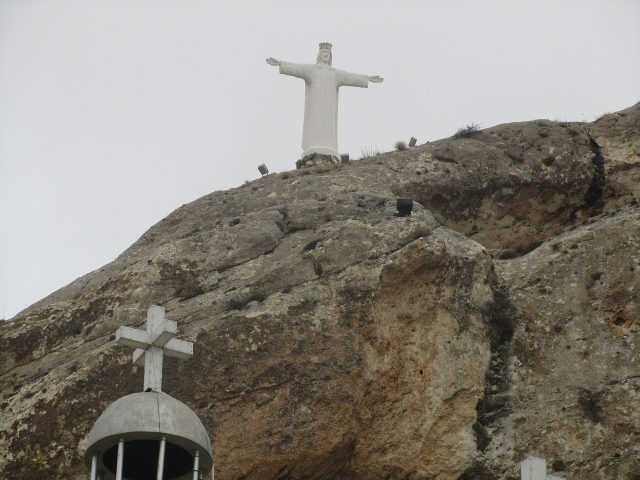
Perched on a hill overlooking Lubango, Nossa Senhora do Monte Cathedral doesn’t demand attention, yet it lingers in the memory long after you’ve left. Its whitewashed walls stand out against the landscape, visible from almost anywhere in the city. Built in the early 20th century, when Lubango was still known as Sá da Bandeira, the cathedral was a spiritual anchor for Portuguese settlers—farmers, traders, and families who had made this highland town their home, far from the metropole. For them, it was more than a place of worship; it was a piece of the familiar in an unfamiliar land.
The architecture is unassuming but striking, a blend of colonial simplicity and local adaptation. The façade is modest, with a triangular pediment above a small portico, while the interior feels spacious and airy, thanks to high wooden ceilings. There’s little ornamentation—just the essentials, with stained glass casting a soft, diffused light that fills the space with quiet warmth. The design reflects the pragmatism of its builders, who brought European traditions to Angola but allowed the environment to shape them.
Dedicated to Our Lady of the Mount, the cathedral’s name carries layers of meaning. The hill it stands on has long been significant. Before the Portuguese arrived, it was a sacred site for the Nhaneca people, who saw it as a place of spiritual connection. The colonizers, in their way, absorbed this reverence, overlaying it with Catholic symbolism. The result is a building that bridges two worlds—one rooted in the land, the other in the faith brought from across the sea.
Inside, the atmosphere is one of quiet devotion. There are no grand altars or gilded decorations, just the raw simplicity of wooden pews, a few understated frescoes, and a small organ. On Sundays, the cathedral comes alive with hymns and prayers, the scent of incense lingering in the air. Even those who don’t share the faith find themselves drawn to the stillness, a rare moment of pause in a city that moves at its own rhythm below.
Lubango is a city of contrasts, and Nossa Senhora do Monte embodies them. It stands as a reminder of Angola’s colonial past, yet it’s far from a relic. After independence in 1975, many churches lost their central role in daily life, but this one endured. It remains a place where people gather for baptisms, weddings, and funerals—a living part of the community, not just a monument to history.
The cathedral is surrounded by a park where locals come to unwind. Children chase each other under the trees, elders sit on benches watching the world go by, and young couples pose for photos against the backdrop of the whitewashed walls. From the hill, the view of Lubango is expansive: red rooftops scattered across the valley, the green slopes of the surrounding mountains, and an endless sky. The best time to visit is at sunset, when the cathedral’s walls glow golden and the city below begins to flicker with lights.
Over the decades, the cathedral has weathered wars, political upheavals, and economic hardships. It has never been grand, but its authenticity is what makes it special. There’s no pretension here, just a quiet resilience that resonates more deeply than any ornate decoration could. If you find yourself in Lubango, the climb up the hill is worth it—not just for the view, but for the sense of place. It doesn’t shout for attention, but it leaves an impression, soft and enduring, like the echo of a prayer in an empty church.