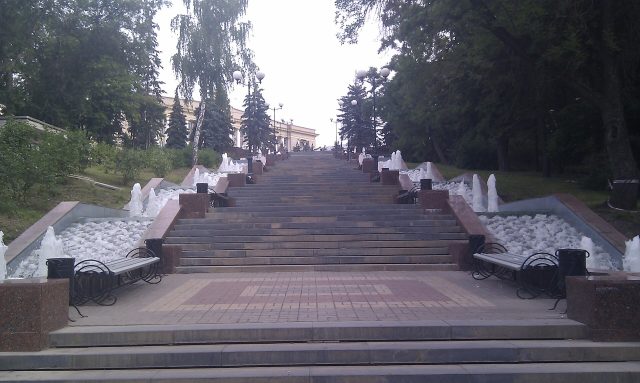
Perched on a quiet hill overlooking Lipetsk, Krasnaya Gorka isn’t the kind of place that demands attention. There are no grand monuments here, no crowds of tourists, no carefully curated experiences—just an unassuming vantage point where the city unfolds beneath you like an old, well-worn map. From this modest elevation, the view stretches across the rooftops of the historic center, the winding Voronezh River, and the industrial outskirts that give Lipetsk its character. On clear days, the horizon blurs into the distance, as if the city itself is dissolving into the sky.
The hill hasn’t always been a place for reflection. In the 18th century, these slopes were part of Lipetsk’s ironworks, one of Russia’s earliest industrial sites. Back then, the land was scarred by mining and smelting, and the hill likely served as a lookout for overseeing operations. When the factories eventually moved on and the city expanded, the area was left to nature, becoming little more than a grassy mound overgrown with weeds. It wasn’t until recent decades that anyone thought to turn it into a public space, though even now, it retains a sense of casual neglect—more of a local secret than a planned attraction.
What makes Krasnaya Gorka special is its lack of pretension. There’s no grand design here, no attempt to impress. A simple wooden platform, a few benches, and a handful of lampposts are all that mark the spot. The absence of fuss is precisely what draws people in. Locals come for the quiet, for the way the wind carries the scent of the river, for the chance to sit and watch the city breathe. In summer, dandelions dot the slopes; in autumn, the trees blaze with color. Winter transforms the hill into a snowy perch, where the lights of Lipetsk below glow like embers in the dark.
The view is the real reason to visit. At sunset, the sky turns soft shades of pink and gold, and the city below takes on a dreamlike quality. The factory chimneys, stark and utilitarian by day, become silhouettes against the fading light, while the river shimmers like a ribbon. At night, the panorama shifts again—the streets, bridges, and buildings light up, creating a sprawling tapestry of flickering dots. It’s the kind of sight that makes you forget, just for a moment, that you’re standing in a city at all.
Krasnaya Gorka isn’t a destination in the traditional sense. There are no signs explaining its history, no guided tours, no souvenir stands. Most people who come here do so almost by accident—on a walk through the nearby park, or while taking a detour from their usual route. The path up the hill is short, winding through trees and past other locals out for a stroll with their dogs or bikes. At the top, there’s always room to sit, even on weekends, when the place is at its busiest.
For Lipetsk, this hill is less a landmark than a part of the city’s rhythm. It’s where people come to pause, to think, or to simply be. There’s no grand narrative here, no attempt to dress up the view with meaning. The city below is just as it is—industrial, quiet, unpolished—and that’s enough. The hill doesn’t try to be anything more than what it is: a place to stand and look out over the world for a little while.
If you ever find yourself in Lipetsk, it’s worth taking the time to climb up here. Bring a thermos of tea, or just stand and listen to the wind. The view might not be the most dramatic you’ve ever seen, but there’s something honest about it. It’s the kind of place that reminds you that cities don’t need to be extraordinary to feel alive—they just need to be real. And sometimes, that’s more than enough.