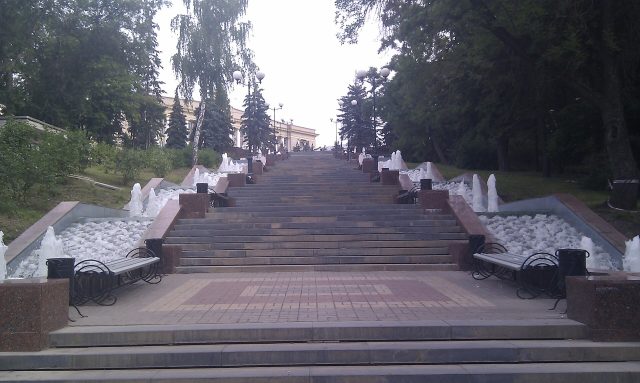
Lower Park in Lipetsk is one of those rare urban spaces where the city’s hustle fades into quiet greenery. Stretching along the banks of the Voronezh River, it occupies the low-lying part of the old town, which is how it got its name. There are no flashy attractions or crowds here—just wide pathways, shaded groves, and calm water reflecting the sky. Over time, the park has become a natural part of the city’s landscape, a place people visit not for entertainment, but simply to be alone with nature.
The history of Lower Park is tied to Lipetsk’s past as a spa town. In the early 19th century, these lands belonged to the Lipetsk Resort, established by decree of Alexander I. Back then, people came to take the mineral waters, and the park served as a promenade for visitors. Though the resort eventually lost its significance, the park remained, evolving into a public space. Some of the old lindens, oaks, and maples planted in those days still stand, though many have been replaced over the years. They carry the memory of a different era, even if the original trees are long gone.
The park’s design is simple but harmonious. The main avenue, paved with tiles and lined with trees, leads from the central entrance down to the riverbank. Benches along the way invite visitors to sit with a book or just watch the park’s quiet life unfold. Near the water, remnants of old granite embankments from the Soviet era still stand. They’ve weathered over time but haven’t lost their charm—in fact, their worn appearance adds a certain character to the place. The river flows lazily by, and from the opposite bank, willow-covered shallows stretch into the distance.
Lower Park isn’t like the meticulously planned urban parks with their manicured lawns and fountains. Instead, it feels more natural, almost wild in places. In summer, the grass grows tall, and in autumn, fallen leaves crunch underfoot. Winter turns the park into a snowy expanse, perfect for a quiet walk, the only sound the soft crunch of snow. But spring is when it’s at its most beautiful—the river swells, flooding the lowlands, and the trees burst into fresh green.
For locals, Lower Park is more than just a place to walk—it’s part of daily life. Families bring their children to ride bikes or fly kites. Retirees gather on benches to chat, while younger crowds set up picnics by the water. On summer evenings, you might hear music—someone strumming a guitar or playing songs from a speaker. The park doesn’t cater to any one group; it welcomes anyone who wants to spend time outdoors.
Despite its unassuming nature, Lower Park plays an important role in the city. It acts as a buffer between the busy streets and the river, softening the urban noise and reminding people that nature is always close by. There are no strict rules here—you can walk on the grass, sit by the water, or even take a dip if the weather allows. In recent years, the park has seen some improvements: new paths, lights, and playgrounds. But these changes have been made carefully, preserving its natural feel.
What makes Lower Park special is its lack of pretension. There are no perfectly trimmed lawns or sculpted bushes, just an authentic sense of place. Here, the city meets nature without artifice, where you can watch the seasons change without distraction. That’s probably why locals love it so much—it doesn’t try to be anything more than what it is.
If you ever find yourself in Lipetsk, it’s worth stopping by for an hour or so. Walk down the main avenue, head to the riverbank, and take a moment to sit by the water. Don’t expect grand sights or entertainment—Lower Park isn’t about that. It’s for those who appreciate quiet, open space, and the chance to be alone with their thoughts and the natural world. In the end, places like this are what make a city feel truly alive.