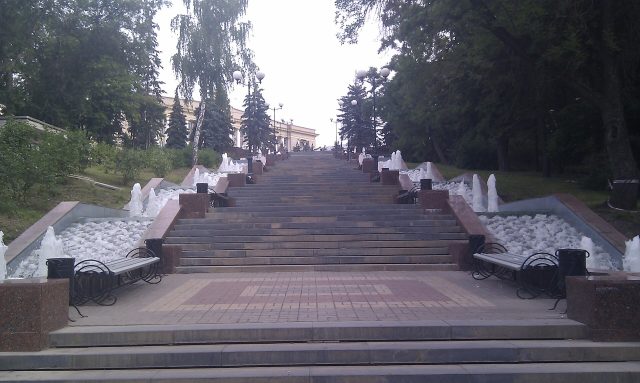
Revolution Square in Lipetsk is one of those places where the city breathes at its own unhurried pace, yet remains deeply woven into its identity. It’s where the main streets converge, almost as if the city’s story begins here—not just in bricks and mortar, but in the lives of the people who pass through. The square doesn’t demand attention with grand gestures; instead, it feels solid and familiar, as though it has always been here, quietly watching Lipetsk evolve around it.
The architecture of Revolution Square tells a story of gradual growth rather than sudden transformation. At its heart stands the regional administration building, constructed in the mid-20th century. Its clean lines and symmetry are classic examples of Soviet monumentalism, yet it doesn’t feel out of place among the surrounding structures. Nearby, a shopping center, a cinema, and residential buildings blend into the scene, creating a sense of warmth despite the scale. There’s a harmony here, an unspoken balance that makes the square feel welcoming—a place where people naturally gather, whether for a stroll or a conversation.
The name Revolution Square carries its own weight. During the Soviet era, it wasn’t just a public space but a stage for celebrations, parades, and rallies. Today, that history lingers in the memories of older residents and in the monuments that remain. The most notable is a small stele dedicated to revolutionaries, erected in the 1970s. It’s modest in size, but its presence serves as a reminder that Lipetsk, though not a city of dramatic upheavals, had its own quiet role in those turbulent times.
Over the decades, the square has grown into more than just a political landmark—it’s now a cultural hub. Throughout the year, it hosts city events: concerts, fairs, and festivals. In summer, flowerbeds brighten the space; in winter, a Christmas tree stands at its center. These traditions give the square a festive air, yet it never feels overly staged. People come here not just for the events but for the everyday moments—sitting on a bench, meeting friends, or simply taking in the atmosphere. In that sense, Revolution Square is a true urban crossroads, where different lives and stories intersect.
The square hasn’t always looked the way it does today. Before the revolution, the area was home to a small market, later replaced by a park with a fountain. In the 1930s, as Lipetsk developed into an industrial center, the first stone buildings appeared. World War II left its mark—bombing in 1941 damaged parts of the square, but by the late 1940s, it had been restored, taking on the form that has largely endured to this day.
Walking around Revolution Square is like stepping into an open-air museum. Look closely, and you’ll find traces of the past in the details: old streetlamps from the Soviet era, building facades where layers of modern renovation reveal hints of earlier designs. Even the paving stones underfoot might carry the weight of generations who have walked here before. These small elements give the square a sense of continuity, a connection to the city’s history that isn’t immediately obvious but feels deeply rooted.
The area around the square is a microcosm of urban life. Shops, cafes, banks, and pharmacies line the streets, making it a practical part of daily routines. This keeps the square from feeling like a relic—it’s alive, evolving alongside the city. Yet it hasn’t lost its historical significance. It remains a place where Lipetsk reflects on its past while moving forward, a quiet anchor in the midst of change.
The square’s character shifts with the time of day. Mornings are quiet, with people hurrying to work as the sun rises over the buildings. By afternoon, it buzzes with activity—children’s laughter, music drifting from cafes, and groups gathering near the fountain. Evenings bring a different kind of energy, as streetlights cast a warm glow over the space. In those moments, the square feels almost like a living room, a shared space where everyone belongs.
Revolution Square isn’t Lipetsk’s most famous landmark, nor does it claim to be the most beautiful. That’s part of its charm. There’s nothing performative about it, just an authenticity that makes it feel like home to those who know it. It’s where the city’s past and present meet, not with fanfare, but with quiet significance. And perhaps that’s why, without any grand titles, it remains the heart of Lipetsk.