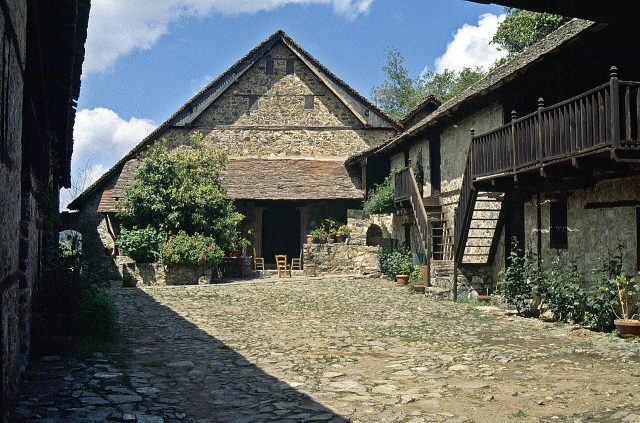
Moutoullas clings to the Troodos Mountains like a secret. At nearly a thousand meters, the village’s stone houses merge with the slopes, their limestone walls darkened by centuries of sun and rain. From the viewpoint, the valley unfolds in layers: roads coil below, hills blur into the Mediterranean haze, and on clear days, the horizon stretches until it feels like the edge of the world.
The village doesn’t announce itself. Its streets are narrow, paved with stones smoothed by decades of footsteps. Houses sag slightly, their wooden shutters warped by winter damp, their balconies tangled with grapevines. There are no crowds, no signs pointing to attractions. The air carries the scent of thyme crushed underfoot, and the only sounds are a dog’s bark or the creak of a door swinging in the wind.
The viewpoint sits where the last houses end. A path winds through olive trees, their gnarled trunks splitting the sunlight, before opening onto a stone terrace. Shepherds once used this spot to watch their flocks. Now, it’s a place to stand and let the wind strip away the noise of elsewhere. No plaque marks the view—just the quiet understanding that some things don’t need explaining.
Dawn turns the valley into a watercolor: mist softens the ridges, and the colors bleed into each other. By noon, the landscape sharpens—the green of the slopes, the brown of the rocks, the white dots of distant houses. Evening arrives slowly, the sky over the sea flaring pink before fading to indigo. Time here doesn’t hurry; it accumulates.
Moutoullas has survived invasions. Byzantine refugees built the first houses, their thick walls a defense against raids. Later, under Frankish and Venetian rule, the village became a stronghold, its isolation its greatest protection. Many of these buildings still stand, their small windows designed to keep out the cold and heat. The stones remember the hands that laid them.
This isn’t the Cyprus of beaches or ruins. Here, the island reveals itself in terraced vineyards, in churches with peeling frescoes, in forests where rare plants grow. The viewpoint isn’t just a place to look—it’s a place to notice. To see how the light changes the color of the rocks, how the wind bends the pines, how the valley breathes.
Winter buries the village in snow. The roads vanish, and Moutoullas becomes an island within an island. Yet the viewpoint remains. The valley below, blanketed in white, looks softer, as if the world has been simplified. Locals who brave the cold bring thermoses, their breath curling in the air as they watch the light shift across the slopes.
Summer here is different from the coast. The heat is dry, the shade of a pine tree deep enough to lose an hour in. Cicadas hum, goat bells clang in the distance, and wildflowers sway in the wind. Sometimes a flock of birds crosses the sky, and for a moment, the terrace feels like part of the landscape, not separate from it.
Moutoullas doesn’t demand attention. There are no grand monuments, no famous landmarks. But it stays with you. Maybe because it offers something rare: a place to stand still. To feel the weight of the stones under your feet, to remember that the world is vast, and that some of its most beautiful corners ask only that you pause and look.