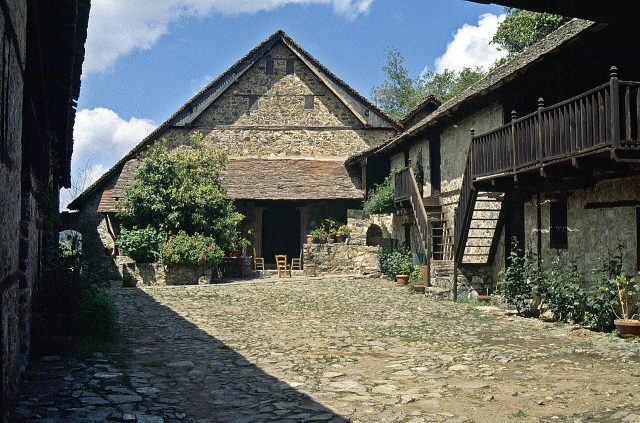
Perched on the slope of a quiet mountain village, Panagia tou Moutoulla feels like a place where time has gently paused. The church is unassuming at first glance, its rough stone walls blending into the surrounding hills, but that very simplicity is what makes it remarkable. Built in the late 13th century, it stands as one of the few surviving examples of Cyprus’s medieval past, a period when the island was a crossroads of cultures, faiths, and artistic traditions.
Inside, the walls come alive with vibrant frescoes, painted in the rich hues of the Byzantine style. These are not mere decorations but stories frozen in pigment—scenes from the life of Christ, the Virgin Mary, and rare glimpses of everyday life from centuries ago. Among the religious figures, you’ll find farmers tending their fields, hunters with bows drawn, and musicians playing instruments long since faded from memory. The artist didn’t just depict the divine; they captured the warmth of human existence, bridging the sacred and the ordinary in a way that feels deeply personal.
The church is dedicated to the Dormition of the Virgin, and its name, Panagia tou Moutoulla, hints at the landscape itself. The word *Moutoulla* likely derives from the Greek for "nose" or "promontory," a nod to the hill’s shape where the village clings. In the Middle Ages, small churches like this one were more than places of worship—they were the heart of rural life. Villagers gathered here for festivals, shared news, and sought solace in difficult times. It was a space where faith and community intertwined, a role it still quietly fulfills today.
The architecture is typical of Cyprus’s mountain churches from that era: a single nave with a steep, tiled roof and a modest apse facing east. The entrance is framed by a simple stone portal, once likely crowned by an icon. Inside, wooden beams support the ceiling, and the uneven stone floor adds to the sense of stepping into a home rather than a grand cathedral. Narrow windows filter the light, casting a soft glow over the frescoes and making the colors shift with the time of day. There’s an intimacy here, a feeling that this was a place built for people, not for spectacle.
One of the most striking frescoes depicts the Last Judgment, a scene filled with movement and emotion. Angels and demons separate the righteous from the damned, their faces twisted in expressions of fear, despair, and hope. Such images weren’t just moral lessons; they were a way to explain complex theological ideas to a largely illiterate population. In an age when books were rare, churches like this one served as "picture Bibles," and the frescoes of Moutoullas are among the most vivid examples of that tradition.
Though remote, Panagia tou Moutoulla was never abandoned. For centuries, the villagers cared for it, and in the 20th century, it caught the attention of art historians and restorers. Today, its frescoes are considered some of the best-preserved on the island, and the church is part of UNESCO’s World Heritage listing for the painted churches of the Troodos region. That recognition isn’t just about art—it’s about preserving a way of life, a connection to the past that still lingers in the quiet of the mountains.
Visiting the church is as much about the journey as the destination. Moutoullas itself is a village where time moves slowly, where narrow lanes wind past houses with wooden balconies and gardens bursting with flowers. In summer, the mountain air keeps the heat at bay, while winter sometimes dusts the hills with snow, turning the landscape into something out of a folktale. The church sits at the edge of the village, reached by a path that meanders through olive groves and vineyards, the scent of wild herbs rising with each step.
From the hill behind the church, the view stretches across the Marathasa Valley, one of Cyprus’s most beautiful. Terraced fields and scattered groves paint a picture of rural life that has changed little over the centuries. In the Middle Ages, this area was known for its monasteries and vineyards, and today, it draws those seeking peace and authenticity. Panagia tou Moutoulla stands as a quiet guardian of this land, a reminder that history doesn’t always need grand monuments to leave its mark. Sometimes, all it takes is a small church on a hillside to reveal the soul of an island.