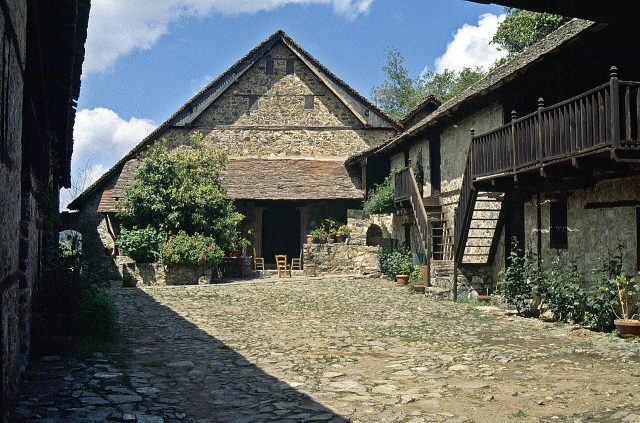
Nestled in the Troodos Mountains, the village of Moutoullas feels like a place where time has quietly settled into the folds of the landscape. The narrow lanes, lined with stone houses topped by terracotta roofs, wind their way through the village without hurry, as if each step has been measured by centuries rather than minutes. The air carries the scent of wild herbs and damp earth, and the only sounds are the rustle of leaves, the distant chime of church bells, and the occasional murmur of voices drifting from a doorway. It’s a world away from the bustle of Cyprus’s coastal resorts, a place where the past isn’t just remembered—it’s still alive.
The Byzantine Museum sits at the heart of this quiet village, housed in a building that once served as part of the local church. The structure itself is a testament to traditional Cypriot architecture, with thick stone walls that keep the interior cool even in the heat of summer, wooden beams that creak underfoot, and small windows that filter the light into soft, golden pools. There’s no grand entrance here, no modern displays or interactive exhibits. Instead, the museum feels like a private collection, carefully preserved and shared with those who take the time to seek it out. The worn floorboards, the faint scent of aged wood, and the way the light falls across the icons all contribute to the sense that you’ve stepped into a space where history hasn’t just been stored—it’s been lived.
The collection spans from the 12th to the 19th century, a period when Cyprus was a crossroads of cultures and faiths. The icons and religious artifacts on display were mostly created by local artists, many of whose names have been lost to time. What remains is their work, a blend of Byzantine traditions and the unique influences of the island. The colors are rich and vibrant, the faces of saints and biblical figures rendered with an intensity that feels almost personal. Some of the icons depict the Virgin Mary in various guises—her expressions shifting from sorrow to tenderness, each one telling a story of devotion and human emotion. The craftsmanship reflects the island’s layered history, where Eastern Orthodox traditions met the artistic currents of the Near East and, later, the Renaissance influences brought by Venetian traders.
One of the most striking pieces in the museum is a fragment of a 12th-century fresco, discovered in an abandoned church in the Troodos Mountains. It depicts Christ Pantocrator, surrounded by angels, a classic Byzantine motif, but the execution is so vivid that the figures seem to hover just beyond the surface of the wall. The fresco bears the marks of time—faded pigments, cracks in the plaster—but these imperfections only deepen its power. Nearby, later icons show the subtle shifts in style that came with new influences, where the rigid lines of Byzantine art begin to soften, hinting at the changes that would sweep through Europe in the centuries to come.
The museum is small, and it’s possible to see everything in an hour, but there’s no need to rush. Each piece demands a moment of stillness, not just for its artistic value, but for what it represents. These icons were more than decorations; they were objects of veneration, carried in processions, kissed by the faithful, and believed to hold protective powers. Some were hidden during invasions, others survived fires or neglect, only to be rediscovered and restored. The quiet of the museum allows these stories to surface, not through grand narratives, but in the details—the worn edges of a frame, the faint traces of candle smoke on a wooden panel.
Moutoullas itself is part of this story. The village sits in a region that became a refuge for iconodules during periods of Byzantine iconoclasm, when the veneration of religious images was banned. In these remote mountains, far from the reach of imperial decrees, small communities kept the traditions alive. Churches and monasteries flourished, and artists working in the area developed a distinct style that would later be recognized as some of the finest examples of Byzantine art. The museum isn’t just a repository of artifacts; it’s a glimpse into a time when faith and creativity were inseparable, when art was a form of worship and every brushstroke carried meaning.
After visiting the museum, the village invites exploration. The streets are empty of crowds, and the only movement comes from the occasional stray cat or an elderly resident tending to a garden. There’s a small church on the outskirts, still in use, where the scent of incense lingers in the air. From the hill above the village, the view stretches across the valley, a patchwork of terraced fields and olive groves. There are no cafes or souvenir shops here, no signs pointing to the next attraction. What Moutoullas offers instead is something rarer: a sense of continuity, a place where the rhythms of life have remained largely unchanged for generations.
The Byzantine Museum isn’t for those looking for entertainment or convenience. There are no guided tours with headsets, no gift shops selling trinkets, no crowds jostling for the best view. What it offers is something quieter, something that lingers long after you’ve left. The icons, with their solemn faces and rich colors, seem to watch over the space, their presence a reminder of the countless hands that have touched them, the prayers that have been whispered before them. The museum doesn’t just preserve history—it lets you feel it, in the stillness of the rooms, in the weight of the centuries that have passed since these works were created.
For those who make the journey to Moutoullas, the reward isn’t just in seeing the art, but in experiencing the atmosphere that surrounds it. It’s a place where the past isn’t distant or abstract, but tangible, almost within reach. The village, the mountains, the museum—all of it exists in a kind of timeless harmony, where the boundaries between then and now blur just enough to let you step into another era, if only for a little while. And perhaps that’s why people return. Not for the spectacle, but for the chance to stand in a place where history hasn’t been packaged or explained, but simply allowed to be.