Perched on the slopes above the village of Madalena, the Miradouro da Madalena is one of those quiet places that feels like a secret, though it’s hardly hidden. It’s just that no one here seems to bother with signs or directions—why would they? The viewpoint is as much a part of the island as the black volcanic earth underfoot or the wind that never really stops. From here, the village unfolds below, a cluster of low houses with roofs the color of rust, their walls built from the same dark stone that paves the streets. Beyond them, the channel stretches toward Faial, its waters shifting between blue and gray depending on the light. On clear days, São Jorge appears in the distance, a long, narrow shadow on the horizon.
Getting here is simple enough. A short walk from the center of Madalena, the path winds upward through narrow lanes where the houses stand close together, their wooden balconies weathered by salt and time. The climb takes no more than ten minutes, but it’s easy to linger. Each turn offers something new—a glimpse of vineyards clinging to the slopes, their vines trained low to the ground in the traditional *currais* style, or a sudden view of the ocean, which always seems closer than it is. The air carries the scent of dry grass and the faint tang of the sea, and if you’re lucky, you might hear the distant clatter of a fishing boat returning to port.
The viewpoint itself is little more than a natural ledge, a flat stretch of packed earth where the hillside levels out just enough to stand and look. There are no benches, no plaques, no vendors selling postcards—just a couple of boulders worn smooth by years of people sitting, watching, thinking. Locals sometimes come here in the evenings with a bottle of wine or a thermos of coffee, settling in to watch the light fade over the water. The wind is almost always strong, tugging at clothes and hair, carrying with it the smell of salt and the occasional cry of a gull. It’s the kind of place where you might stay longer than you intended, not because it’s spectacular, but because it feels right.
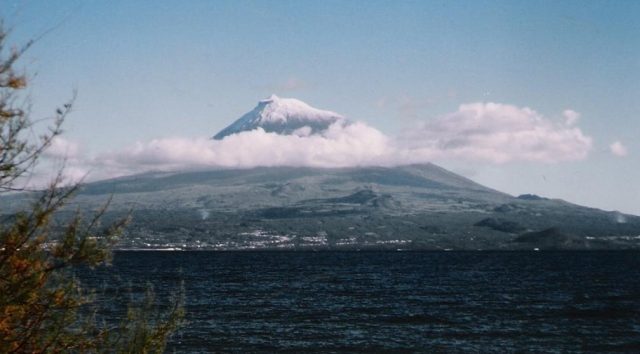
Pico is known for its volcano, of course—the mountain looms over everything, its slopes rising steeply from the sea, its peak often lost in the clouds. But it’s here, at the miradouro, that you begin to understand its scale. The lower slopes are covered in vineyards, their dark soil rich with the minerals that give Pico’s wine its distinctive taste. Higher up, the land grows rougher, the vegetation sparser, until all that remains are jagged rocks and the occasional hardy shrub. The mountain doesn’t dominate the view so much as it defines it, a silent presence that shapes the island in ways both visible and unseen. Local stories say that Pico is a sleeping giant, and from this spot, it’s easy to believe. The idea that it might one day wake, that the islands could shift and change, doesn’t feel like folklore here—it feels like a possibility.
There’s no grand architecture at the miradouro, no carefully designed lookout point meant to impress. That’s not the point. What makes this place special is its ordinariness, the way it fits so seamlessly into the rhythm of life in Madalena. The houses below are built from the same black stone as the walls that crisscross the vineyards, and in the evening, when the lights come on, the village looks like something that grew naturally from the earth rather than something constructed. It’s a place where time moves differently, where the hours aren’t measured by clocks but by the changing light, the tides, the slow turning of the seasons.
For visitors, the miradouro offers a chance to see Pico not as a tourist attraction, but as a living, breathing part of the island. There are no guides here, no interpretive signs explaining the geology of the volcano or the history of the vineyards. There’s just the wind, the sea, and the quiet. If you listen, you can almost hear the echoes of the past—the voices of the farmers who worked these slopes for centuries, the fishermen who set out in small boats to face the Atlantic, the eruptions that reshaped the land in a single night. It’s a place where the island’s history feels tangible, not something confined to museums or guidebooks.
The best times to come are early morning or late evening. In the morning, the sun rises behind Faial, casting long shadows across the water and turning the sea into a sheet of gold. In the evening, the setting sun paints the sky in shades of pink and orange, while the volcano becomes a dark silhouette against the fading light. At these hours, the miradouro is almost always empty, and it’s easy to imagine what the island must have been like before tourism—wild, untamed, a place where the land and the sea set the rules. Pico is a UNESCO World Heritage site now, a destination for wine lovers and hikers, but its spirit hasn’t changed. It’s still a place where nature calls the shots.
This isn’t the kind of spot that will make it onto postcards or into travel brochures. There’s no dramatic viewpoint, no sweeping panorama that takes your breath away. What it offers instead is something quieter, something harder to define. It’s a place where you can sit and watch the world go by, where the wind and the waves and the distant hum of the village create a kind of music. The Azores aren’t about luxury resorts or crowded beaches—they’re about the raw, unfiltered beauty of the Atlantic, about islands that feel like the edge of the world. The Miradouro da Madalena is just one small part of that, but it’s a part that stays with you. It’s not a place you visit to check something off a list; it’s a place you come to understand what the Azores are really about. And maybe, just maybe, that’s why it lingers in your memory long after you’ve left.