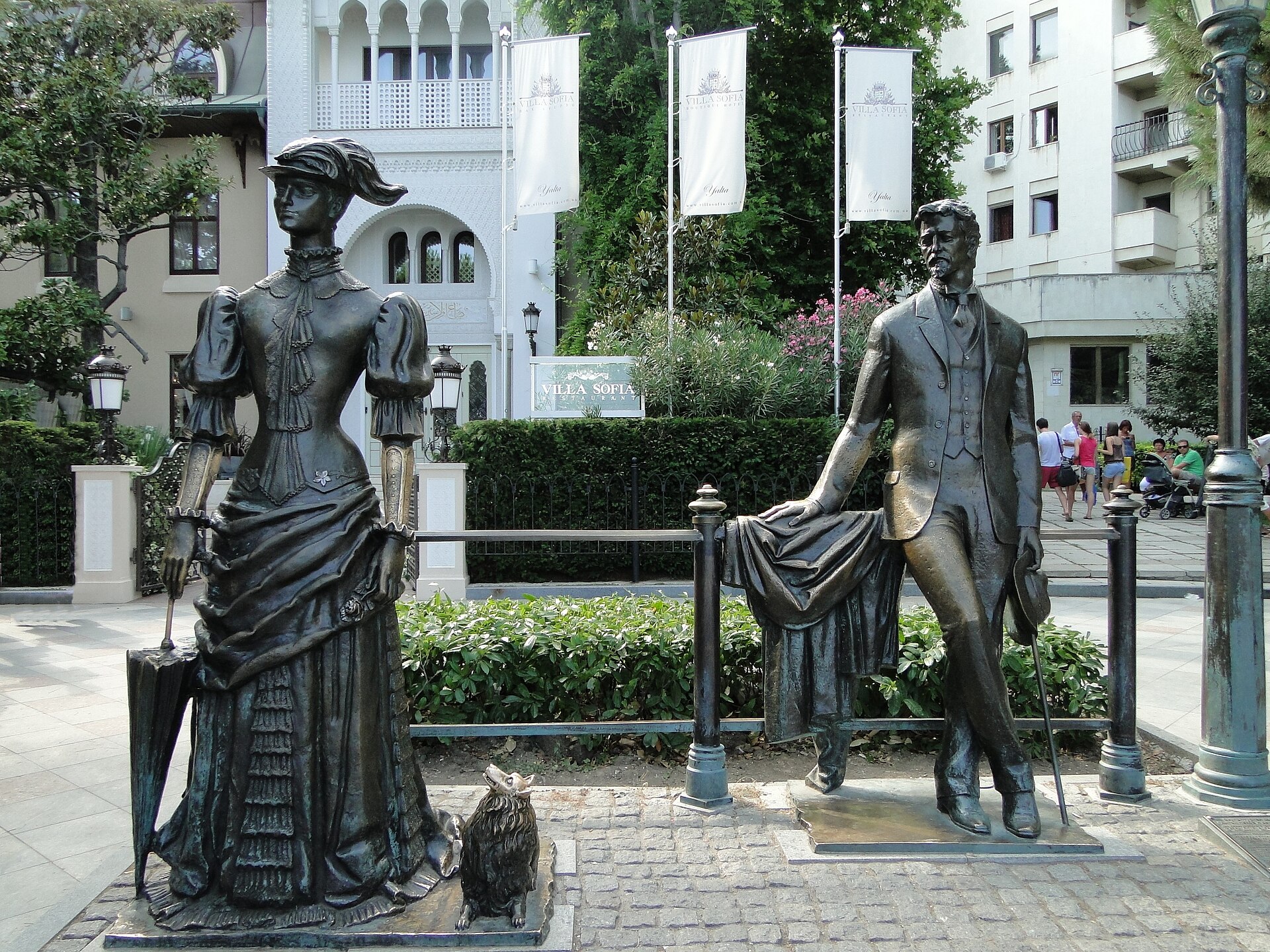
On Yalta’s seafront promenade, where the city meets the Black Sea, a quiet bronze sculpture sits unassumingly on a bench. Anton Chekhov, slightly hunched in his usual suit, shares the space with a woman in a flowing dress, her small dog curled at her feet. There’s no grand gesture here, no demand for attention—just two figures frozen in a moment, as if they’ve always belonged to this place, as much a part of Yalta as the salt in the air or the cry of gulls overhead.
Chekhov came to Yalta in the late 1890s, when tuberculosis had already begun to shape his days. The mild climate, the briny breeze, the way the light softened the edges of the world—all of it offered a kind of refuge from the noise of Moscow. He rented a house in Autka, a quiet neighborhood above the city, where he lived for years, writing plays and stories that would outlast him. Yalta wasn’t just a retreat for him; it was a place where time moved differently, where the sea and the mountains seemed to slow everything down, where even the act of breathing felt deliberate.
The woman beside him isn’t anyone in particular. She’s an echo of *The Lady with the Dog*, one of Chekhov’s most famous stories—a tale of a fleeting love affair that begins almost by accident, like a summer storm, and ends just as suddenly, leaving behind only a quiet ache. Yalta has always been a place for such encounters, a city where people came not just to heal but to lose themselves, if only for a little while. The sculpture doesn’t try to tell the whole story; it just hints at the way love and longing can feel here, how easy it is to get swept up in the moment, how hard it is to leave it behind.
The figures are rendered with understated realism. Chekhov looks like a man who has just returned from a long walk, his posture weary but content. The woman leans back slightly, her dress rippling as if caught in a sea breeze, while the dog gazes off into the distance, alert but at ease. It’s all so natural that you half-expect them to stand up and walk away—Chekhov with a notebook in hand, the woman with her parasol, the dog trotting beside them. But they stay, a still point in a city that has changed around them.
The sculpture was installed in the early 2000s, long after Yalta had transformed from the genteel resort Chekhov knew into something else entirely. Yet it doesn’t try to recreate the past. Instead, it invites you to notice what hasn’t changed—the way the sea still crashes against the shore, the way the mountains still loom over the city, the way people still come here searching for something they can’t quite name. Chekhov and his lady with the dog aren’t a monument in the traditional sense; they’re more like an invitation to sit down, to pause, to see the world through their eyes for a moment.
Unlike many tourist attractions, this one doesn’t draw crowds. There are no lines for photos, no souvenir stands nearby, no signs pointing the way. It exists almost in its own world, noticed only by those who pay attention to the details, who look for something deeper than beaches and restaurants. Maybe that’s why it fits so well here—because it doesn’t demand anything, just waits to be discovered.
There’s always space on the bench beside them. You can sit next to Chekhov, rest your hand on the back of the seat as if he’s an old friend, and watch the waves roll in. Or you can stand beside the woman, feel the lightness of her dress, imagine that you’ve just arrived in this city where anything feels possible. The sculpture doesn’t tell a story so much as it continues one, letting each person find their own meaning in it. For some, it’s a reminder of a story they’ve read; for others, it’s a reflection of their own memories; for a few, it’s just a quiet spot by the sea.
Yalta has changed, but the sea remains the same. Chekhov left long ago, but his characters stayed behind. This sculpture isn’t really a tribute to the writer—it’s a tribute to the emotions he captured. Emotions that don’t fade with time or trends: love, loneliness, hope, the bittersweet weight of a moment that slips away too soon. They’re all here, in the bronze, in the murmur of the waves, in the way people sometimes pause by the bench, as if sitting beside Chekhov and his lady with the dog might help them understand something about themselves.