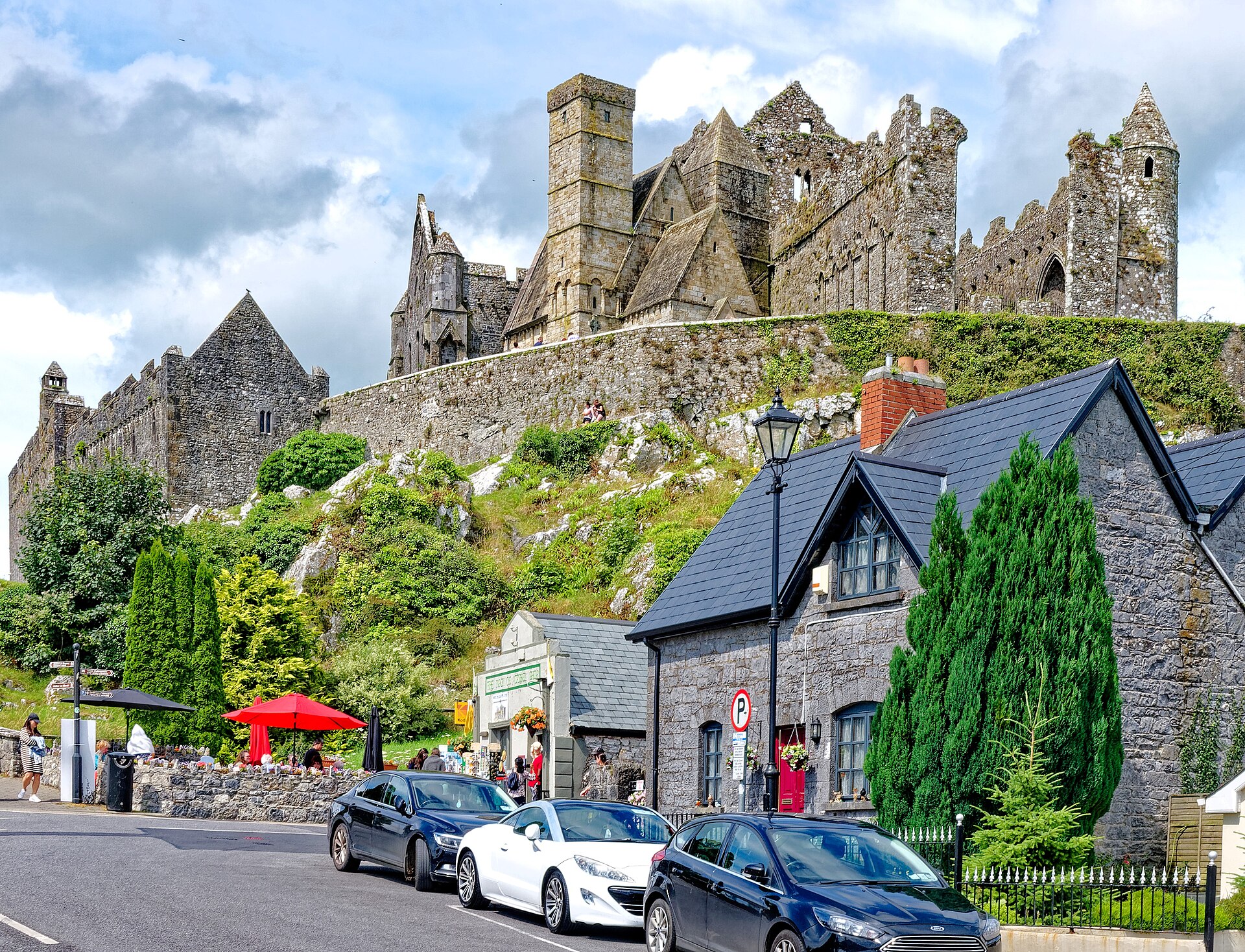
Rock of Cashel rises from the rolling green hills of County Tipperary like a silent sentinel of Ireland’s layered past. It isn’t just a striking geological formation—it’s a place where power, faith, and legend converge, where every stone seems to hum with the weight of centuries. From its heights, the view stretches across patchwork fields and scattered woodlands, the horizon dissolving into mist, as if the landscape itself is reminding you how fleeting human ambitions can be against the march of time.
The first whispers of Cashel appear in the 4th century, when it became a stronghold for the kings of Munster. Local lore claims that St. Patrick himself climbed the rock in the 5th century to baptize the reigning monarch, marking a turning point when Cashel transformed from a seat of political power into a spiritual heartland. By the 12th century, the first stone church had taken root here, later followed by a grand Gothic cathedral, its soaring arches now reduced to weathered ruins. These walls have witnessed the rise and fall of dynasties, the clash of armies, and the slow shift from pagan traditions to Christian devotion.
The architecture of Cashel is a story carved in limestone and mortar. The Round Tower, built in the 12th century, stands as a defiant symbol of early Christian Ireland, its tapered silhouette unmistakable against the sky. Nearby, the ruins of Cormac’s Chapel, with its intricate frescoes and barrel-vaulted ceiling, offer a rare glimpse of Romanesque artistry in Ireland. The most striking relic, though, might be the High Cross of St. Patrick—a 9th-century monument covered in intricate carvings where Celtic knots intertwine with biblical scenes. Each structure here, from the fortress-like bulk of the Hall of the Vicars Choral to the delicate tracery of the cathedral’s windows, reflects the priorities of its time: strength, faith, and the enduring need to leave a mark.
What makes Cashel truly unforgettable, though, is its setting. The rock juts from a broad plain where the wind moves freely, and the sky feels impossibly close. On clear days, the Galtee Mountains loom in the distance, while below, sheep graze lazily on the slopes. The Irish call it *Carraig Phádraig*—Patrick’s Rock—a name that carries both reverence and familiarity. There’s no urban bustle here, just the quiet rhythm of the land: the cry of a hawk, the rustle of grass, the occasional murmur of visitors tracing the same paths trodden by kings and saints.
Today, Cashel is a place where history doesn’t just sit behind glass—it’s something you can touch. The climb to the summit is steep, the steps worn smooth by centuries of footsteps. Inside the ruins, narrow staircases spiral upward, leading to viewpoints that make your breath catch. The roofless cathedral, though open to the elements, still carries the echo of medieval grandeur. At the base of the rock, a small museum holds fragments of the past—coins, tools, and everyday objects that hint at the lives once lived here. But the real draw isn’t the exhibits; it’s the sense of standing where so many pivotal moments unfolded.
Cashel has a way of making history feel tangible. There are no flashy displays or crowds jostling for photos, just the wind, the stones, and the quiet persistence of the past. On rainy days, when mist clings to the ruins, the rock takes on an almost mystical air, as if guarding secrets just out of reach. In sunlight, the lichen-covered walls glow gold, a reminder that some things endure long after the people who built them are gone.
For the Irish, Cashel is more than a landmark—it’s a cornerstone of national identity. This was where kings were crowned, where battles were planned, where the foundations of modern Ireland were laid. Even the nearby town of Clonmel owes its name to the rock; in Irish, it means *the meadow by the limestone cliff*. The influence of Cashel ripples through the region’s culture, language, and traditions, a quiet but unshakable presence.
Visiting Cashel isn’t like stepping into a history book. There are no costumed reenactments or scripted tours, just the raw, unfiltered weight of the past. You can wander among the ruins for hours, tracing the carvings on the crosses or trying to imagine the voices that once filled these spaces. Or you can simply sit on the edge of the rock, looking out over the fields, and feel the sheer scale of time. This is a place that has seen empires rise and fall, that has stood witness to faith and conflict, and yet it remains—unchanged, unyielding, and utterly itself.
Cashel doesn’t need embellishment. Its power lies in its authenticity, in the way it refuses to be anything other than what it is: rugged, majestic, and just a little mysterious. It’s a place where history isn’t confined to the past but lingers in every stone and gust of wind. And perhaps that’s why people keep coming back—not for the spectacle, but for the chance to connect with something real, something that has outlasted kingdoms and will outlast us all.