Navahrudak is one of those Belarusian towns where history lingers in the air, thick with the stories of people who once walked its streets. It’s a place where different cultures, religions, and traditions intertwined over centuries, leaving behind traces that still feel alive today. Among them is the old synagogue at the heart of the town—a building that isn’t just an architectural relic but a quiet witness to the Jewish community that shaped Navahrudak for generations.
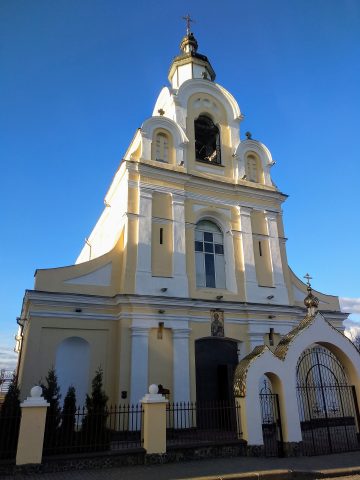
The synagogue dates back to the late 16th century, when the town was part of the Grand Duchy of Lithuania. At the time, Navahrudak was home to one of the largest Jewish populations in the region, and the synagogue served as more than just a house of prayer. It was a gathering place, a center of learning, and a hub of social life. Over the years, the building underwent several reconstructions, yet it retained its distinctive appearance—thick stone walls, tall arched windows, and a fortress-like solidity that hints at an era when synagogues were often built with defense in mind.
The architecture tells a story of survival and adaptation. Originally a wooden structure, it was rebuilt in brick and stone after fires and wars, blending elements from different periods. The facade is simple but striking, with semicircular arches, recessed niches, and subtle decorative details that give it a timeless charm. Inside, the prayer hall once stretched beneath high ceilings supported by columns, with rows of benches lining the walls. Little remains of the original interior today, but the space still carries the weight of history—of voices raised in prayer, of debates over sacred texts, of celebrations and sorrows shared within these walls.
Navahrudak was a center of Jewish scholarship in Eastern Europe, attracting rabbis, philosophers, and poets whose influence extended far beyond the town. The synagogue was more than a religious space; it was a place where ideas were exchanged, where the boundaries between faith and daily life blurred. Even Adam Mickiewicz, the great Polish poet, spent time here in the 19th century. Though not Jewish himself, he drew inspiration from the region’s culture, and it’s said that some of his works reflect the spirit of Navahrudak—perhaps even the echoes of this very synagogue.
Like so many Jewish communities in Belarus, Navahrudak’s was nearly erased during World War II. The town fell under occupation, and most of its Jewish residents perished. The synagogue survived, but its purpose was lost. For decades after the war, it stood empty, used first as a warehouse, then as workshops, and eventually abandoned. Time and neglect took their toll until restoration efforts began in the early 2000s, slowly bringing the building back from ruin.
Today, the synagogue serves as both a monument and a memorial. Inside, visitors can learn about the town’s Jewish history—the lives of its people, the traditions they upheld, and the ways their community evolved over centuries. Occasionally, the space hosts chamber music concerts or exhibitions on Jewish culture, though it no longer functions as a place of worship. Yet even now, the atmosphere feels charged with something intangible, as if the past hasn’t quite faded away.
Walking through Navahrudak, it’s easy to imagine the town as it once was—the murmur of Yiddish in the streets, the clatter of footsteps on cobblestones, the distant sound of prayers drifting from the synagogue. The town remembers all its people, those who left and those who stayed. The synagogue stands as a reminder that history isn’t divided into good or bad, ours or theirs. It simply exists, and it’s up to us to carry it forward.
If you ever find yourself in Navahrudak, take a moment to pause in front of this building. Look closely at its walls, think about the hands that built them, the voices that once filled them. In moments like these, history stops being just a list of dates and facts. It becomes something real, something you can almost touch.