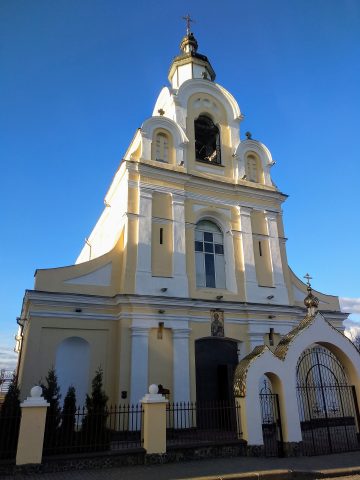
The Church of the Transfiguration of Our Lord in Navahrudak
Navahrudak feels like a town where history hasn’t just been recorded—it’s still happening. The Church of the Transfiguration of Our Lord crowns the hill, the oldest active Catholic church in Belarus. Its walls have seen Navahrudak as the capital of the Grand Duchy of Lithuania, a political center, and a quiet provincial town.
Built in the 14th century, the church has been rebuilt and restored, but its Gothic core remains. The red-brick walls, pointed arches, and buttresses are original. Later, Baroque and Renaissance details were added—delicate gables, decorative flourishes—softening the medieval severity.
Inside, 17th-century frescoes cling to the vaulted ceilings. Their colors have faded, but you can still make out the patterns, the faces, the stories they were meant to tell.
This church wasn’t just a place of worship. It was where Mindaugas, the first Grand Duke of Lithuania, was crowned. Noble families like the Radziwiłłs are buried in the crypt beneath the altar. In the Middle Ages, it was a civic and cultural hub, a place where decisions were made and history was shaped.
The 19th century brought change. Belarus became part of the Russian Empire, and the church was closed. It was used as a warehouse, then converted into an Orthodox church. It wasn’t until the early 20th century that it was returned to the Catholic community. Today, it’s a place of pilgrimage, with services held regularly.
The church stands in the old town, where narrow streets twist past 19th-century houses. Navahrudak is quieter than Minsk or Grodno. There’s no rush here. From the hill, you can see rolling green fields, forests, and distant horizons—a landscape that hasn’t changed much in centuries.
Inside the church, the air is thick with the scent of wax and aged wood. The quiet rustle of prayer books fills the space. It’s a place where you can almost hear the echoes of medieval services, the murmurs of prayers, the voices of preachers long gone.
If you visit, take your time. Walk the old streets. Climb the hill. Stand in the shadow of the church and look out over the landscape. It’s not a place that demands attention—it’s one that earns it, slowly, over time.