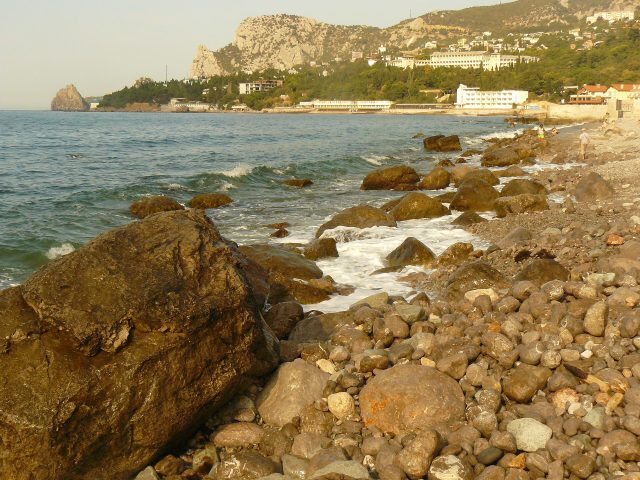
Simeiz Park is one of those rare places where nature and history intertwine so seamlessly that time seems to move at its own pace. Perched on the slopes of Mount Koshka, it cascades down toward the Black Sea, blending the soft Mediterranean climate with lush southern vegetation and the remnants of old estates that once belonged to wealthy landowners. Though small in size, the park’s terrain—steep paths, stone staircases, terraces, and hidden clearings—creates the illusion of boundless space. Every turn reveals a new vista: a rocky cape, the endless sea, or the surrounding mountains, each view more striking than the last.
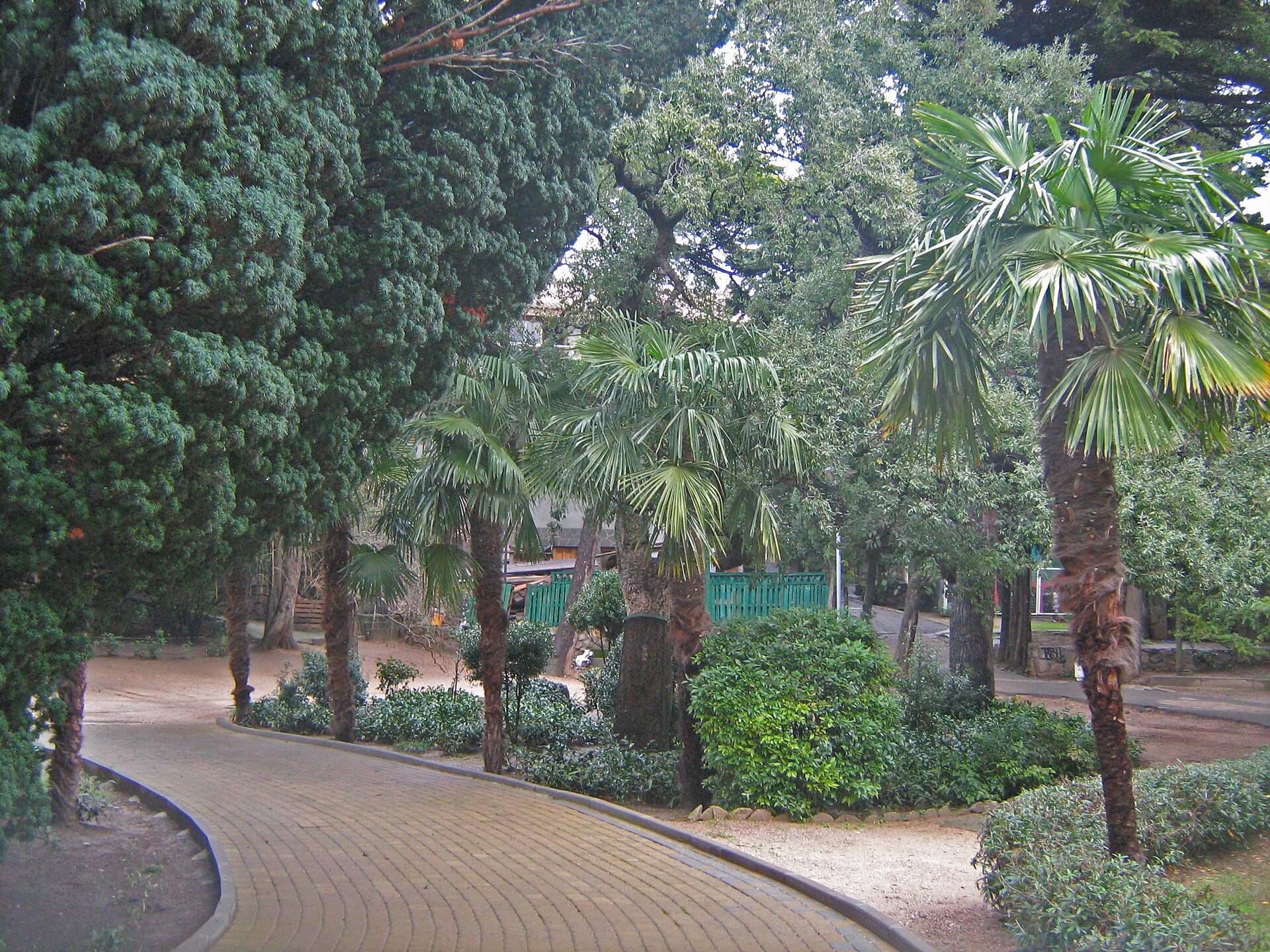
The park’s story begins in the late 19th century, when Ivan Maltsov, a Moscow industrialist, purchased these lands. Determined to transform the wild hillside into a model park, he hired the finest gardeners and landscape architects of his time. Maltsov spared no expense, importing exotic plants from around the world, laying out winding paths, and constructing pavilions and fountains. The selection of flora was particularly meticulous—cypresses, magnolias, palms, pines, and even cork oaks were planted, thriving in the warm Crimean climate. The park was conceived not just as a place for leisurely strolls but as a botanical experiment, testing how southern plants would adapt to the region.
One of the park’s most intriguing features is the observatory, built in 1908. Its location wasn’t accidental—Simeiz was renowned for its clear skies and lack of light pollution, making it ideal for astronomical observations. Though modest in size, the observatory played a significant role in Russian science, hosting renowned astronomers who discovered asteroids and studied the night sky. Today, the building appears somewhat neglected, but its silhouette against the mountains still lends the park a unique charm, a quiet reminder of the scientific activity that once thrived here.
The architecture of Simeiz Park is inseparable from its history. The surviving structures are mostly remnants of the estate complexes built in the early 20th century. Among them, the so-called Small Palace, or Maltsov’s dacha, stands out—a two-story neoclassical building with columns and balconies offering sweeping views of the sea. Nearby lie the ruins of other once-elegant constructions: pavilions, grottoes, and fountains that have succumbed to time. Far from diminishing the park’s appeal, these half-collapsed structures add a touch of romance, inviting visitors to imagine the park in its heyday.
The vegetation here tells its own story. Simeiz Park is home to plants that struggle to survive elsewhere in Crimea: evergreen magnolias, slender Italian stone pines, cork oaks with their thick bark, and a variety of shrubs and flowers brought from distant corners of the world. Spring is especially magical, when magnolias and rhododendrons bloom, filling the air with their sweet fragrance. Summer brings shade and coolness, while autumn paints the foliage in gold and crimson, contrasting with the evergreens. Even in winter, the park doesn’t lose its allure—rare snowfalls transform it into a fairy-tale landscape, where palms and cypresses glisten with frost.
A walk through Simeiz Park is a slow journey through different eras and moods. Narrow paths lead upward to scenic viewpoints or downward to the sea, where small beaches and grottoes hide among the rocks. One of the most popular trails takes visitors to the Divа Rock, a massive stone formation resembling a woman’s silhouette. Legend has it that the rock was named in memory of a girl who leapt into the sea to escape her pursuers. Today, Divа is one of Simeiz’s symbols, and the view of it from the park’s paths lingers in the memory.
The park is deeply tied to the history of Simeiz itself, which in the early 20th century was a fashionable retreat for Russian aristocracy and creative intellectuals. Writers, artists, and scientists came here to relax, and the park served as a place for inspiration and contemplation. After the revolution, the estates were nationalized, and the park gradually fell into disrepair. Soviet-era efforts restored some of the plantings, but many structures remained in ruins. Today, Simeiz Park is less a meticulously maintained attraction and more a place with character, where everyone can find something personal—a quiet corner to rest, a picturesque view for a photograph, or simply a moment of solitude with nature and history.
In recent years, the park has drawn more visitors, yet it remains a refuge from the hustle and bustle. There are no crowds, no noisy attractions, no intrusive services—just the sea, the mountains, the trees, and the silence, broken only by the cries of gulls and the sound of waves. For some, Simeiz Park is a monument to a bygone era; for others, it’s simply a beautiful place for a walk. Either way, it leaves a sense of quiet melancholy and peace, as if reminding us that beauty doesn’t always need to be loud or flashy—it can be subtle, almost unnoticed.