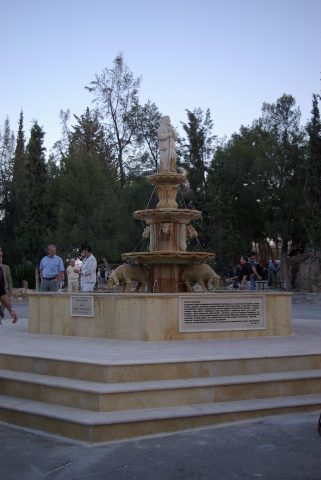
Shepherds’ Field is one of those rare places where history and faith feel almost tangible. Nestled in the quiet town of Beit Sahour, just outside Bethlehem, it carries the weight of an ancient story—one that has shaped the imagination of millions. According to the Gospel of Luke, it was here that angels appeared to shepherds on a hillside, announcing the birth of Jesus. The land itself seems to hold that moment in time, and today, the modest Shepherds’ Field Chapel stands as a quiet witness to a tradition that spans centuries.
The chapel as it exists now is relatively young, built in the mid-20th century, but the reverence for this site goes back much further. Early Christian communities in Palestine already considered it sacred, and by the Byzantine era, small chapels and monasteries had taken root here. The current structure was designed by Antonio Barluzzi, an Italian architect who left his mark across the Holy Land. His vision was to create something that felt organic to the landscape, and the result is a building that seems to rise naturally from the earth, its curves echoing the gentle slopes of the surrounding hills.
Inside, the chapel is simple but rich in symbolism. Its tent-like shape is a nod to the nomadic life of the shepherds who once roamed these fields. Light filters in through small windows near the ceiling, casting a soft glow over the space. The altar is adorned with a mosaic depicting the angelic announcement, while frescoes along the walls tell other biblical stories. The most striking feature is the ceiling, painted to resemble a starry night—a subtle homage to the Star of Bethlehem that guided the Magi.
The land around the chapel has changed little over the centuries. Rolling hills stretch out in every direction, dotted with olive trees and the occasional flock of sheep. Even now, shepherds can be seen tending their animals in the early morning or late afternoon, their voices carrying across the quiet fields. For the people of Beit Sahour, many of whom trace their ancestry back to those biblical shepherds, this place is more than a religious site. It’s a living connection to their past, a reminder of the traditions that have shaped their community.
Visitors come for different reasons. Some arrive as part of a pilgrimage, following in the footsteps of countless others who have sought spiritual meaning here. Others come simply for the peace of the place. Unlike the bustling streets of nearby Bethlehem, Shepherds’ Field offers a sense of stillness. There’s a bench beneath an olive tree where you can sit, listen to the wind, and watch the light shift across the hills. The evenings are especially beautiful, when the setting sun turns the landscape golden and the shadows grow long.
The history of this land is as layered as the region itself. Over the centuries, it has been ruled by empires and kingdoms, yet the memory of that biblical night has endured. In the Middle Ages, Crusaders built a monastery here, though it was later destroyed. Under Ottoman rule, the site fell into disrepair, but local Christians continued to visit, keeping the tradition alive. By the 19th century, European travelers and scholars began to take notice, and Shepherds’ Field slowly regained its significance.
The chapel is open year-round, with no admission fee. Inside, you can light a candle, say a prayer, or just sit in silence. Nearby, a small museum displays artifacts unearthed from the area—fragments of ancient mosaics, pottery, and other remnants of the people who have lived here over the millennia. These objects tell their own quiet stories, adding another layer to the site’s history.
What makes Shepherds’ Field special isn’t just its past, but the way it bridges the sacred and the everyday. It’s a place where the stories of the Bible feel close, where the land itself seems to whisper of ancient times. Whether you come as a pilgrim or a traveler, the experience lingers—not as a grand spectacle, but as something quieter, more personal. There’s a sense of continuity here, a reminder that some things endure even as the world changes around them. And in a landscape that has seen so much, that alone is enough.