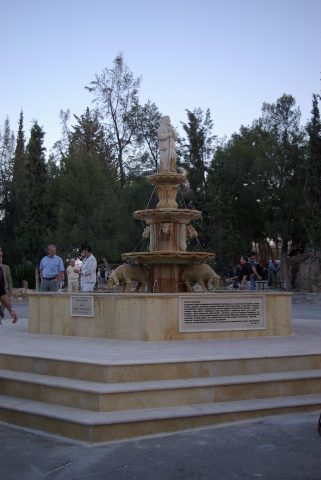
Salamana Monastery sits on a quiet hillside near Beit Sahour, a small town on the West Bank where the air carries the scent of olive trees and the weight of centuries. The land here rolls gently into valleys, its slopes dotted with ancient groves and stone terraces that have shaped the landscape for generations. The monastery itself feels like a place untouched by time, its walls holding stories of Byzantine monks, Ottoman rulers, and the quiet persistence of faith across shifting empires.
The name Salamana comes from a hermit who lived in these hills during the fourth or fifth century. According to tradition, he spent his days in prayer inside a cave, his life defined by solitude and devotion. Over time, others joined him, forming a small monastic community that eventually grew into the modest complex that stands today. The monastery remains active, though far from the bustling center it once was. A handful of monks still live here, tending to the land and their rituals, their days marked by the rhythm of work and worship rather than the demands of the outside world.
The architecture reflects the simplicity of its purpose. Built from local limestone, the buildings have softened over time, their golden hues blending into the hillside. The main church is small, its interior dimly lit by narrow windows, but the walls still bear faint traces of Byzantine frescoes—figures of saints and biblical scenes rendered in earthy tones. The iconostasis, darkened by age, stands as a quiet testament to the hands that crafted it. Nearby, the cave where Salamana once lived has been preserved, its rough stone walls enclosing a tomb that draws pilgrims seeking a moment of reflection.
The monastery is surrounded by gardens where olive and fruit trees grow alongside rows of grapevines. The monks cultivate the land themselves, their labor a continuation of traditions passed down through generations. The air here moves slowly, carrying the sound of wind through leaves and the occasional chime of a bell calling the faithful to prayer. Visitors often find themselves falling into the same unhurried pace, the heat of the day softened by the shade of trees and the coolness of the stone. In winter, when mist clings to the hills, the monastery takes on an even more secluded air, as if the world beyond has faded entirely.
Beit Sahour, the town nearby, is known in Christian tradition as the place where shepherds first heard the news of Christ’s birth. Unlike more tourist-heavy destinations in the region, it retains a quiet authenticity. The streets are narrow, lined with homes and small shops where life unfolds at its own pace. The town’s Christian Arab community has preserved its heritage carefully, maintaining old churches and traditions that feel more lived-in than curated. There are no crowds here, no staged performances for visitors—just the ordinary, enduring presence of a place that has seen countless seasons come and go.
Salamana Monastery isn’t a destination for those seeking spectacle or entertainment. It doesn’t offer grand attractions or polished experiences, but rather something far more subtle: the chance to step into a rhythm older than memory. There are no souvenir stands or guided tours, no noise beyond the occasional murmur of prayer or the rustle of leaves. The monks who live here don’t perform for visitors; they simply carry on as they always have, their lives shaped by devotion rather than expectation. The monastery’s value lies in its refusal to conform to modern demands—it exists as it always has, a quiet witness to the passage of time.
Visiting requires no special preparation, though it does ask for respect. This is a living monastery, not a museum, and the monks appreciate visitors who approach the space with reverence. Modest clothing and quiet behavior are expected, but those who come with genuine curiosity often find the monks welcoming. They might offer tea brewed over an open fire, a small gesture that lingers in memory as much as the ancient frescoes or the view from the hill. These moments of connection—unscripted and unhurried—are part of what makes the place feel real.
The surrounding countryside invites exploration. Narrow paths wind through olive groves and fields where farmers still grow wheat and vegetables as they have for centuries. The landscape is one of dusty roads and sun-baked earth, its colors and contours unchanged from the scenes depicted in ancient texts. Other monasteries and churches dot the distant hills, their presence a reminder of the region’s deep spiritual roots. Walking these trails, it’s easy to imagine that time has paused here, allowing a glimpse of a world untouched by the rush of modernity.
Salamana Monastery is more than a historical site; it’s a place where history breathes. It doesn’t announce itself with fanfare or demand attention, which is precisely why those who find it leave with something deeper than photographs. Here, the past isn’t preserved behind glass—it’s alive in the stones, in the rituals, in the silence that settles over the hills at dusk. For some, it becomes a place to return to, a quiet anchor in a world that moves too quickly. And perhaps that’s the point: some places don’t need to change because they already hold everything that matters.