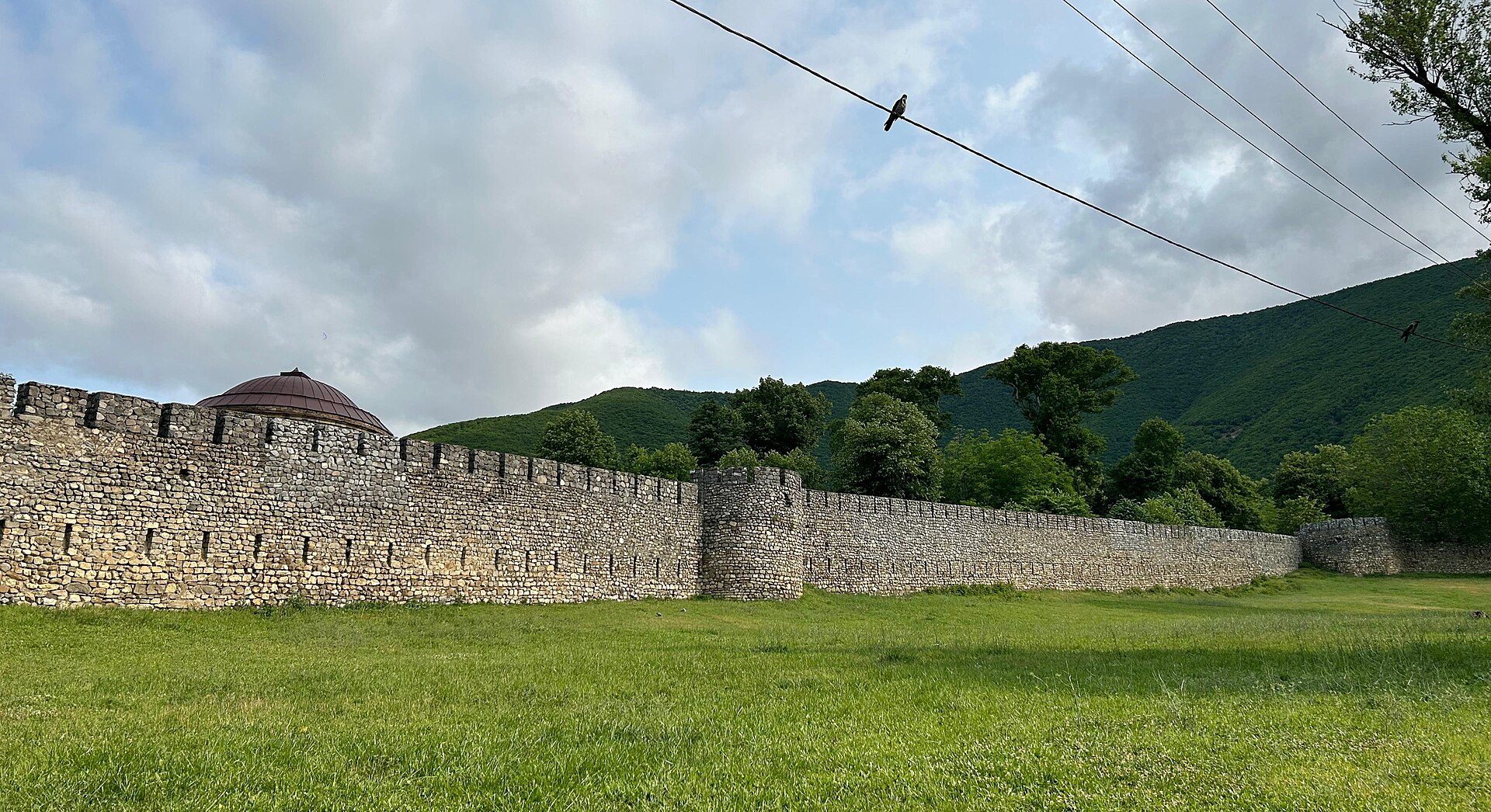
Perched on a gentle hill in the heart of Shaki, the fortress walls rise quietly above the town, as if watching over a place where time moves at its own unhurried pace. Unlike the towering citadels built for war, this structure was never meant to intimidate. Its modest height and unassuming presence tell a different story—one of trade, diplomacy, and the quiet rhythm of daily life that unfolded within its embrace. For centuries, Shaki stood at the crossroads of caravan routes, where merchants from Persia, Russia, and the Ottoman Empire converged to exchange silk, spices, and stories. The fortress was less a shield against invaders and more a silent witness to the ebb and flow of people and goods, a place where power was exercised not through force, but through negotiation and craftsmanship.
The fortress took shape in the 18th century, when Shaki emerged as the capital of its own khanate. Under the rule of Haji Chelebi, who sought to carve out independence from Persian dominance, the walls were raised not as an impenetrable stronghold, but as a residence—a blend of authority and everyday life. Built from sun-dried brick, the material was practical, offering coolness in the scorching summers and warmth during the harsh winters. Yet it was also fragile, demanding constant care. Over time, the elements and history have worn away much of the original structure, leaving behind fragments of walls and towers that once formed the heart of the khans’ living quarters.
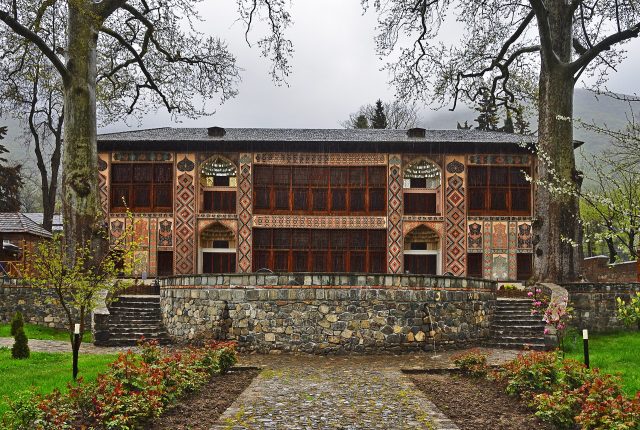
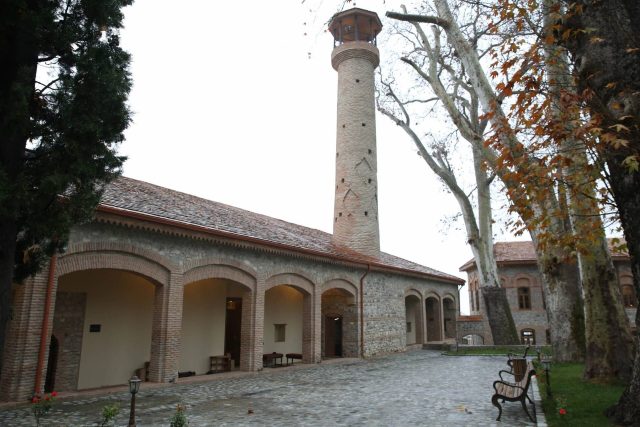
The main gates, facing the town below, open into what was once a bustling inner courtyard. Here, the khan’s palace, a mosque, and a caravanserai once stood, their foundations still visible today. Though little remains of these buildings, their outlines hint at the life that once filled this space—official receptions, whispered deals between merchants, and the hum of artisans at work. The most striking survivor is the Sheki Khan’s Palace, a separate structure that stands as a testament to the fortress’s dual role as both a seat of power and a center of culture. Inside, the walls are adorned with intricate frescoes, their vibrant colors and delicate patterns depicting scenes of hunting and courtly life, offering a glimpse into the tastes and aspirations of the ruling elite.
The architecture of the fortress is unpretentious yet deliberate. The walls, roughly two meters thick, were built for endurance rather than grandeur. The corner towers, though sturdy, served more as lookout points than defensive bastions, offering sweeping views of the town and the surrounding valleys. From here, the khan’s guards could spot approaching caravans or potential threats long before they reached the gates. Interestingly, the fortress never faced a serious siege. Shaki’s strength lay not in its military might but in its position as a trading hub, where rulers often preferred diplomacy over conflict.
Today, walking through the fortress grounds feels like stepping into a living memory. The air carries the weight of centuries—of khans holding court, of merchants haggling over silk and saffron, of craftsmen shaping copper and wood into objects of beauty. The old town sprawls below, its narrow streets lined with mud-brick houses and wooden balconies carved with intricate designs. These homes, still inhabited, lend the place an authenticity that no museum could replicate. Time here doesn’t stand still; it simply moves more slowly, as if reluctant to erase the traces of the past.
The Sheki Fortress is more than just a historical monument; it is a piece of Azerbaijan’s cultural tapestry, woven from the threads of East and West. For centuries, this region has been a meeting point of empires, religions, and traditions, and the fortress stands as a quiet symbol of that convergence. In 2019, Shaki and its khan’s palace were recognized as a UNESCO World Heritage Site, a nod to their global significance. Yet the true value of the fortress lies not in its official status, but in the way it embodies the spirit of the place—a spirit of resilience, adaptability, and the quiet confidence of a town that has always known its worth.
To visit the fortress is to experience Shaki at its most atmospheric. The best time to climb the hill is in the late afternoon, when the setting sun bathes the walls in golden light and stretches the shadows long across the ground. Below, the town stirs to life—voices drift up from the streets, the scent of fresh bread and brewing tea fills the air, and the view from the ramparts reveals a patchwork of rooftops and the lush green slopes of the Caucasus. There are no crowds here, no hurried footsteps, only the sense of stepping into a world that has remained largely unchanged for generations.
What lingers after a visit to the Sheki Fortress is not the grandeur of its architecture or the details of its history, but the feeling of having touched something enduring. It is a place where the past is not confined to textbooks or exhibits, but lives on in the stones, the streets, and the stories of the people who still call this town home. In a world that often feels rushed and disconnected, the fortress offers a rare reminder of what it means to move at the pace of life itself.