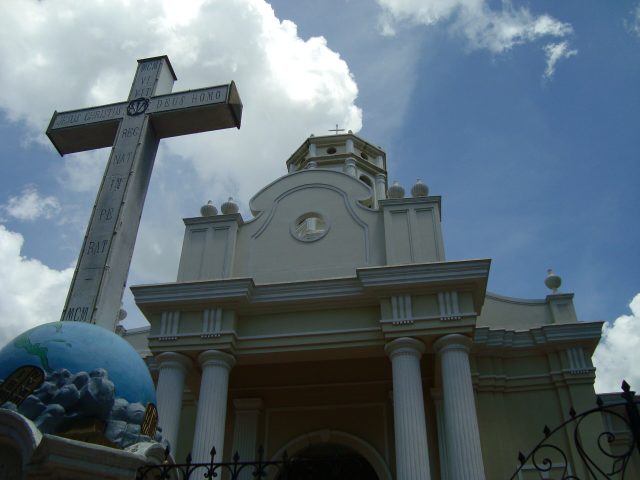
Santa Ana is the kind of city that reveals itself slowly. Most travelers pass through without stopping, but those who linger, even for a day, often find themselves surprised by its quiet charm. Tucked away in the western highlands of El Salvador, it feels like a place where time moves at its own pace—less hurried than the capital, less polished than the tourist hubs along the coast. The streets are lined with low-slung houses, their red-tiled roofs weathered by sun and rain, and the air carries the scent of roasting coffee and fresh tortillas from the morning markets. In the heart of it all stands the Santa Ana Cathedral, a building that doesn’t demand attention but somehow earns it.
The cathedral was built in the mid-1800s, a time when El Salvador had already broken free from Spanish rule but still looked to Europe for inspiration. The architects drew from the Gothic Revival style then popular in France and Germany, yet the final result feels distinctly Salvadoran. The twin towers of the facade are slightly mismatched—one just a little taller than the other—as if the builders refused to sacrifice practicality for perfect symmetry. Inside, the space is airy and bright, despite the heavy columns and soaring vaults. There’s no gilded opulence here, no dramatic chiaroscuro of light and shadow like in the great cathedrals of Spain. Instead, the stained glass casts a soft, diffused glow, depicting not just biblical scenes but local saints and symbols of Salvadoran history.
What makes the cathedral particularly interesting is that it wasn’t built from scratch. The land it occupies once held an older church, dating back to colonial times, but that structure was destroyed in an earthquake in the early 19th century. El Salvador sits on a volatile stretch of the Pacific Ring of Fire, and earthquakes have shaped its architecture as much as its people. The cathedral has been damaged and repaired multiple times over the decades, each restoration subtly altering its character while preserving its essence. Perhaps that’s why it doesn’t feel like a museum piece. There’s a lived-in quality to it, like an old family home that’s been patched and repainted but never stripped of its soul.
The main altar is a study in restrained elegance. Crafted from wood and gilded in places, it lacks the extravagance of some Latin American cathedrals, but its simplicity carries its own weight. Nearby, statues of saints stand in quiet reverence, including one of Archbishop Óscar Romero, a figure deeply revered in El Salvador. Romero was assassinated in 1980 for speaking out against government oppression and advocating for the poor, and his presence here is more than symbolic. For many Salvadorans, the cathedral is not just a place of worship but a sanctuary of hope, especially in times of hardship. On anniversaries of his death and other significant dates, services are held in his memory, and the atmosphere becomes especially moving.
Outside, the cathedral opens onto a small plaza that serves as an extension of its walls. This is where the building truly comes alive. Locals gather here not just for mass but for the rhythms of daily life—chatting on benches, buying snacks from street vendors, or simply watching the world go by. In the shade of the trees, elderly men play chess while children chase pigeons across the pavement. On feast days, the plaza transforms into a stage for concerts and processions, with crowds carrying statues of saints through the streets, their voices rising in song. It’s a reminder that the cathedral isn’t just a monument; it’s a living part of the city.
The architecture of Santa Ana Cathedral reflects a pivotal moment in El Salvador’s history. The 19th century was a time of transition, when the country was shedding its colonial past but hadn’t yet defined its future. The cathedral embodies that uncertainty. It’s neither a relic of Spanish rule nor a fully original creation. Instead, it’s a blend—European influences filtered through local craftsmanship, a building that looks outward and inward at the same time. The result is something uniquely Salvadoran, a quiet testament to a nation still finding its way.
Today, the cathedral remains one of those places that offers a glimpse into the real El Salvador, away from the well-trodden tourist paths. There are no crowds of foreigners here, no souvenir stalls or guided tours. What you’ll find instead is the unvarnished spirit of a provincial city, where history and modernity coexist without fanfare. The cathedral doesn’t try to impress with grandeur; its beauty lies in its unassuming presence. It’s a place where people pray, meet, argue, and celebrate—just as they have for generations.
If you ever find yourself in Santa Ana, the cathedral is worth a visit, not just for its architecture but for the stories it holds. Sit on one of the plaza benches for a while, watch the light change on the stone facade, and listen to the sounds of the city drifting through the open doors. It’s a small window into the life of this corner of El Salvador, a place where the past is never too far from the present.