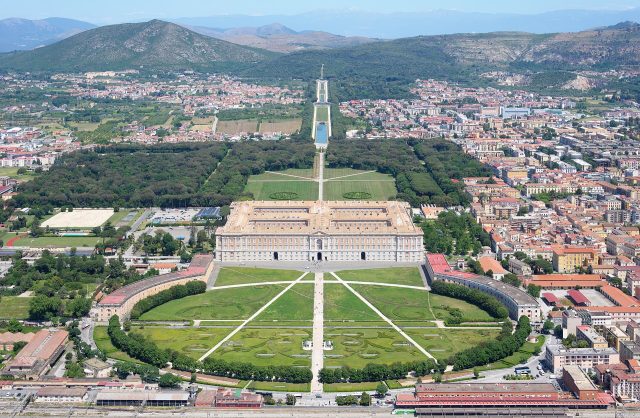
Caserta doesn’t reveal itself at first glance. Tucked away in Campania, an hour and a half from Naples, this city often fades into the background behind its more famous neighbors—Pompeii, the Amalfi Coast, the chaotic streets of Naples itself. Yet here, away from the usual tourist trails, lies one of the most ambitious creations of Italian Baroque: the Royal Palace and its Vanvitelli Gardens. This is a place where architecture and nature merge into a single vision, conceived as a challenge to Europe’s monarchs and a symbol of the power and grandeur of the Neapolitan Bourbons.
The gardens begin just beyond the palace, and the first thing that strikes you is the arrow-straight avenue stretching for nearly a mile into the distance. It feels endless, especially when you stand at the foot of the palace steps and gaze toward the misty outline of the Fountain of Diana and Actaeon. This perspective isn’t just a landscape trick—it’s part of a grand design by architect Luigi Vanvitelli, who in the mid-18th century was tasked by King Charles VII with creating a residence to rival Versailles. The king didn’t just want a palace; he wanted an entire world where every detail reinforced his authority.
Vanvitelli spent nearly two decades on the project, and the result exceeded all expectations. The gardens, covering over 250 acres, are far more than a collection of flowerbeds and fountains. They form an intricate system of terraces, cascades, grottoes, and water channels that descend from the hillside, creating the illusion of a natural landscape. Water is the lifeblood here, flowing through a 25-mile aqueduct built specifically to feed the fountains and pools. Without it, the gardens would be just another park, but thanks to this ingenious engineering, they remain alive, shifting, and murmuring with every step.
A walk through the gardens is a journey through time. It begins at the palace, where broad staircases lead to the first terrace and the modest yet elegant Fountain of Margherita. From there, the path winds past the Fountain of Aeolus, where bronze figures of the winds seem frozen in an eternal dance, and the Fountain of Ceres, surrounded by statues representing the seasons. Each fountain tells its own story, part of a mythological narrative that unfolds as you ascend. The most breathtaking is the Fountain of Diana and Actaeon at the top, where water cascades down like a waterfall, and the statues of the goddess and the hunter—caught by her in the act of spying—echo ancient myths that were as popular in the 18th century as blockbuster films are today.
But the Vanvitelli Gardens aren’t just about fountains. There’s also an English garden, added in the early 19th century when the fashion for formal Baroque gardens had faded. It contrasts sharply with the geometric precision of the main section: winding paths, artificial ruins, a lake with a small island where a tiny villa once stood. This corner of the gardens feels more intimate, almost wild, as if you’ve stumbled into a forest, though the palace is never far away. The English garden reflects a shift in how nature was perceived—not as something to be tamed, but as a space for quiet reflection.
The history of the gardens is intertwined with that of Caserta itself. Once a small town known only for its castle, it became a royal residence after the palace was built, drawing aristocrats, diplomats, and artists. Lavish receptions, hunting parties, and theatrical performances took place here. The gardens weren’t just decoration; they were a stage for politics, where alliances were forged and destinies decided. Today, the grandeur of those days lingers only in echoes, but the atmosphere remains: the hush broken only by the sound of water, the shade of ancient trees, the scent of damp earth and greenery.
Time moves differently in the gardens. There’s no rush, no crowds like those that fill Italy’s more famous landmarks. Even in peak season, you can find a quiet spot to sit on a bench and watch the fountains or stroll the paths without encountering another soul. Perhaps it’s because Caserta still lies off the beaten path, or perhaps because the Vanvitelli Gardens demand time. They can’t be rushed; to truly feel them, you need to wander slowly, revisit familiar spots, watch how the light changes, how the water catches the sun.
Today, the gardens are more than just an architectural monument—they’re a living organism. Water still flows, trees grow, flowers bloom, and the fountains work just as they did 250 years ago. Occasionally, the gardens serve as a film set, with scenes from *Star Wars* and *Angels & Demons* shot here, where grandeur and mystery are required. But even without cameras, the place blurs the line between reality and imagination. Maybe that’s because Vanvitelli’s vision was as bold as any Hollywood script: to create a perfect world where nature and art exist in harmony, and where visitors feel part of something greater.
Caserta and its gardens are a reminder that Italy isn’t just Rome, Florence, or Venice. Off the usual tourist routes, you can find places that impress just as deeply—perhaps even more so, because they haven’t been worn smooth by the gaze of millions. The Vanvitelli Gardens are a place where history is tangible: in the cool touch of marble statues, the murmur of water, the silence suddenly broken by a bird’s call or the distant echo of footsteps. It’s a place that can’t be described in words—it has to be seen, felt, walked from beginning to end, to understand why, two and a half centuries ago, one man decided to create his own paradise here.