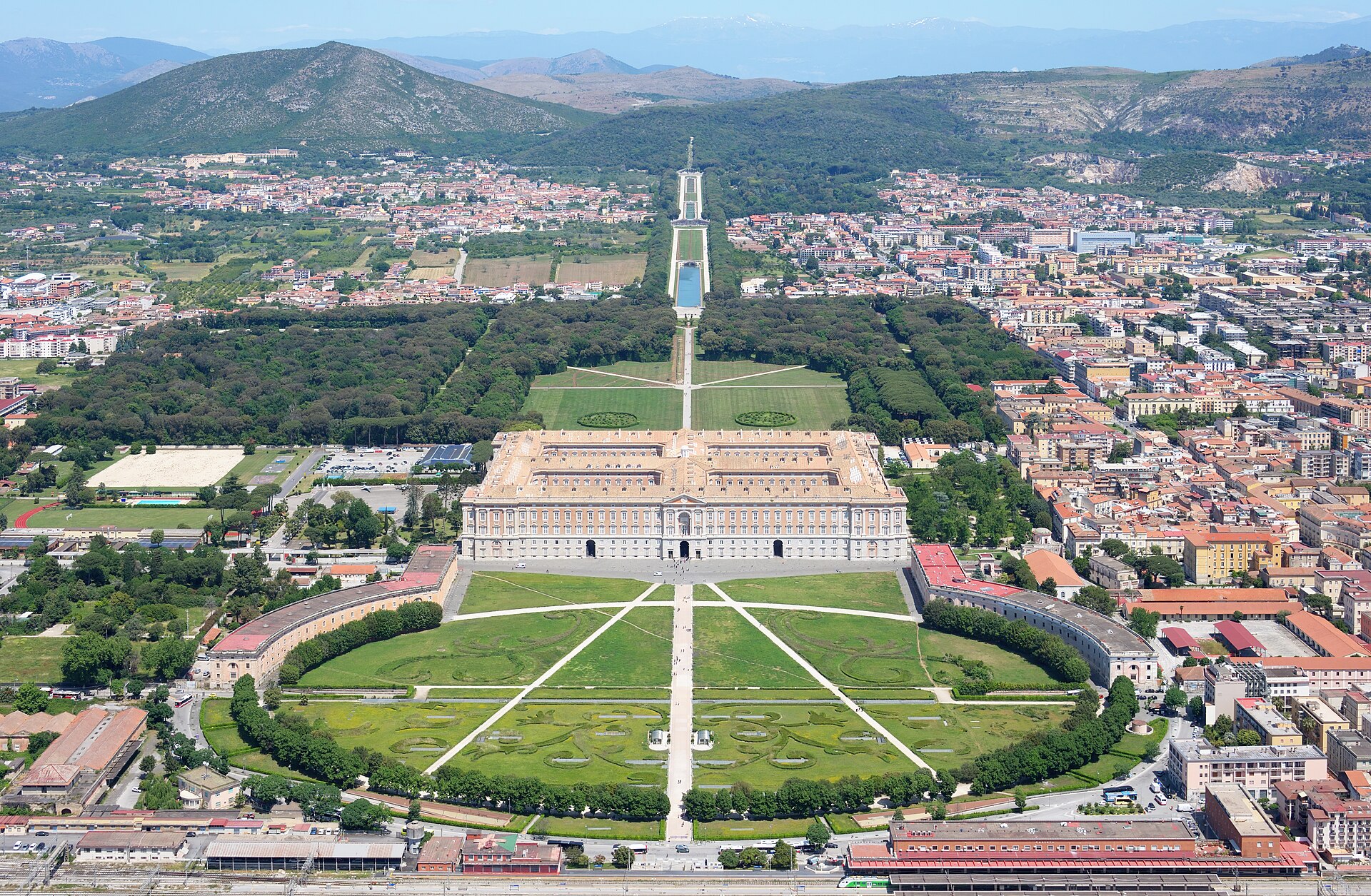
The Royal Palace of Caserta is one of those rare places where ambition and artistry collide on a grand scale. Commissioned in the 18th century by Charles III of Naples, it was conceived as a statement of Bourbon power, a rival to the grandeur of Versailles. The architect Luigi Vanvitelli, drawing inspiration from French models, designed not just a royal residence but a self-contained world where politics, culture, and science could flourish under one roof. What emerged was a monument to the aspirations of a dynasty—one that still stands today as a testament to how raw ambition can be transformed into something enduring.
The palace is vast in a way that feels almost impossible to grasp at first. Over a thousand rooms unfold across its length, their interiors a symphony of frescoes, gilded stucco, and marble. The main façade stretches nearly a quarter of a kilometer, its symmetry broken only by the dome of the palace chapel. Inside, every detail serves a sense of harmony: the grand staircase, with its smooth marble curves, ascends as if weightless, bathed in light from towering windows. The effect is one of effortless elegance, as though the building itself were designed to make power feel graceful.
Beyond the palace walls lies a park that is just as meticulously planned. Covering over a hundred hectares, it was conceived as an extension of the architecture, a landscape where nature and human design merge seamlessly. Wide avenues lead to fountains, cascades, and artificial lakes, all arranged in a precise geometric pattern. The most striking feature is the Great Cascade, a water staircase that descends from a hilltop to the Fountain of Diana below. On hot days, the sound of rushing water and the cool mist from the fountains offer relief from the southern Italian sun, while the shade of ancient trees provides a quiet respite.
For much of its history, the palace was hidden from public view. First as a private royal residence, then as a military installation, it remained closed off for decades. Restoration began in the mid-20th century, and today visitors can explore its many spaces: the grand state rooms, the private apartments of the Bourbon kings, the royal library, and even an 18th-century pharmacy. Some rooms, like the royal bedchamber, remain almost untouched, with original furnishings and decor. Others bear the marks of later occupants, including French troops during the Napoleonic wars, whose presence left subtle traces in the palace’s history.
Caserta itself is a city shaped by the palace’s existence. Built in a fertile valley surrounded by mountains, it was chosen as a safer alternative to Naples, where the royal court often faced unrest. Over time, the palace became the administrative heart of the region, and the modern city grew around it. Today, Caserta is a quiet provincial town, far from the tourist crowds of Rome or Florence, but its residents take pride in their most famous landmark. The palace is not just a relic of the past—it’s a living part of the city’s identity.
A visit to Caserta is a step into a world where art and power were inseparable. There’s a sense of timelessness here, especially in the early morning or late afternoon, when the light softens the palace’s stone and the park’s fountains murmur as they have for centuries. The statues that line the gardens seem to watch over visitors with quiet detachment, as if they’ve seen empires rise and fall. The palace has survived wars, occupations, and neglect, yet it remains a place where history feels tangible.
What makes Caserta special is its ability to feel both monumental and intimate. The grandeur of the state rooms is undeniable, but there’s also a sense of human scale in the private apartments, where the details of royal life—books on a shelf, a chair by a window—hint at the people who once lived here. The park, too, offers moments of quiet reflection, whether it’s the sound of water echoing through the gardens or the sight of a peacock strutting along a gravel path. It’s a place where the past isn’t just preserved; it’s still alive in the smallest details.
The Royal Palace of Caserta is more than just a historical site. It’s a reminder of how architecture can shape not just a building, but an entire era. The Bourbons may be long gone, but their vision endures in the stone and water, the light and shadow of this extraordinary place. To walk through its halls and gardens is to understand why some places transcend their time—they don’t just tell a story, they let you step inside it.