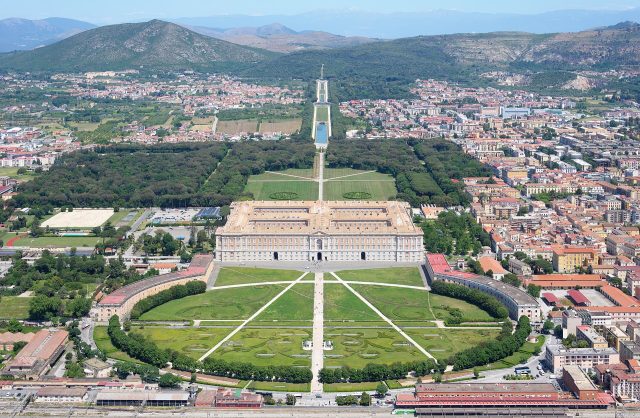
Piazza Vanvitelli in Caserta is one of those places where history and everyday life blend so seamlessly that time seems to slow down just a little. Named after Luigi Vanvitelli, the architect behind the city’s grand Royal Palace, the square serves as a quiet introduction to that monumental structure. From here, the palace’s facade comes into view, and if you look closely, you’ll notice how the lines of the square echo its design—as if Vanvitelli had envisioned them as part of a single, harmonious whole.
The square itself is small but perfectly proportioned. Its elongated rectangular shape is framed by low-rise buildings in a restrained neoclassical style, creating an intimate, enclosed space. At its center stands a fountain with a marble sculpture representing the Volturno River, one of the region’s most important waterways. The water flows softly, and on warm evenings, locals often gather along its edges to chat, watch passersby, or simply enjoy the quiet.
Unlike the bustling piazzas of Rome or Florence, Piazza Vanvitelli feels like the heart of a provincial town. There’s no rush here, just a steady rhythm of life that has unfolded over centuries. The surrounding buildings house small cafés and shops where you can sip an espresso or pick up local specialties like buffalo mozzarella, olive oil, or fresh produce. In the summer, tables spill onto the cobblestones, turning the square into an open-air living room where the hum of conversation, the scent of coffee, and the sound of footsteps blend into a familiar, comforting backdrop.
The square’s history is deeply tied to the Royal Palace, built in the 18th century for the Bourbon kings of Naples. Vanvitelli, the palace’s architect, didn’t just design the grand residence—he also shaped the space around it. Piazza Vanvitelli was meant to be the palace’s ceremonial entrance, a place where guests would gather before royal receptions. Today, the grandeur of those events lingers only in traces, but if you visit early in the morning, when the square is nearly empty, it’s easy to imagine the clatter of carriages and the murmur of courtiers in elaborate dress.
The architecture here is simple but elegant. The buildings surrounding the square are a mix of neoclassical and baroque elements, their facades adorned with pilasters, cornices, and small balconies. The details are subtle, inviting closer inspection rather than overwhelming the eye. The way light plays across the stone changes with the time of day—soft and golden in the morning, warm and lingering in the evening—highlighting the texture of the buildings and the quiet beauty of the space.
Piazza Vanvitelli is also where you can feel the pulse of Caserta. Unlike the tourist crowds of Naples or Rome, this square belongs to the people who live here. Mornings bring the sounds of the nearby market, where vendors call out their wares and shoppers haggle over prices. By midday, the square grows quiet, save for the occasional car or a group of schoolchildren on a field trip. But as evening falls, it comes alive again—locals stroll, teenagers gather by the fountain, and cafés fill with the clink of glasses as people order aperitivo.
Though modest in size, the square plays a key role in the city’s cultural life. Small concerts, open-air exhibitions, and local festivals often take place here. In December, the square is strung with Christmas lights, and in January, a lively fair celebrates Saint Anthony, the patron saint of Caserta. These events draw both visitors and residents, reinforcing the square’s place in the daily rhythm of the city.
If you visit Caserta, don’t stop at the Royal Palace. Take time to wander Piazza Vanvitelli, sit at a café, and listen to the cadence of Italian spoken around you. There’s nothing flashy here, but that’s precisely what makes it special. The beauty of this place isn’t in grand gestures—it’s in the quiet moments, the way the past and present coexist, and the sense of belonging that lingers long after you’ve left.