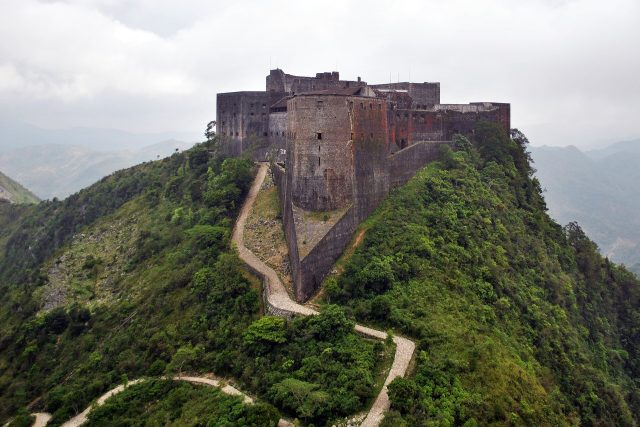
The ruins of Sans-Souci Palace stand as a quiet testament to Haiti’s turbulent past, a place where history lingers in the air like the scent of damp earth after rain. Built in the early 19th century, this once-grand residence was more than just a home—it was the centerpiece of King Henri Christophe’s vision for a new Haiti, a nation born from revolution and determined to carve its own path. Today, the palace is a shadow of its former self, its crumbling walls and overgrown courtyards bearing witness to the rise and fall of a kingdom that dared to defy the world.
Perched on a hill near the town of Milot, not far from Marmelade, Sans-Souci was conceived as a statement of power and ambition. Christophe, a former slave who rose to become a general and then a king, wanted to create something that would rival the palaces of Europe while remaining distinctly Haitian. The architecture blended neoclassical grandeur with local influences: towering columns, vast halls, and terraces that offered sweeping views of the surrounding plantations and mountains. The king oversaw the construction himself, demanding precision from the laborers, though the work was grueling and the conditions harsh. The result was a structure that spoke of both aspiration and oppression, a paradox that defined Christophe’s reign.
Sans-Souci was never meant to be just a private residence. It was the heart of a new state, a place where Christophe hosted foreign diplomats, held lavish balls, and convened councils to prove that Haiti could stand as an equal among nations. The palace was part of a larger complex that included the fortress of Laferrière, barracks, a church, and even a university. Yet Christophe’s ambitions stretched beyond what the young nation could sustain. The construction drained resources, and his authoritarian rule bred resentment among the people. The palace, meant to symbolize Haiti’s strength, instead became a monument to the fragility of power.
The fall of Sans-Souci was as dramatic as its rise. In 1820, after a rebellion and Christophe’s suicide, the palace was looted and abandoned. An earthquake in 1842 delivered the final blow, reducing much of it to ruins. For decades, the site was left to the mercy of the elements, swallowed by tropical vegetation until efforts in the 20th century began to uncover and preserve what remained. Today, the ruins are protected as part of Haiti’s national heritage, though time and nature continue to erode them, slowly but relentlessly.
Visiting Sans-Souci is less about admiring a tourist attraction and more about stepping into a story. There are no polished exhibits or neatly labeled signs, just the raw, unfiltered remnants of the past: collapsed arches, half-buried staircases, and fragments of frescoes clinging to the walls. The place feels suspended in time, as if the ghosts of Christophe and his court might still linger in the shadows. Locals sometimes share tales of spirits haunting the ruins, though these stories carry more melancholy than fear, a poetic echo of a bygone era.
The atmosphere here is one of contradictions. On one hand, the ruins stand as a testament to human determination, a defiant gesture against the forces that sought to keep Haiti subjugated. On the other, they serve as a reminder of how quickly empires crumble, how easily dreams can turn to dust. Sans-Souci was built to proclaim Haiti’s independence and strength, yet today it feels like a fragile relic, a whisper of what once was. The surrounding landscape—rolling hills dotted with banana plantations and distant mountains—only deepens the sense of solitude, a quiet acknowledgment that nature, not man, has always held the final word.
For those who seek to understand Haiti’s history, Sans-Souci is essential. It offers a glimpse into the early 19th century, when the nation was still finding its footing in a world that refused to recognize its sovereignty. The palace was more than just a building; it was part of a grand experiment in nation-building, an attempt to forge a society where former slaves could govern themselves. That experiment ultimately faltered, but its traces remain etched into the stones of Sans-Souci, a silent witness to a bold and imperfect dream.
The ruins continue to draw not only travelers but also researchers. Archaeologists work here sporadically, piecing together fragments of the past—shards of pottery, coins, remnants of jewelry—that hint at the lives once lived within these walls. Yet much of Sans-Souci’s story remains lost, buried beneath layers of time and neglect. The palace’s true legacy lies not in what has been preserved, but in what has been forgotten, a gap that invites speculation and reflection.
A journey to Sans-Souci is also a chance to see Haiti beyond the stereotypes. The country is often reduced to images of poverty and disaster, but here, in the quiet north, another side emerges: one of resilience, beauty, and deep history. The ruins are not just a tourist stop; they are a place where the past speaks for itself, unfiltered and unvarnished. Standing among the stones, it’s impossible not to feel the weight of what was—and what might have been.