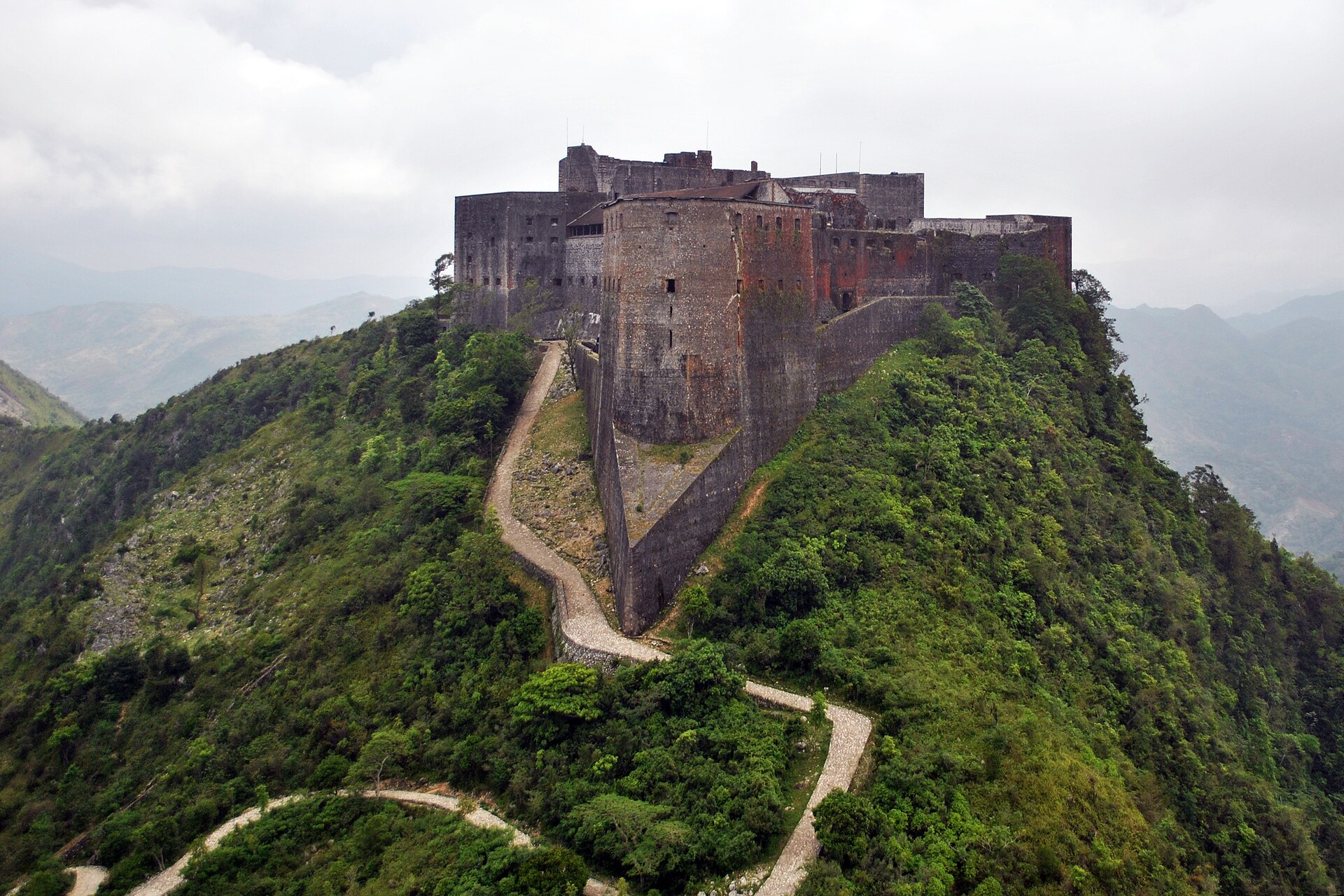
Perched high above the lush hills near Marmelade, the Citadelle Laferrière isn’t just a museum—it’s a monumental relic of Haiti’s turbulent past and a testament to the ambition of a nation that dared to defy history. Built in the early 1800s under the orders of King Henri Christophe, one of the key figures of the Haitian Revolution, this fortress stands as a symbol of the country’s hard-won independence. It was here, on this remote mountaintop, that Haiti declared its sovereignty as the first Black-led republic in the world, a defiant act that sent shockwaves through colonial powers. The fortress and the small museum within its walls preserve the memory of that era, not just as a military stronghold but as a bold statement of freedom and resilience.
The Citadelle itself is an engineering marvel of its time, a sprawling complex of stone walls and battlements clinging to the summit of Bonnet à L’Evêque. Rising nearly a thousand meters above sea level, it dominates the landscape, its massive ramparts stretching for hundreds of meters, built to withstand any invasion. Inside, the fortress reveals a labyrinth of barracks, storerooms, dungeons, and even royal chambers—all constructed by hand, without modern machinery, by tens of thousands of laborers. The sheer scale of the project is staggering, especially considering the harsh conditions and the limited resources available. Local stories suggest that French prisoners of war may have been among those forced to work on the site, though historical records are scarce. What remains undeniable is the fortress’s imposing presence, a physical manifestation of Christophe’s determination to protect Haiti’s fragile independence.
The museum inside the Citadelle offers a glimpse into the broader story of Haiti’s revolution and its aftermath. The exhibits include weapons from the era, documents signed by Christophe himself, and personal artifacts that humanize the larger-than-life figures of the time. Detailed models of the fortress show how it once functioned as a self-sustaining military complex, complete with cisterns, bakeries, and armories. Beyond the military history, the museum also displays everyday objects—pottery, tools, and musical instruments—that paint a picture of life in 19th-century Haiti. The collection is modest but carefully curated, designed to immerse visitors in the atmosphere of the period without overwhelming them with too much detail.
Beyond its historical significance, the Citadelle is a place of breathtaking natural beauty. From its ramparts, the view stretches across rolling green valleys, distant mountain ranges, and, on clear days, the faint outline of the coastline. The air is cooler here than in the lowlands, filled with the scent of tropical foliage and the calls of birds that nest in the surrounding forests. Locals often visit not just for the history but to escape the heat and noise of the cities below, finding peace in the quiet grandeur of the landscape. The journey to the fortress is part of the experience—winding roads lead up from Marmelade, and the final ascent must be made on foot or by mule, as the path becomes too steep for vehicles. The climb itself feels like stepping back in time, with each turn revealing another layer of Haiti’s rugged beauty.
Henri Christophe, the man behind the Citadelle, was a complex and controversial figure. A former slave who rose to power during the revolution, he crowned himself king in 1811 and ruled with an iron fist, imposing strict discipline on his subjects while working to modernize the country. The fortress was meant to be the crown jewel of his kingdom, a symbol of Haiti’s strength and a deterrent to foreign invasion. Yet despite its imposing size, the Citadelle was never tested in battle. Christophe’s reign ended in tragedy in 1820, when a rebellion and his own suicide left the fortress abandoned. Over time, nature began to reclaim parts of the structure, and today, it stands as much as a monument to his ambitions as it does to Haiti’s struggle for survival.
Visiting the Citadelle today is a quiet, almost meditative experience. Unlike the crowded tourist sites of Port-au-Prince or the beach resorts, this place feels untouched by time. There are no large tour groups, no vendors hawking souvenirs—just the wind rustling through the stone corridors and the occasional guide sharing stories passed down through generations. The museum’s hours can be unpredictable, and the entry fee is nominal, but the real value lies in the sense of connection to Haiti’s past. Guides often weave local legends into their tours, speaking of ghostly soldiers who still patrol the battlements or hidden treasures buried beneath the fortress. Whether these tales hold any truth is less important than the way they add to the mystique of the place, making the visit feel like uncovering a secret.
For those willing to make the journey, the Citadelle offers more than just a history lesson. It’s a chance to see Haiti from a different perspective—one that goes beyond the headlines of poverty and political instability. Here, the country’s proud and defiant spirit is on full display, embodied in the sheer scale of the fortress and the stories it holds. The site invites contemplation, whether you’re standing on the ramparts at sunrise, exploring the dimly lit chambers of the museum, or simply sitting on a stone ledge, watching the clouds drift over the valleys below. It’s a reminder that Haiti’s story is far richer and more nuanced than many realize, and that its past continues to shape its present in ways both visible and unseen.
The Citadelle Laferrière isn’t just a destination; it’s an experience that lingers long after you’ve descended the mountain. The memories of its towering walls, the echoes of its history, and the quiet beauty of its surroundings stay with you, offering a counterpoint to the more familiar narratives about Haiti. It’s a place where the past feels alive, where the struggles and triumphs of a nation are etched into every stone. And while the fortress may no longer serve as a military stronghold, it remains a powerful symbol of what Haiti once was—and what it still aspires to be.