High in the green hills of northern Haiti, where the land rolls gently toward the sea, the National History Park stands as a quiet monument to a fleeting empire. This is not a place of polished exhibits or carefully curated displays, but rather a landscape where history lingers in the crumbling stone and the stories passed down through generations. The park lies near the small town of Marmelade, once part of the short-lived Haitian Kingdom that rose from the ashes of revolution in the early 19th century. For a brief moment, this corner of the island was the heart of a bold experiment—a nation forged by former slaves who dared to defy the colonial powers of Europe.
At the center of the park are the ruins of Sans-Souci Palace, built by Henri Christophe, a man whose life reads like a tale of ambition and contradiction. Born into slavery, Christophe fought in the revolution that secured Haiti’s independence, then rose to become a general, and finally, a king. His vision for the new nation was grand: a monarchy modeled after European courts, but rooted in African traditions. Sans-Souci, completed in 1813, was meant to embody that vision. Its name, meaning "carefree" in French, carries a bitter irony—Christophe’s reign was anything but peaceful. The palace was said to be lavish, with marble floors, crystal chandeliers, and gilded furniture, though today only moss-covered walls and arched doorways remain. The wind still moves through them, just as it did two centuries ago, carrying whispers of a time when this place was alive with power and intrigue.
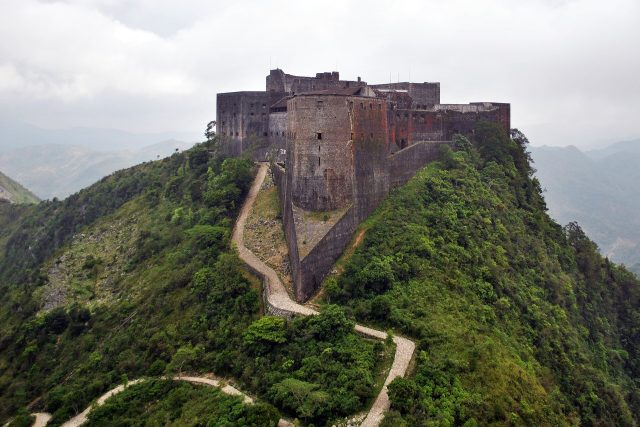
A short distance away, perched atop the mountain Bonnet-à-L’Evêque, stands the Citadelle Laferrière, one of the most imposing fortresses in the Americas. Construction began in 1805, driven by Christophe’s fear of a French invasion. For nearly fifteen years, thousands of laborers toiled to build a stronghold that could withstand any attack. The result was a colossal structure, its walls five meters thick in places, its towers rising over forty meters high. Inside, there was space for five thousand soldiers, along with enough supplies to endure a years-long siege. Local lore claims Christophe wanted the fortress to be visible from the sea, a warning to any who might challenge Haiti’s sovereignty. Today, the climb to the summit is a journey through dense forest, where the air hums with the sounds of birds and insects. From the top, the view stretches across northern Haiti—jungles giving way to plantations, villages dotting the hills, and the distant shimmer of the ocean.
The park holds more than just these two landmarks. Scattered across the hills are the remnants of other buildings from Christophe’s era: the ruins of a royal residence in Milot, the shell of a church in Limonade where the king and queen were once married, and fragments of old roads that once connected the capital to the far reaches of the kingdom. These places tell a story not just of power, but of its fragility. Christophe’s empire lasted barely a decade. In 1820, facing rebellion and betrayal, the king took his own life. Without his iron will, the kingdom collapsed, and its grand buildings were left to the mercy of time and nature. What remains is a haunting reminder of how quickly glory can fade.
The atmosphere here is thick with the weight of the past. Walking through the ruins, it’s easy to imagine the clatter of royal carriages on cobblestone roads, the march of soldiers toward the Citadelle, or the quiet conversations of laborers resting in the shade after a day’s work in the sugarcane fields. The surrounding villages move at a slower pace, their rhythms shaped by the land and the seasons. Locals speak of Christophe with a mix of pride and distance—his legacy is part of their history, though their lives today bear little resemblance to the grandeur of his reign. In these communities, traditions brought from Africa endure in music, dance, and craftsmanship, woven into the fabric of Haitian culture.
For many Haitians, the National History Park is more than a historical site—it’s a sacred place, a connection to the ancestors who fought for freedom. The ruins are a testament to the revolution that made Haiti the first Black-led republic in the world, a nation born from the ashes of slavery. Yet they also serve as a reminder of the cost of that freedom. The park is often the setting for Vodou ceremonies, where the past and present intertwine. For those who practice, Vodou is not just a religion but a way of honoring the spirits of those who came before, a bridge between the living and the dead.
Visiting the park is as much about the journey as it is about the destination. The road to the Citadelle winds through lush forests, where rare plants thrive and brightly colored birds dart between the trees. The air is thick with the sounds of the jungle—the calls of parrots, the buzz of cicadas, the rustle of leaves underfoot. The climb to the fortress is steep, but the reward is worth the effort. From the summit, the landscape unfolds in all directions: rolling hills, patches of farmland, and the distant curve of the coastline. It’s a view that makes the scale of Christophe’s ambition feel almost tangible.
There are no glass cases or informational plaques here, no neatly packaged narratives. Instead, the park invites visitors to piece together the story for themselves, to feel the weight of history in the silence of the ruins. For those with an interest in Haiti’s past, it’s an essential stop. But even for the casual traveler, the place leaves a lasting impression. It’s a reminder of how fleeting human achievements can be, and yet how deeply they can shape the world that comes after. The stones of Sans-Souci and the Citadelle are more than just relics—they are witnesses to a moment when a nation dared to redefine its own destiny.