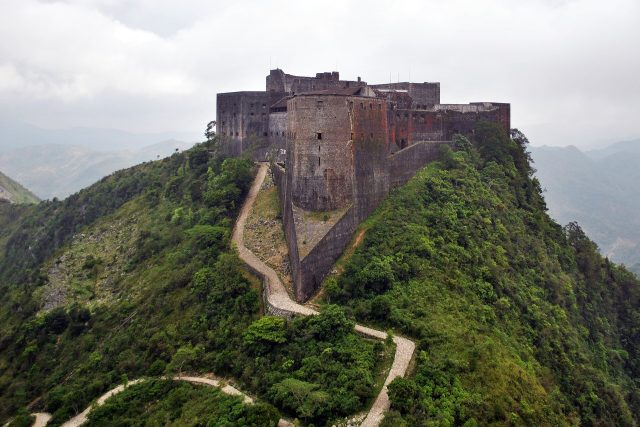
Perched high in the mountains of northern Haiti, the Citadelle Laferrière is a fortress that seems to defy both time and gravity. Rising nearly a thousand meters above sea level on the slopes of Bonnet-à-L’Evêque, its massive stone walls dominate the landscape, visible for miles around. Built in the early 19th century, it remains one of the most striking examples of military architecture in the Caribbean, a monument not just to engineering but to the fierce determination of a nation fighting for its freedom.
The Citadelle was commissioned by Henri Christophe, a former slave who rose to become a general in the Haitian Revolution before declaring himself king. Haiti had only recently won its independence from France, and Christophe, wary of a possible return of colonial forces, ordered the construction of an impregnable stronghold. Work began in 1805, with thousands of laborers—many of them former slaves—hauling stone and mortar up the steep mountain paths. The conditions were brutal, and the project took nearly fifteen years to complete, but the result was a fortress designed to withstand any assault.
The structure itself is a marvel of defensive design. Built from local limestone and mortar, its walls reach up to five meters thick in places, with bastions and battlements arranged to repel invaders. Inside, the Citadelle housed barracks, storerooms stocked with enough supplies to endure a years-long siege, and even royal quarters where Christophe and his family could take refuge. Hundreds of cannons were installed along the ramparts, many of which still stand today, silent witnesses to the fortress’s intended purpose. Yet despite its formidable appearance, the Citadelle never saw major combat. After Christophe’s death in 1820, it was gradually abandoned, left to the mercy of time and the encroaching jungle.
The architecture of the Citadelle blends European military traditions with local building techniques, creating a structure that feels both imposing and strangely harmonious with its surroundings. The fortress seems to grow naturally from the rocky outcrop, its walls following the contours of the mountain. From the upper terraces, the view stretches across dense forests and valleys, all the way to the Atlantic coast. On clear days, the distant outline of Tortuga Island, once a haven for pirates, can be seen on the horizon. The design was meant to intimidate, but it also offers a breathtaking perspective on the land it was built to protect.
For decades after its abandonment, the Citadelle was shrouded in superstition. Locals whispered that it was haunted by the spirits of those who had died during its construction, and few dared to venture inside. Nature slowly reclaimed parts of the fortress, with vines creeping over the stone and trees taking root in the courtyards. It wasn’t until the mid-20th century that restoration efforts began, transforming the Citadelle into one of Haiti’s most important historical sites. Today, it is recognized as a UNESCO World Heritage site, a testament to the country’s turbulent past and enduring resilience.
Visiting the Citadelle is an experience that goes beyond mere sightseeing. The journey to reach it is part of the adventure—whether on foot or by horseback, the steep climb up the mountain trail takes about an hour, winding through lush vegetation and offering glimpses of the fortress long before you arrive. Inside, the air is cool and still, broken only by the sound of the wind and the occasional cry of a bird. Some of the original features remain: the cannons lined up along the walls, the worn stone steps leading to the upper levels, the remnants of Christophe’s quarters. But the real draw is the atmosphere, the sense of stepping into a place where history feels alive.
The Citadelle is more than just a relic of the past; it is a symbol of Haiti’s struggle for independence and the complex legacy of its revolution. It stands as a reminder of the sacrifices made by those who fought for freedom, as well as the challenges that followed. For Haitians, it remains a source of pride, a physical embodiment of their nation’s defiance. For visitors, it offers a rare glimpse into a chapter of history that is often overlooked, a story of resilience carved into stone and set against the backdrop of a breathtaking landscape. The fortress may no longer guard against invaders, but it still stands as a guardian of memory, a place where the past is never far away.