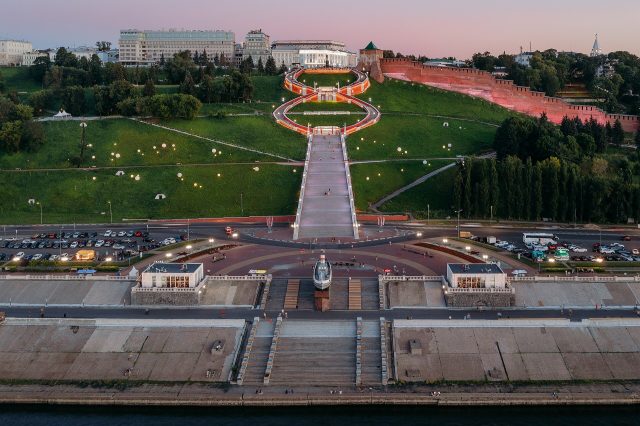
Nizhny Novgorod’s Rozhdestvenskaya Street is one of those rare places where time seems to slow down, allowing you to step into a quieter, more deliberate rhythm. Stretching along the high bank of the Volga, it connects two of the city’s most iconic landmarks—the Kremlin and the historic fairgrounds—like a thread weaving together different eras. The street isn’t just a pedestrian zone; it’s a living postcard where merchant grandeur, provincial charm, and modern urban life coexist in an unhurried balance. The past isn’t preserved here in glass cases but embedded in the very stones underfoot, in the facades of buildings that have witnessed centuries of change.
The street begins at People’s Unity Square, a place that once buzzed with the energy of traders and now draws locals and visitors alike. From here, the view opens up to the confluence of the Volga and Oka rivers, their waters merging into a single, powerful current. On clear days, the distant landscapes of the Transvolga region shimmer on the horizon, while in winter, the frozen river transforms the scene into a monochrome etching of ice and snow. The street itself descends toward the embankment in a gentle curve, flanked by buildings that have stood since the 19th century. Many of them bear the marks of classicism and Art Nouveau—ornate stucco, wrought-iron balconies, and heavy wooden doors that once led to merchant offices, shops, and living quarters.
A significant portion of Rozhdestvenskaya Street is tied to the legacy of the Nizhny Novgorod Fair, which moved here in 1817 and turned the city into the economic heart of the Volga region. This wasn’t just a marketplace but a world unto itself, where the fate of Russian trade was often decided. The street once housed the main pavilions, banking houses, and hotels that accommodated merchants from across the empire. Today, some of these buildings have been repurposed as museums, cafes, and shops, yet the echoes of their former importance linger in the air. Walking past them, you can almost hear the clatter of hooves on cobblestones and the murmur of deals being struck in multiple languages.
The most striking structure on the street is the Church of the Nativity, from which it takes its name. Originally built in the 17th century, the church was later reconstructed in the Baroque style, its white facade and gilded domes standing out against the surrounding architecture. Inside, the frescoes and iconostasis reflect the work of local artisans, their craftsmanship preserved through fires and restorations. The church remains an active place of worship, its bells ringing out over the river, a sound that has marked the passage of time for generations.
Many of the buildings along Rozhdestvenskaya Street have stories of their own. The former Deulin Hotel, for instance, once hosted prominent merchants and travelers, while the Rukavishnikov House now serves as an art museum. Each structure feels like a page from a history book, written not in ink but in brick and plaster. Some of the houses are known by their sculptural details—Atlantes supporting balconies, griffins perched on cornices, lions guarding doorways—symbols of the wealth and status of their original owners. These aren’t just decorative elements but remnants of a time when such flourishes were a language of power.
Yet Rozhdestvenskaya Street isn’t frozen in the past. It’s a place where history and contemporary life intersect naturally. In summer, outdoor cafes spill onto the sidewalks, offering coffee with a view of the Volga, while winter brings Christmas fairs and festivals that draw crowds. Street musicians often perform here in warmer months, and artists display their work along the pavement, adding to the street’s creative energy. Locals come not just to admire the architecture but to soak in the atmosphere—a blend of tranquility, nostalgia, and the quiet hum of everyday life.
What makes Rozhdestvenskaya Street special is its authenticity. Unlike carefully curated historic districts, it hasn’t been turned into a museum piece. It’s still a living part of the city, where the layers of time are visible but not overwhelming. You can sit on a bench, watch people pass by, and listen to the river’s murmur, feeling the weight of centuries without the pressure of a guided tour. The street doesn’t just tell the story of Nizhny Novgorod; it lets you experience it.
Walking its length, from the square down to the embankment, you begin to understand why the city was once called the "pocket of Russia." There’s a sense of unpretentious solidity here, a place where history isn’t polished for tourists but allowed to exist as it is. Rozhdestvenskaya Street doesn’t need embellishment—its charm lies in its quiet persistence, in the way it carries the past into the present without losing its soul.