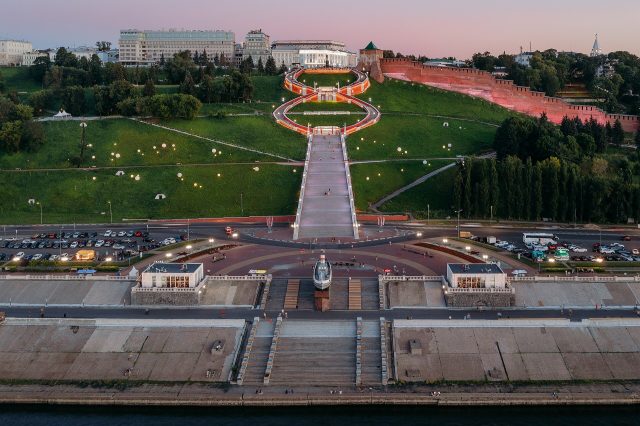
Nizhny Novgorod Fair is one of those rare places where the past doesn’t just linger in old stones—it breathes, moves, and shapes the present. Built in the early 19th century, it quickly became more than a marketplace; it was the economic heartbeat of an empire, a crossroads where trade routes from Persia, Central Asia, China, and Europe converged along the Volga River. For decades, this was where fortunes were made and lost, where merchants haggled over tea, silk, and furs, and where the pulse of commerce dictated the rhythm of life. The fair wasn’t just a place to buy and sell—it was where the world, in all its diversity, passed through a single city.
The architecture of the fair tells its own story, one of ambition and ingenuity. The main building, designed in the neoclassical style, stands like a temple of commerce, its columns and pediment giving it an air of grandeur, yet its proportions feel surprisingly light, almost weightless. It was constructed after the devastating fire that destroyed the old Makaryev Fair in the early 1800s, and the new complex was built to impress. Beyond the trading halls, there were hotels, restaurants, and even a theater—all the amenities of a self-contained world. The engineers behind it didn’t just think big; they thought practically. A system of canals and locks allowed ships to dock directly at the warehouses, a marvel of its time that turned the fair into a seamless link between river and land.
Today, the fair is still very much alive, though its role has evolved. It’s no longer the sole engine of the city’s economy, but it hasn’t become a relic either. Inside its walls, you’ll find exhibitions, fairs, concerts, and festivals that draw crowds year-round. In summer, the grounds transform into a bustling market where vendors sell everything from fresh local produce to handmade crafts. Winter brings a different kind of magic: the square in front of the main building glows with holiday lights, and inside, Christmas markets offer gingerbread, mulled wine, and the kind of warmth that makes the cold outside feel distant. Even on ordinary days, there’s a sense of energy here, as if the fair is always waiting for the next gathering, the next celebration.
But the fair has always been more than a commercial hub. It was a place where cultures collided and mingled, where languages, cuisines, and traditions from across Eurasia found common ground. In the 19th century, you could hear Persian spoken alongside German, sample spices from the Caucasus, or marvel at fabrics from distant lands. That legacy hasn’t faded. Today, the fair hosts international exhibitions, scientific conferences, and cultural forums, turning it into a space where ideas are exchanged as freely as goods once were. It’s a reminder that trade has always been about more than transactions—it’s about connection.
The fair’s influence on Nizhny Novgorod itself is hard to overstate. The city had long been an industrial center, but the fair gave it a new identity, one tied to movement and exchange. It attracted not just merchants, but inventors, artists, and entrepreneurs, turning Nizhny Novgorod into one of Russia’s most dynamic cities. Even after the revolution, when the fair’s commercial role waned, its buildings remained in use—first as factories and warehouses, later as exhibition spaces. The main building, in particular, has weathered wars, economic upheavals, and political shifts, yet it still stands, a testament to the enduring power of commerce as a cultural force.
Stepping inside the main building feels like entering a time capsule. The original decor—ornate moldings, frescoes, antique chandeliers—has been preserved, and the air carries the faint echo of a bygone era. It’s easy to imagine the clatter of hooves on cobblestones, the murmur of merchants negotiating deals, the scent of tea and spices filling the halls. Yet the fair isn’t frozen in the past. Outside, the modern city hums with life: cars rush by on busy streets, and across the river, the skyline is dotted with glass-and-steel towers. This contrast—between the fair’s historic grandeur and the city’s contemporary energy—makes it feel like a living bridge between eras.
The fair is at its most atmospheric in winter, when snow dusts the rooftops and the glow of streetlamps casts a golden hue over the cobblestone paths. The air smells of roasted chestnuts and citrus, and the sound of laughter carries from the holiday stalls. Summer brings a different kind of vibrancy: tourists snap photos in front of the main building, children dart between the alleys, and locals stroll along the embankment, soaking in the warmth. No matter the season, the fair has a way of making time feel elastic—here, the past isn’t just remembered; it’s still being written.
What makes the Nizhny Novgorod Fair special isn’t just its history or its architecture, but the way it embodies the spirit of the city itself. Nizhny Novgorod has always been a place where paths cross, where different worlds meet, and where history isn’t confined to museums but spills into the streets. The fair is a microcosm of that—part marketplace, part cultural hub, part time machine. To visit it is to understand why this city has always been more than just a dot on the map. It’s a place where the past and present coexist, where every stone has a story, and where the air still hums with the energy of all those who have passed through its gates.