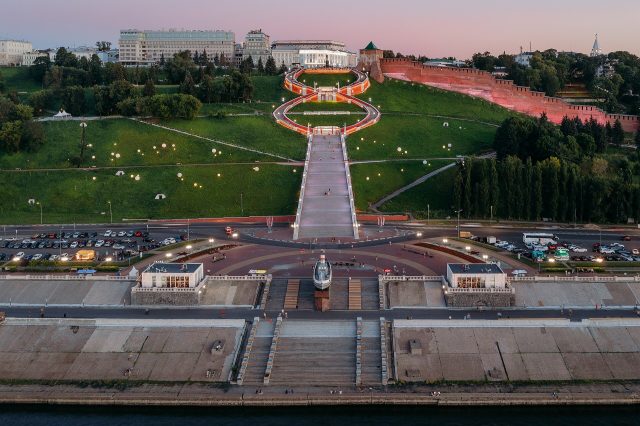
Nizhny Novgorod Kremlin isn’t just a fortress—it’s the city’s living heart, the place where centuries of history have unfolded. Built in the early 1500s by order of Vasily I, it was more than a defensive stronghold; it became a symbol of power that united these lands. The walls, made of deep red brick, were once crowned by thirteen towers, each built to withstand sieges and raids. Today, twelve remain, their weathered stone holding stories of the past. The Dmitrievskaya Tower, the tallest and most recognizable, once served as the city’s main gate, while the Koromyslova Tower earned its name from a local legend about a clever girl who outsmarted invaders by hiding her yoke and buckets along the wall during an attack.
Perched on a high bluff where the Volga and Oka rivers meet, the Kremlin has always been a place of strategic importance. Merchants once traveled these routes, armies gathered before campaigns, and later, government offices took root within its walls. Inside, the buildings tell their own stories—from ancient churches to Soviet-era structures. The Mikhailo-Arkhangelsky Cathedral, founded in the 13th century, became the final resting place of Prince Yuri Vsevolodovich, who died in battle against the Mongols. Though rebuilt over the centuries, its walls still carry the weight of that distant past.
The architecture of the Kremlin reflects the layers of time. Originally a wooden fortress, it was rebuilt in stone after fires and wars left it in ruins. The walls, nearly two kilometers long and up to five meters thick, encircle the grounds, their uneven towers creating a silhouette that defines the city’s skyline. The Clock Tower once housed a mechanism that marked the hours for the townspeople, its chimes echoing across the river. Today, visitors can walk along the paved paths, pass rows of old cannons, or climb to a viewing platform for a sweeping panorama of the city and the rivers below.
Beyond its military role, the Kremlin has always been a center of public life. Markets thrived here, assemblies were held, and in the 19th century, it became home to Russia’s first public museum. During the Soviet era, it hosted rallies and demonstrations, and in World War II, it served as a headquarters for air defense. Now, the grounds are alive with museums, exhibitions, and festivals, but the real draw is the sense of continuity—the way the stones seem to whisper of the people who walked here before.
A stroll through the Kremlin feels like stepping through time. You might begin at the Dmitrievskaya Tower, where merchants and travelers once entered the city, then follow the walls, running your fingers along the rough brick. Nearby, the monument to Prince Yuri Vsevolodovich stands as a quiet reminder of the city’s origins. In summer, the grounds are lively with tourists, children playing on the lawns, and locals soaking in the atmosphere. Winter transforms the space—snow dusts the towers, and the air fills with the scent of mulled wine at holiday fairs.
The Kremlin played a pivotal role during the Time of Troubles in the early 1600s. It was here that Kuzma Minin and Dmitry Pozharsky rallied the people’s militia, which would go on to liberate Moscow from Polish invaders. Their legacy is honored in a bronze monument on the grounds, one of the city’s most recognizable landmarks. Visitors often pause here, reflecting on the courage of those who shaped Russia’s history.
But the Kremlin isn’t just a relic of the past—it’s a living part of the city. Festivals, concerts, and fireworks light up the sky above its walls, drawing crowds year after year. In summer, artists display their work on the viewing platforms, while winter brings ice skating and snow-covered paths. The annual City Day celebrations spill across the grounds, turning the fortress into a stage for music, food, and community.
What makes the Nizhny Novgorod Kremlin special is the way it bridges history and the present. You can stand where princes and merchants once stood, touch the same walls that bore witness to battles and trade, and feel the weight of the centuries in the air. It’s more than a landmark—it’s a piece of the city’s soul, a place where the past isn’t just remembered but still alive. And whether you’re a visitor or a local, walking these paths makes you part of that story, if only for a moment.