Rinella Battery stands as a quiet sentinel on Malta’s eastern coast, a place where the island’s layered history feels almost tangible. Tucked into a small bay near the village of Kalkara, this 19th-century fortification was part of Britain’s ambitious effort to secure the Grand Harbour, the strategic heart of its Mediterranean empire. Built between 1878 and 1880, the battery was designed to deter naval attacks at a time when Malta’s harbours were among the most heavily defended in the world. The British Empire relied on these waters for control over trade routes and military movements, and Rinella was meant to ensure that no enemy fleet could approach unchallenged.
What makes the battery remarkable is its armament: two Armstrong guns, the most powerful artillery pieces of their era. Each weapon weighed over a hundred tons, with barrels stretching nearly ten metres long. They could fire one-ton projectiles up to eight kilometres, a range that made them formidable against the ironclad warships dominating naval warfare in the late 1800s. Yet for all their might, these guns were cumbersome relics of an age before automation. Loading one required a team of twelve men and nearly half an hour of labour, a process that involved hauling massive shells and carefully aligning the barrel by hand. The sheer scale of the operation is still evident in the preserved mechanisms, which visitors can examine up close.
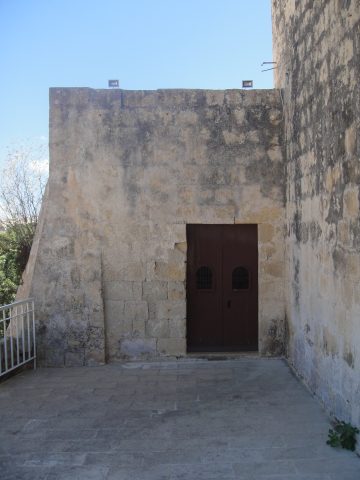
The architecture of Rinella Battery reflects the pragmatic grandeur of Victorian military engineering. The fort is a semicircular structure of thick limestone walls, blending seamlessly with Malta’s rocky landscape. Inside, the casemates—vaulted chambers where ammunition was stored—are cool and dim, their stone surfaces worn smooth by time. The gun emplacements sit on raised platforms, their massive iron carriages still in place, though one of the original guns was removed in the early 20th century. A dry moat encircles the battery, and the entrance is guarded by heavy gates and the remnants of a drawbridge, all designed to repel land-based assaults. The fort’s compact design belies its strength, a testament to the era’s focus on functionality over ornamentation.
Today, Rinella is an open-air museum, offering a rare glimpse into 19th-century military life. The surviving Armstrong gun remains in near-original condition, its barrel pointing out to sea as if still on watch. Visitors can explore the underground chambers, climb to the gun platforms for a view of the coastline, or wander through the open spaces where soldiers once drilled. Occasionally, historical reenactments bring the past to life, with enthusiasts in period uniforms demonstrating the laborious process of loading and firing the gun—though, thankfully, without live ammunition. These events are a reminder of how different warfare was in an age before mechanisation, when battles were won as much by manpower as by firepower.
Unlike Malta’s more famous landmarks, Rinella has escaped the crowds. There are no souvenir stalls or guided tour groups here, just the quiet hum of the wind and the distant murmur of the sea. The air carries the scent of salt and dry grass, and the only sounds are the cries of gulls and the occasional rustle of leaves. The surrounding landscape is untouched, with low hills and scattered shrubs stretching toward the horizon. From the battery’s ramparts, you can see modern cargo ships gliding past, a stark contrast to the ironclads that once patrolled these waters. It’s a place where the past and present coexist without fanfare, where history feels less like a spectacle and more like a natural part of the environment.
Rinella’s appeal isn’t limited to military history buffs. There’s a timeless quality to the site, a sense of stillness that invites reflection. The fort’s weathered stones seem to absorb the sunlight, casting long shadows that shift with the hours. It’s easy to imagine the soldiers who once manned these walls, their routines dictated by the slow rhythm of 19th-century life. The surrounding area is dotted with remnants of old roads and foundations, hints of a community that thrived here long before the battery was built. Over time, the fort has become as much a part of the landscape as the hills and the sea, its presence now inseparable from the place itself.
The battery is also a piece of a larger puzzle. Just a short distance away, other British fortifications—like Fort Ricasoli and Fort Cambridge—form a defensive network that once guarded Malta’s harbours. Together, these sites tell the story of an island that was constantly contested, its strategic value drawing empires from the Phoenicians to the Knights of St. John and, finally, the British. Exploring them offers a deeper understanding of why Malta has always been a crossroads of cultures and conflicts. Rinella, in particular, highlights the technological arms race of the 19th century, when naval power was measured in the size of guns and the thickness of armour.
In the end, Rinella Battery is a monument to obsolescence. The guns that were once the pinnacle of military engineering became outdated within decades, rendered useless by advances in naval technology. Yet that very obsolescence is what makes the site so compelling. It’s a window into a world where progress moved at a different pace, where the tools of war were as much about human ingenuity as they were about brute force. For those willing to venture off the beaten path, Rinella offers something rare: a chance to step into history without the distractions of modern tourism. It’s a place where the past isn’t just remembered—it’s still alive in the stones, the sea, and the silence.