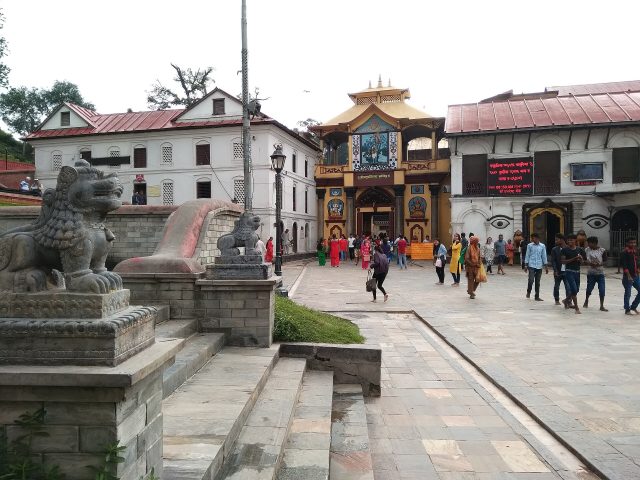
The Bagmati River in Gokarna is one of those rare places where Nepal’s natural beauty and cultural depth merge seamlessly. Just a short distance northeast of Kathmandu, the river flows gently past rolling hills and ancient settlements, but its significance to the people who live along its banks goes far beyond its physical presence. For locals, the Bagmati isn’t just water—it’s a sacred lifeline, a thread woven through centuries of tradition, belief, and the very cycle of life and death.
Gokarna itself is a quiet town, best known for its temple complex dedicated to Shiva. Yet the river here holds just as much importance. For Hindus, the Bagmati is more than a body of water; it’s an embodiment of the divine, a purifying force that washes away sins. Along its shores, rituals unfold daily—cremations, prayers, and the quiet act of bathing in its waters. Even those who don’t share the faith can’t help but feel the weight of the place. The air is thick with the scent of incense, the murmur of mantras, and the rustle of leaves in the breeze, all blending into a hush that feels almost sacred.
The history of the Bagmati in Gokarna stretches back thousands of years. Archaeological evidence suggests that people have lived here since the Neolithic era, drawn to the river’s steady flow. With the spread of Hinduism, the Bagmati became a pilgrimage site, its banks lined with temples and monasteries that still stand today. Among them, the Gokarneshwar Mahadev Temple is particularly revered, its stone walls and intricate carvings a testament to the skill of ancient craftsmen. The temple isn’t just a place of worship; it’s a living record of the valley’s spiritual heritage.
The architecture along the Bagmati in Gokarna reflects the layers of time. Here, simple mud-and-thatch homes stand alongside elegant pagodas, their tiered roofs a hallmark of Newari design. The most striking features, though, are the ghats—the stone steps leading down to the water. Some are adorned with statues of gods and mythical creatures, their details worn smooth by centuries of use. Others are plain, built for function rather than ornamentation, but all bear the marks of countless footsteps. These steps aren’t just for access; they’re a bridge between the earthly and the divine, where the act of washing in the river becomes a ritual.
Beyond religion, the Bagmati is the heart of daily life in Gokarna. Women come to wash clothes in its waters, their laughter mixing with the sound of the current. Children play along the banks, chasing each other over the smooth stones. Elders sit in the shade, watching the river flow as they have for decades. There’s a rhythm here, unhurried and unchanging, that feels almost foreign in a world that moves too fast. Visitors often find themselves lingering longer than planned, drawn into the quiet pace of life along the water.
Yet the Bagmati is also a river of contrasts. During the monsoon, it swells into a powerful force, carving new paths through the land. In the dry season, its waters recede, exposing muddy banks and scattered rocks. Locals take these changes in stride, but for outsiders, the transformation can be startling. Even in its lowest months, though, the river doesn’t lose its allure. The exposed stones and sandbars create a stark, almost otherworldly landscape, as if the river itself is revealing its hidden layers.
Gokarna and the Bagmati are places where tradition refuses to fade. Ancient rituals still unfold here, passed down through generations with little change. During the Teej festival, women gather on the banks to fast and pray for their families’ well-being. On full moon nights, thousands of oil lamps are set afloat, their flames dancing on the water in a spectacle that feels timeless. These moments aren’t performances for tourists; they’re the living pulse of a culture that has endured for centuries.
For those who want to see Nepal beyond the postcard images, the Bagmati in Gokarna offers something far more meaningful. There are no crowds here, no souvenir stalls or guided tours—just the river, the people, and the quiet weight of history. It’s a place where you can sit on the steps of a ghat and watch life unfold exactly as it has for hundreds of years. The water flows on, indifferent to time, and in that constancy, there’s a kind of magic. Not the kind that dazzles, but the kind that lingers, long after you’ve left.