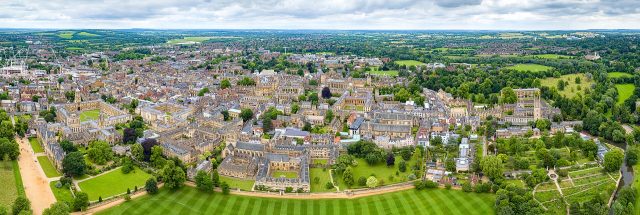
The Radcliffe Camera stands as one of Oxford’s most recognizable landmarks, a building that seems to have stepped straight out of a bygone era. Its circular form and domed roof rise above the city’s historic center, drawing the eye with a quiet elegance that belies the weight of its stone construction. Nestled among other venerable structures, it occupies a space where several streets converge, yet it holds its own, its proportions so balanced that it feels almost weightless despite its solidity.
Commissioned in the 18th century, the Radcliffe Camera was the vision of John Radcliffe, a physician and benefactor whose legacy included a substantial endowment for a new library at Oxford University. The task of designing the building fell to James Gibbs, an architect already known for his work on several notable English structures. Gibbs chose a circular plan, inspired by classical models but adapted to the practical needs of the time. Construction stretched over decades, and though Radcliffe did not live to see its completion, his name became permanently tied to the building.
Today, the Radcliffe Camera is part of the Bodleian Library, one of Europe’s oldest and most extensive academic collections. Originally conceived as an independent repository for scientific works, its interior still reflects that purpose. High vaulted ceilings, adorned with intricate plasterwork, and spacious reading rooms evoke the atmosphere of a place where rare manuscripts and scholarly tomes once filled the shelves. While the building now serves as a study space for students and researchers, the sense of history lingers in its details, particularly in the dome, which bathes the interior in a soft, diffused light.
The exterior of the Radcliffe Camera is as striking as its interior. Built from pale stone that has mellowed into a warm hue over the centuries, the facade features columns framing the entrance, supporting a balcony beneath the dome. At the very top, a small lantern crowns the structure, adding to its distinctive silhouette. A small garden surrounds the building, offering a place for students and visitors to pause, whether to admire the architecture or simply catch their breath. It’s easy to imagine 18th-century scholars strolling these same paths, debating the latest intellectual currents of the day.
The Radcliffe Camera is deeply woven into the fabric of Oxford University, an institution that has long stood as a center of learning and ideas. Over the centuries, it has been a place of study and discovery for figures whose names have shaped history—philosophers, writers, scientists, and statesmen. The building itself has become a symbol of the continuity of knowledge, a bridge between past and present. Even as the university has expanded across the city, the Radcliffe Camera remains one of its most enduring emblems.
When the building was first proposed, its design sparked considerable debate. Some contemporaries found the circular form too unconventional, questioning whether it was a fitting choice for a library. Yet over time, the Radcliffe Camera became an integral part of Oxford’s skyline, its architecture now celebrated as a harmonious blend of classical ideals and innovative thinking. Comparisons are often drawn to the Pantheon in Rome, though the Radcliffe Camera is more modest in scale, its charm lying in its intimacy rather than grandeur.
For many visitors, the Radcliffe Camera is a photogenic landmark, a must-see stop on any tour of Oxford. But those who take the time to linger will notice something deeper—the way the building seems to exist in two worlds at once. Outside, the city hums with activity: students hurrying to lectures, tourists poring over maps, locals going about their day. Inside, the atmosphere is one of quiet focus, the only sounds the rustle of pages and the occasional footsteps. This contrast between the bustle of the streets and the stillness within gives the Radcliffe Camera its unique character.
Though the building no longer serves its original purpose in full, it continues to play a vital role in university life. It hosts academic conferences, exhibitions, and lectures, and remains a symbol of scholarly tradition. For students, it often becomes the place where they first engage with serious research; for visitors, it offers a tangible connection to the history of one of the world’s oldest universities.
Oxford would not be the same without places like the Radcliffe Camera. It serves as a reminder that the city is more than just a collection of beautiful buildings—it is a living entity shaped by centuries of history, culture, and intellectual pursuit. Walking its streets, one can almost hear the echoes of the past: the founding of small colleges, the turning of handwritten pages, the debates of long-ago scholars. While Oxford has grown into a modern academic hub, its essence remains unchanged, and the Radcliffe Camera stands as one of the landmarks that help preserve that spirit.