That Luang isn’t just a temple—it’s the soul of Laos, a place where history, faith, and national identity converge in a single golden spire. Rising on the outskirts of Vientiane, its towering silhouette is visible from afar, a sharp pinnacle piercing the sky like a needle. For locals, it’s simply the Great Stupa, a name that carries the weight of centuries. More than a pilgrimage site, That Luang embodies the Buddhist values that shape daily life in Laos, a living monument to the country’s past and its hard-won independence.
The origins of That Luang are shrouded in legend, with historians debating its exact beginnings. Some believe Indian missionaries established a sacred site here as early as the 3rd century BCE, linking it to the spread of Buddhism across Southeast Asia. What we see today, however, took shape much later. In the 16th century, King Setthathirat moved the Lao capital to Vientiane and ordered the construction of a grand stupa on the ruins of an older shrine. Over the centuries, That Luang has been rebuilt and restored, particularly after Thai invasions in the 18th and 19th centuries left it in ruins. Each era has left its mark, yet the core remains—a soaring structure that has witnessed the rise and fall of kingdoms.
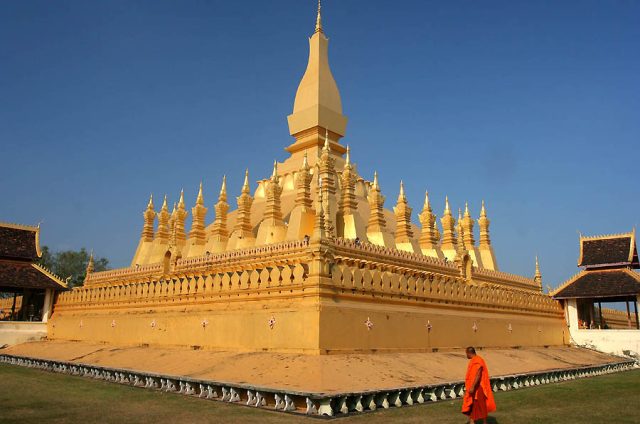
The architecture of That Luang is a study in balance and symbolism. The central stupa, standing nearly 45 meters tall, rests on three terraces, each representing a different realm. The lowest terrace symbolizes the human world, the middle one the realm of spirits, and the highest the path to enlightenment. Surrounding the main stupa are thirty smaller ones arranged in a circle, a physical representation of the Buddhist journey toward nirvana. The gilded surface, which glows under the sun, isn’t just for grandeur—it serves as a reminder of the impermanence of earthly wealth. Inside, relics tied to the Buddha’s life are said to be preserved, though access is restricted.
The temple complex extends far beyond the central stupa, encompassing monasteries, pavilions, and gardens that hum with activity. Monks in saffron robes move quietly between buildings, while pilgrims kneel in prayer and visitors wander, trying to absorb the atmosphere. The liveliest time of year is during the That Luang Festival in November, when the full moon transforms the temple grounds into a vibrant hub of celebration. Religious ceremonies, traditional dances, and even elephant races draw crowds from across the country. For Lao people, the festival is more than a spectacle—it’s a chance to honor ancestors and reinforce the spiritual bonds that tie them to their homeland.
Yet That Luang isn’t only a place of ceremony. The gardens surrounding the stupa offer a quiet retreat, where the air is scented with frangipani and the only sounds are the rustle of leaves and distant chanting. Benches invite visitors to sit and reflect, and the slow pace of life here makes it easy to forget the outside world. Many come at dawn, when the first light catches the golden stupa, or at dusk, when its shadow stretches long across the ground. In these moments, the temple feels timeless, as if the weight of history has momentarily lifted.
That Luang has weathered political shifts and changing times. During the years when Laos was closed to the outside world, the stupa stood as a symbol of national resilience. Today, as the country gradually opens to tourism, it remains a touchstone for Lao identity. It’s a reminder that Laos is more than its landscapes—it’s a culture with roots stretching back centuries. For travelers, visiting That Luang often marks the beginning of a deeper understanding of the country, a first glimpse into the traditions that shape its people.
If you find yourself in Vientiane, take the time to visit. Even if Buddhism isn’t your focus, there’s something here that transcends religion. You might be struck by the hush of the inner courtyard, where monks murmur prayers, or the way the stupa seems to float above the earth. Or perhaps you’ll simply sit on a bench and watch as locals arrive with offerings, their quiet devotion a testament to the enduring power of this place. That Luang doesn’t demand attention—it earns it, leaving an impression that lingers long after you’ve walked away.